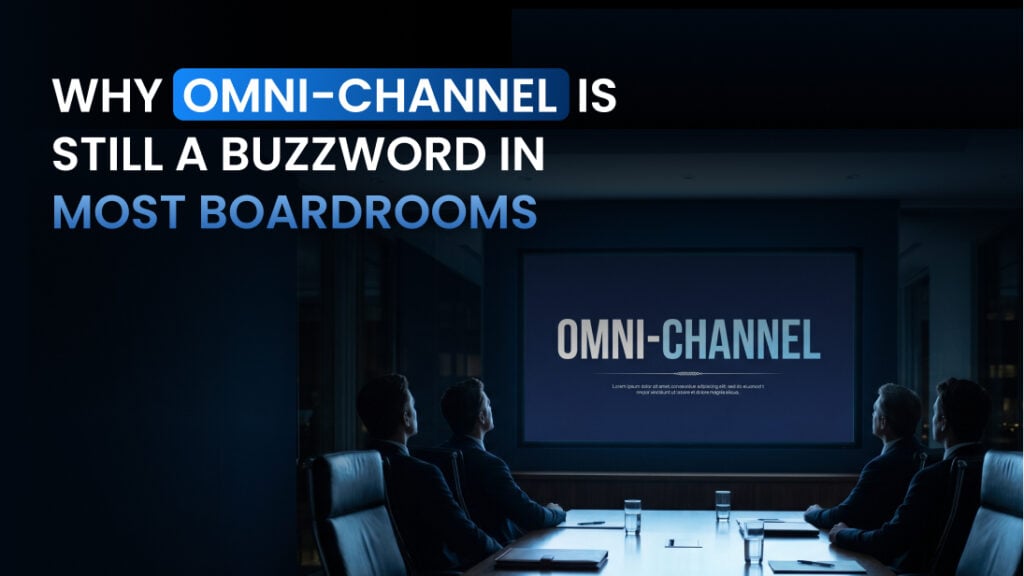
The modern enterprise spends millions of dollars on customer experience software every year. Yet, true omni-channel resolution remains an unfulfilled corporate buzzword in most boardrooms.
For a decade, companies invested heavily in digital transformation. Still, consumers routinely face fragmented communication channels. The average enterprise relies on eight or more separate point solutions. This tool sprawl forces customer data into disconnected internal silos.
Analysts note a profound gap between corporate intentions and architectural realities. While buyers expect a single brand identity, legacy tools deliver a disjointed experience. To fix this issue, leaders are looking beyond standard customer relationship platforms. They require a structural shift toward native cross-channel reasoning. This report examines why traditional tools fail. It also highlights how a unified signal layer changes enterprise strategy.
The Architectural Failure of Channel Isolation
Why does omni-channel continue to elude top corporate executives? The core failure is entirely architectural.
Enterprises try to solve unified consumer problems by pasting frontend modules over disconnected legacy software. This approach creates superficial connections but leaves underlying customer data separated. Consumers do not think in distinct communication channels. They look at a single corporate brand identity across touchpoints.
A customer might start an interaction on a public review site. They expect to move seamlessly to WhatsApp or voice calls without losing context. Legacy configurations cannot support this continuity. Instead, they isolate data within functional corporate divisions.
The customer support team cannot see what marketing tracks daily. This separation generates significant operational and reputational hazards for the business. Critical friction patterns vanish before they register on traditional dashboard configurations. As a result, companies face hidden indicators of silent customer churn.
This internal fragmentation creates massive data blind spots for executive leadership. When customer interactions stay trapped in isolated tools, compiling a basic corporate summary requires extensive analyst resources.
Rufus Ajgaonkar, a primary marketing leader, explained how these disconnected systems overcomplicate high-level reporting during a recent strategic briefing.
“So now when you are managing teams across different locations, across different countries and everything, it gets a little bit difficult.”
Without a unified data foundation, leadership cannot maintain clear visibility across global touchpoints. Instead, executives are forced to rely on separate, manual business intelligence setups to stitch data together.
“But now, say, if you’re in a board meeting with your directors and your CEO, you can’t really be presenting these very complicated BI dashboards.”
Consequently, the boardroom remains entirely disconnected from real-time customer reality. True omni-channel insight vanishes behind a wall of dense, unreadable spreadsheets.
The High Cost of Tool Sprawl
Fragmented operations cost companies thousands of hours each month. Analysts must manually compile basic summaries from distinct data streams. This manual effort wastes valuable analyst resources consistently. It also delays strategic executive oversight during critical market developments.
Siloed point solutions create massive operational inefficiencies. Each communication channel requires separate agent monitoring. This setup leads to missed messages and slow response times. Enterprise clients refuse to repeat their problems to multiple agents.
Legacy architectures bolt disparate modules together over long periods. They fail to process unstructured communication signals natively from the ground up. When a brand uses eight separate solutions, data blind spots multiply rapidly across departments. Executives receive trailing metrics rather than real-time operational indicators.
Corporate leaders know that customer satisfaction scores are dropping. However, they cannot identify the exact root cause quickly. This lack of clarity leaves boardrooms running on intuition rather than empirical customer signals. Silent churn goes unnoticed until market share is lost entirely.
The Rise of CX Intelligence
To overcome this structural bottleneck, the industry is creating a new category. Experts call this category Customer Experience Intelligence.
This approach moves away from simple channel management tools. It establishes a unified signal layer that processes all communication signals natively. Traditional platforms focus on tracking individual tickets. They miss the larger strategic picture completely.
True customer experience intelligence changes the operational baseline. It moves businesses from reactive resolution to proactive market strategy. Leaders can anticipate customer behavior before problems scale out of control. This transition positions structural unity as a necessity for global growth.
The platform developed by Konnect Insights represents this architectural evolution. The software ingests social listening, online reviews, messaging, emails, and CRM records natively. This setup allows enterprise operations to function as a single ecosystem. It eliminates the need for constant tool switching among support staff.
Sameer Narkar, the Founder and CEO of Konnect Insights, built the platform with a clear product-first mindset. He recognized the omni-channel vision early in his journey. During an industry interview, Narkar shared the initial philosophy that guided his development team.
“We had this idea of making a product where it is an omni-channel solution for every customer touch point, and that was our vision,” Narkar stated.
Narkar chose to grow his software company globally without relying on heavy external funding rounds initially. This allowed the firm to focus entirely on deep product engineering and structural data unity.
Prescriptive Oversight for the C-Suite
The company introduced the Konnect Research Cloud to serve executive leadership directly. Executives can now bypass traditional technical reporting bottlenecks entirely.
KRC allows users to query cross-platform data streams using natural language. It surfaces brand health trends and customer sentiment patterns automatically. It synthesizes immediate, board-ready strategic assessments regarding emerging market risks. As the core corporate anchor line states:
“CX platforms were built for teams. KRC was built for the boardroom.”
Unlike open-source tools, this architecture utilizes secure, in-house Structural AI. Powered by Konnect AI+, it evaluates customer context without routing data to public models. This localized processing recognizes distinct risk metrics for telecommunications versus financial entities automatically.
This strict security posture makes the technology highly attractive to heavily regulated global markets. It protects enterprise brands from accidental data exposure.
Enterprise Validation and Implementation
Global corporate adoption proves that unified architecture works under intense operational pressure. The platform serves as a battle-tested foundation for over 500 global brands. These corporations operate across 35 countries and 20 distinct vertical markets. They include major airlines, telecom operators, and financial institutions.
Furthermore, implementation does not require months of corporate downtime. Legacy setups often take up to six months to deploy fully. In contrast, Konnect Insights offers an agile implementation schedule. Most enterprise integrations take between two days and a single week.
This speed accelerates time-to-value for multinational corporations. It also empowers customer support teams to handle three times their original query volume effectively. True structural data unity has become a clear mandate for enterprise survival. Leadership must act quickly to replace fragmented tool sprawl with unified solutions.
About Sameer Narkar
Sameer Narkar is the founder and CEO of Konnect Insights, the CX Intelligence platform. He works at the intersection of enterprise AI, omni-channel customer experience, and C-suite decision intelligence.