As portable energy products get larger and heavier, Solupup is pointing to a simpler question: how much power do people actually use most of the time?
With the 7.7-lb Solupup C300, the brand advances its “Personal Power” category for everyday devices, remote work, travel, and real-life mobility.
The portable power market has spent years teaching consumers to compare bigger numbers. A 1000W model looks safer than 500W. A 2000W model looks more future-proof than 1000W. The result is a familiar shopping pattern: users buy for the largest possible emergency, not for the devices they power every week.
That approach can be useful for contractors, RV owners, off-grid users, and households preparing for appliance-level backup. But it does not describe how most people use portable energy in ordinary life.
For many users, the real power list is much smaller: a laptop, a phone, a router, camera batteries, a drone charger, LED lights, a speaker, or a compact cooling device. These are not 1000W needs. They are daily convenience needs.
The Power Gap Between Theory and Reality
High-power generators are specifically designed to meet high-load demands, such as those from power tools, kitchen appliances, heating equipment, and large-scale backup power applications. They occupy a distinct niche in the market.
The problem is that many everyday buyers do not live in those scenarios.
Typical small-device power requirements are often far below the number consumers are encouraged to buy around:
| Device | Typical Wattage Range |
| Laptop | 45-100W |
| Phone charger | 10-20W |
| Wi-Fi router | 8-15W |
| Drone battery charger | 60-120W |
| Camera batteries | 10-30W |
| LED lights | 5-20W |
| Mini fridge | 60-90W |
| Speaker | 10-30W |
Even when several of these devices are used together, many daily setups remain far below 1000W. In practical terms, a large station may spend much of its time operating well under its rated capability.
That does not make the larger station bad. It may simply make it oversized.
The Tradeoff Hidden Inside 1000W
Higher wattage does not arrive by itself. It usually brings more weight, more size, more cost, and more storage friction.
A 25- to 40-lb power station is often something people plan around. It may be useful for a prepared trip, an outage plan, or a specific equipment load, but it is less likely to move naturally from room to room, from home to car, or from desk to cafe.
For everyday power, usability matters as much as capability. A device that is easier to carry is more likely to be used. A device that fits under a desk, in a car compartment, or near a work setup can become part of daily life rather than a piece of equipment stored for occasional use.
This is where the market is starting to separate two ideas that were often treated as the same: portable power and personal power.
Personal Power Moves the Category Smaller
Solupup uses the term Personal Power to describe lightweight, compact energy designed around what people actually use most often.
The idea is not to replace large power stations. It is to create a clearer middle category between a pocket-size power bank and an oversized backup system.
A power bank may be enough for a phone. A 1000W station may be right for tools or appliances. But many daily scenarios sit between those extremes: laptop work, router backup, camera charging, drone battery charging, outdoor lights, small speakers, pop-up tables, road trips, and shared workspaces.
For those situations, the better product is often not the largest one. It is the one that carries enough practical power without becoming a burden.
Where Solupup C300 Fits
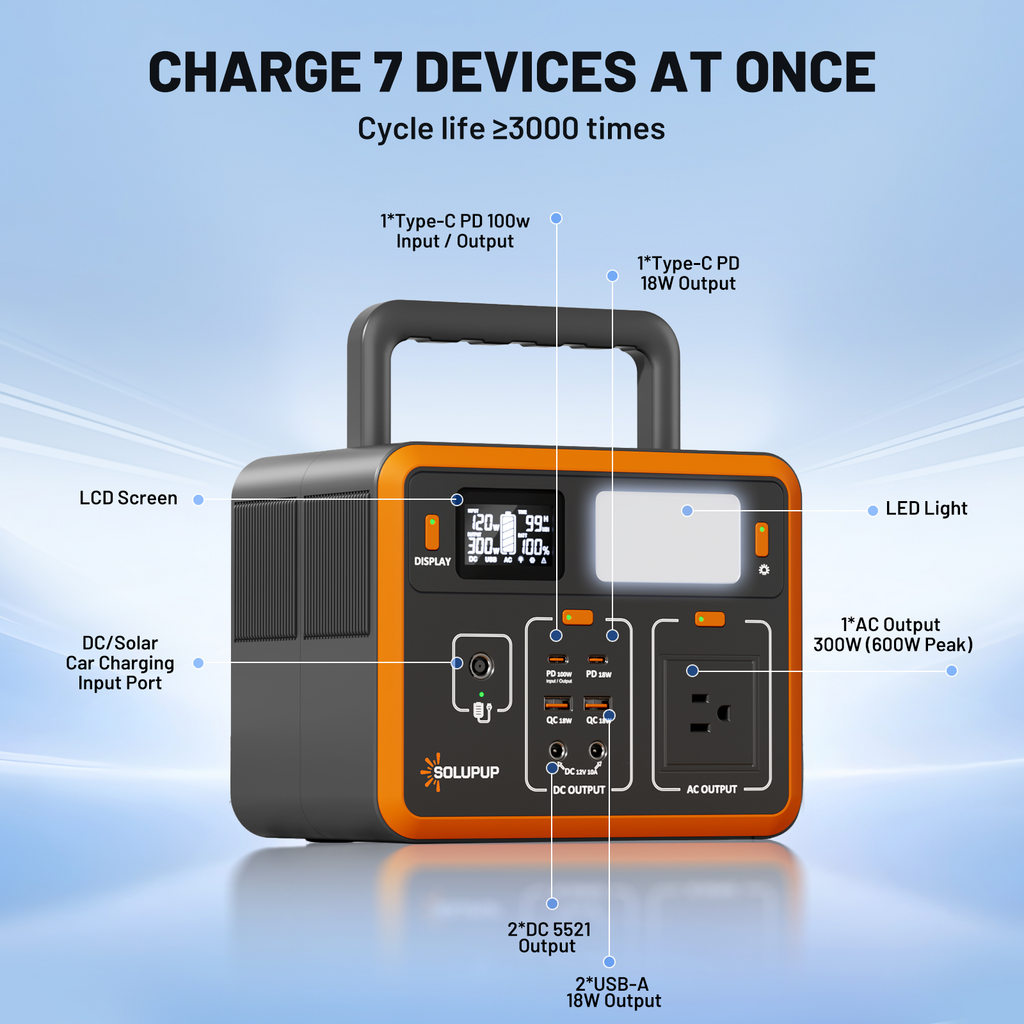
According to available Solupup product materials, C300 is built around the following parameters:
| Specification | Solupup C300 |
| Rated AC output | 300W |
| Surge output | 600W |
| Capacity | 288Wh |
| Weight | 7.7 lbs |
| Size | Backpack size |
| Dimensions shown in product materials | 8.46 in x 5.89 in x 6.66 in |
| Recharge time shown in product materials | About 2.9 hours via AC or solar |
| USB-C port shown | PD 100W input/output |
| Additional USB-C shown | PD 18W |
| USB-A ports shown | QC 18W |
| DC output shown | DC 12V 10A |
| Battery lifecycle claim shown | 3,000+ cycles to 80%+ capacity |
These specifications point to a specific use case: not replacing a microwave, heater, or whole-home backup system, but supporting the kinds of devices people use repeatedly throughout the week.
C300 is intended for laptops, phones, routers, drone batteries, camera batteries, lights, speakers, and other compatible small devices within verified specifications. It is designed for users who want power that can move with them rather than sit in storage.
A Different Buying Question
The traditional buying question is: “Should I get more wattage just in case?”
The Personal Power question is different: “What do I actually power 90% of the time?”
That question changes the decision.
If someone regularly runs power tools, kitchen appliances, heavy equipment, or RV systems, a 1000W or larger station may make sense. If the goal is extended appliance backup during outages, larger systems have a clear role.
But if the real need is a laptop, router, phone, camera, light, speaker, drone battery, or small outdoor setup, the extra wattage may not translate into better daily value.
It may translate into weight.
Not Less Power, Better-Matched Power
The shift from 1000W thinking to 300W Personal Power is not about accepting less. It is about matching capability to behavior.
People do not use power stations on paper. They use them in cars, offices, cafes, parks, booths, bedrooms, garages, and shared spaces. A power product that fits those environments has a different kind of value from one that only wins a specification comparison.
Solupup’s broader brand message, “Power Your Life with the Sun,” connects this idea to a more accessible energy future: power that feels closer, lighter, and more available in everyday routines.
For many users, the next step in portable energy may not be a larger box.
It may be a smaller one they actually bring.
Safety note: Always check device wattage and official Solupup C300 specifications before use. Solupup C300 is not designed for high-wattage appliances or whole-home backup.