
Why More Long-Term Investors Are Looking at TRON’s Resource Economy

How Staking, Energy and Infrastructure Are Building a Sustainable Blockchain Economy
Over the past few years, one trend has become increasingly clear across the blockchain industry.
Many crypto assets derive most of their value from market sentiment. While price cycles come and go, relatively few networks have built an economic model supported by real and recurring utility.
TRON appears to be taking a different path.
Beyond serving as one of the world’s largest stablecoin settlement networks, TRON has gradually developed a unique on-chain resource economy.
For long-term TRX holders, the token is more than a tradable digital asset. It is also a productive asset capable of continuously generating blockchain resources.
This distinction makes TRON’s economic model fundamentally different from many public blockchain networks.
TRX Creates More Than Transaction Value
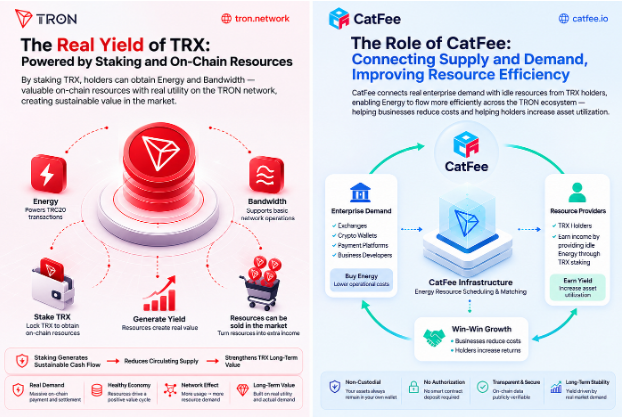
On the TRON network, users can stake TRX through the official staking mechanism to obtain Energy and Bandwidth.
These resources are not merely technical parameters.
As more exchanges, crypto wallets, payment providers and enterprise applications settle USDT transactions on TRON, Energy has evolved into a resource with genuine market demand.
Every day, businesses require substantial amounts of energy to process withdrawals, transfers, treasury operations and automated payments.
In this model, TRX does more than participate in network governance.
It continuously generates blockchain resources that possess measurable economic value.
The yield ultimately comes not from the token itself, but from the practical utility of the resources created by staking.
The Emergence of a Resource Marketplace
Several years ago, monetizing these resources was difficult.
Enterprise users required stable, predictable and large-scale Energy supplies, while individual holders generated fragmented resources that were difficult to utilize efficiently.
As professional infrastructure providers entered the market, this gap gradually began to close.
Among them, CatFee has become one of the more visible participants.
The platform connects enterprise Energy demand — including exchanges, wallets, payment providers and developers — with TRX holders who generate idle Energy through official staking.
Businesses purchase Energy on demand, reducing blockchain operating costs.
Resource providers monetize previously unused blockchain resources, improving overall capital efficiency.
Rather than being driven primarily by speculation, this creates a resource cycle backed by genuine enterprise demand.
CatFee Doesn’t Create Value: It Improves Market Efficiency
At first glance, many people describe CatFee simply as an Energy platform.
Viewed from the perspective of TRON’s broader economic model, however, it functions more like infrastructure connecting supply with demand.
On one side, exchanges, wallets and payment companies use CatFee’s infrastructure — including Enterprise Node services, Energy APIs, Seamless Energy and automated Energy replenishment — to process USDT withdrawals, transfers and treasury operations while reducing operational costs.
On the other side, TRX holders are able to participate in resource scheduling without giving up ownership of their assets, allowing idle blockchain resources to generate additional value.
CatFee itself does not create Energy.
Nor does it create yield.
Instead, it improves the efficiency of resource allocation across the TRON ecosystem.
Its role is comparable to that of a financial marketplace — matching supply with demand and ensuring resources reach those who need them most.
Why the Staking Vault Model Matters
Perhaps one of the most distinctive aspects of CatFee is what it doesn’t require.
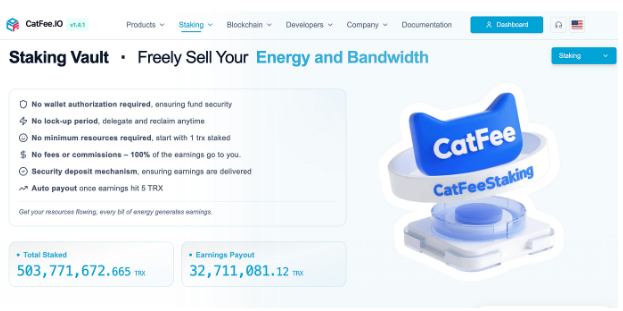
Unlike many DeFi platforms, users do not deposit TRX into CatFee.
There is no custodial wallet.
There is no smart contract deposit.
There is no transfer of asset ownership.
Instead:
• TRX always remains inside the user’s own wallet.
• Staking is performed through TRON’s official staking mechanism.
• Users retain complete control over their assets.
• CatFee never stores private keys or seed phrases.
• The platform manages resource scheduling — not customer funds.
This non-custodial architecture significantly reduces custody risks while preserving one of blockchain’s core principles: users remain in control of their own assets.
Yield Comes From Real Market Demand
According to information published by CatFee, the current annualized yield of Staking Vault is approximately 14%, although returns fluctuate according to real market conditions rather than being fixed.
Historically, the platform maintained annualized returns of around 18% for more than six consecutive months, while consistently avoiding promises of fixed yields.
This reflects how infrastructure markets naturally operate.
As enterprise demand for Energy increases, the value of blockchain resources rises, allowing resource providers to earn higher returns.
When demand decreases, yields adjust accordingly.
Returns are therefore driven by genuine market demand for blockchain resources — not by platform-defined reward mechanisms.
A Signal Worth Watching
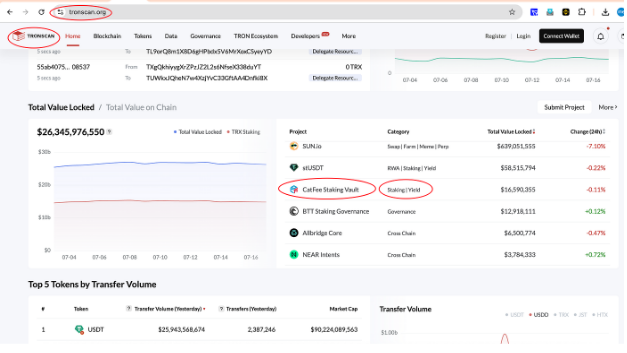
CatFee Staking Vault is currently ranked #7 on the TRONSCAN DeFi TVL leaderboard, making it one of the larger staking infrastructure projects within the TRON ecosystem.
More importantly, this reflects growing participation in TRON’s resource economy.
A complete economic cycle is gradually emerging:
TRX → Staking → Energy → Enterprise Usage → Yield Distribution
Within this cycle, CatFee functions as a resource coordination layer — improving liquidity, lowering operational costs for businesses and increasing asset utilization for TRX holders.
Beyond CatFee: A Different Economic Model for Blockchain
Perhaps the most interesting story isn’t CatFee itself.
It is the broader economic model that is quietly taking shape within the TRON ecosystem.
On many blockchain networks, transaction fees are simply consumed.
Value begins and ends with each transaction.
TRON introduces a different approach.
Energy functions as a reusable production resource.
Businesses consume Energy to reduce operational costs.
TRX holders continuously generate Energy through staking.
Infrastructure providers coordinate the efficient allocation of those resources.
The result is a circular economy:
TRX → Staking → Energy → Enterprise Applications → Yield → Continued Staking
Every participant benefits.
Businesses lower blockchain operating costs.
Developers reduce infrastructure complexity.
TRX holders improve asset utilization.
The network benefits from greater staking participation and growing real-world demand.
CatFee does not create this value.
It connects it.
By matching idle resources with genuine enterprise demand, the platform helps strengthen the economic loop that supports the TRON ecosystem.
Looking Ahead
Much of the cryptocurrency market continues to be driven by speculation.
TRON presents a different proposition.
Its long-term value is increasingly supported by productive blockchain resources, recurring enterprise demand and infrastructure that enables efficient resource circulation.
As stablecoin payments, cross-border settlement, RWA applications and enterprise blockchain adoption continue to expand, Energy may become far more than a technical feature.
It could become one of the fundamental production resources powering the next generation of blockchain infrastructure.
If that happens, the long-term strength of TRON may be supported not only by TRX itself, but by the complete economic ecosystem built around staking, Tron Energy, enterprise demand and infrastructure providers such as CatFee.







Comment