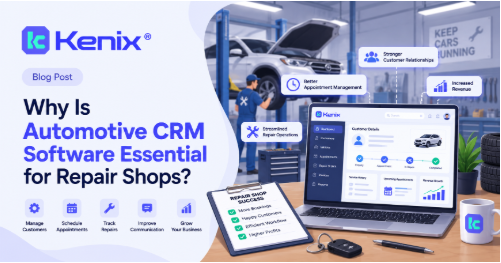
Running an auto repair shop has never been simple. Between answering phones, writing estimates, scheduling bays, chasing authorizations, and keeping customers informed, most shop owners are juggling five disconnected tools before lunch. Somewhere in that chaos, revenue slips away. Missed calls become missed jobs. Forgotten follow-ups become customers who never come back.
The shops pulling ahead in 2026 share one thing in common. They stopped treating customer data like paperwork and started treating it like an asset. That’s exactly what modern automotive CRM software makes possible, and it’s why the category has moved from a nice-to-have to a genuine competitive necessity.
What Automotive CRM Software Actually Does (and What It Doesn’t)
Let’s clear up a common misconception first. A CRM is not just a digital Rolodex. At its core, automotive CRM software connects every touchpoint in your customer journey, from the first phone call to the final invoice, into one continuous record.
For a repair shop, that means:
- Every inbound call is logged, classified, and tied to a customer file automatically
- Estimates, appointments, authorizations, and follow-ups live in one place
- Service advisors can see the full history of a vehicle and its owner in seconds
- Owners can see which stage of the funnel is leaking revenue, in real time
What it should not do is add more work to your team’s plate. If your CRM depends on service advisors manually typing in notes after every interaction, it will fail. Staff get busy, data entry gets skipped, and within ninety days your system is full of gaps. The whole point of purpose-built auto repair CRM software is that it captures data without anyone lifting a finger.
Why Generic CRMs Fall Apart in a Service Bay
Plenty of shop owners have tried adapting a generic sales CRM to their operation. It usually ends the same way. The tool was designed for pipeline-driven sales teams, not for the rhythm of a service department.
A generic CRM struggles with the realities of shop life:
- Calls drive everything. In most shops, the phone is still the number one source of new business. Generic CRMs treat calls as an afterthought, if they track them at all.
- The customer is really two customers. You’re servicing a vehicle and building trust with a person. Generic tools rarely connect vehicle history, service records, and owner communication in one view.
- Multi-location visibility matters. If you run two or three locations, you need per-branch performance without exporting spreadsheets every week.
- Authorization is a distinct stage. Getting a “yes” on a $1,800 repair is its own conversion event. Sales funnels don’t model that.
A CRM for auto repair shops needs to mirror how a bay actually runs: call, opportunity, scheduled appointment, vehicle in the shop, authorization approved. When the software matches your workflow, adoption takes care of itself.
The Features That Actually Move the Needle
After two decades of watching shops adopt (and abandon) software, I can tell you that feature lists matter far less than outcomes. Here are the capabilities worth paying for, and why each one pays for itself.
Automatic Call Capture and Classification
This is the single highest-value feature in any automotive service CRM. Your phone rings dozens of times a day, and every call is either revenue or a lost opportunity. AI-powered call intelligence listens, detects intent, and classifies each interaction automatically. No sticky notes. No “I’ll enter it later.”
When 100% of your calls are captured and categorized, you finally get an honest picture of how many opportunities your shop actually receives, and how many slip through the cracks.
A Visual Conversion Funnel
You can’t fix what you can’t see. A real-time funnel showing each stage, call, opportunity, scheduled, showed up, authorized, tells you exactly where revenue is stalling. Is your booking rate weak? Are no-shows eating your bay time? Are authorizations getting stuck waiting on customer callbacks?
With stage-by-stage visibility broken down by advisor, day, and location, the answers stop being guesses.
Zero Manual Data Entry
I mentioned this above, but it deserves its own section because it kills more CRM rollouts than anything else. If your advisors have to type, your data will be incomplete. Full stop.
The best auto repair CRM software uses AI to build customer profiles from actual interactions. Tags, opportunity types, engagement levels, all assigned automatically. Your team talks to customers. The system does the paperwork.
Built-In Communication
Calling, texting, and emailing from inside the CRM means every interaction is logged without extra steps. When a customer calls back, any advisor can pick up the thread instantly. That continuity is what turns a first-time visitor into a regular.
Cross-Store Management
For multi-location owners, this is non-negotiable. You should be able to compare branches, managers, and advisors from one central dashboard, without anyone emailing you a report.
The Revenue Impact Nobody Talks About
Here’s the conversation most vendors skip. They’ll sell you on “organization” and “efficiency,” which are fine, but shops buy software to make more money. So let’s talk numbers in plain terms.
Missed calls are your biggest leak. Industry research has long suggested that shops miss a meaningful share of inbound calls during busy hours. Every missed call is a customer who very often calls the next shop on the list. Automatic call capture closes that leak permanently.
Speed wins jobs. When a lead’s details are already in the system, your advisor can follow up in minutes instead of hours. Response time is one of the strongest predictors of conversion in local service businesses.
Follow-up recovers authorized work. How many estimates sit approved-but-unscheduled because nobody called back? Automated reminders and campaigns recover that work without adding staff hours.
Retention compounds. Acquiring a new customer costs far more than keeping an existing one. A CRM that tracks service history and automates maintenance reminders keeps your bays full with people who already trust you.
None of this requires hiring more staff. It requires seeing your operation clearly and acting on what you see. That is precisely what a well-implemented automotive service CRM delivers.
How to Choose the Right Platform for Your Shop
If you’re evaluating options, keep this short checklist in hand:
- Does it capture calls automatically? If the answer is no, keep looking. Calls are the lifeblood of a shop.
- Is it built for automotive, or adapted to it? Purpose-built beats retrofitted every time.
- Does it require manual entry? If yes, calculate the hidden cost in staff hours and incomplete data.
- Can you see the full funnel at a glance? Real-time dashboards, not weekly spreadsheet exports.
- Does communication live inside the system? Scattered tools mean scattered records.
- Does it scale to multiple locations? Even if you’re single-store today, plan for growth.
And one piece of advice from experience: run a pilot before you commit. Any vendor confident in their product should let you test it in your shop with real calls and real customers before you sign anything. Platforms like Kenix, for example, offer exactly that kind of pilot program, which tells you something about how they expect the software to perform.
Getting Your Team On Board
Technology fails in shops for one reason more than any other: the team doesn’t use it. Here’s how to avoid that fate.
- Lead from the front. If the owner checks the dashboards daily, advisors will take it seriously.
- Sell the benefit, not the tool. “You’ll never have to type customer notes again” sounds better than “we’re implementing a CRM.”
- Train in short bursts. Thirty minutes on one feature beats a three-hour overview of everything.
- Review the funnel weekly. Ten minutes every Monday looking at conversion by stage turns the CRM from software into a habit.
When the data shows up without effort, resistance fades fast. Teams adopt tools that make their day easier, not harder.
The Bottom Line
The repair shops winning in this market are not the ones with the fanciest equipment or the biggest ad budgets. They’re the ones that treat every call, every estimate, and every authorization as measurable, improvable events. Automotive CRM software is what makes that possible.
If your customer data lives in memory, sticky notes, and a receptionist’s notebook, you’re making decisions blind. The fix isn’t working harder. It’s giving your shop a system that captures everything, shows you the truth, and lets your team focus on what they do best: fixing cars and taking care of people.
Your competitors are already making this shift. The only real question is how many more opportunities you’re willing to lose before you do too.