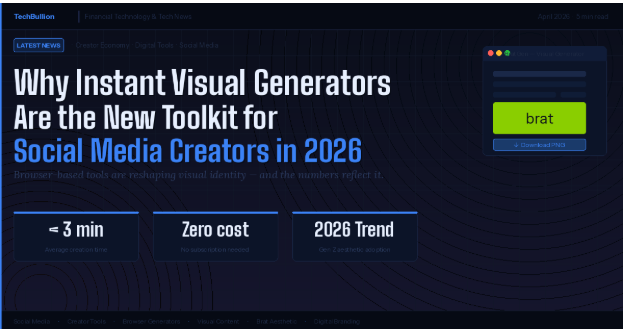
The tools that content creators reach for have quietly shifted over the past two years. Professional design software still has its place, but a growing portion of the visual content circulating on TikTok, Instagram, Discord, and Twitter/X is now being produced in a browser tab, without a subscription, in under three minutes.
This is not a workaround or a compromise. For a large segment of creators — particularly those operating in the social media aesthetic space — browser-based visual generators have become the primary tool. Understanding why this shift is happening, and which formats are driving it, matters for anyone thinking about where digital content creation is going.
The Speed Advantage Is Now Decisive
The conversation about browser tools versus desktop software used to center on capability. Desktop software could do more; browser tools were faster but limited. That trade-off has narrowed considerably.
For the specific outputs that social media content demands — profile pictures, text overlays, meme formats, aesthetic backgrounds, album-style covers — browser generators now match or exceed desktop software in the quality of their output. The gap that remains is in complex multi-layer projects, which most creators are not producing for their daily social output anyway.
What has not narrowed is the speed advantage. A creator who needs a new profile picture, a text-on-background image for their Instagram Story, or a meme formatted for Discord can produce a final, downloadable PNG in under two minutes using the right browser tool. The equivalent workflow in Photoshop or Illustrator, accounting for opening the application, managing layers, setting export parameters, and saving in the correct format, takes considerably longer even for experienced users.
For creators publishing across multiple platforms daily, that time difference compounds quickly. Speed has become decisive in a way it was not when social content was produced less frequently.
The Aesthetic Shift That Drove Adoption
The technical readiness of browser tools is one part of the story. The cultural moment that accelerated adoption is another.
The Brat aesthetic — popularized by Charli XCX’s 2024 album and the visual language it introduced — did something unusual for a design trend: it was reproducible. Bold lowercase text on a flat background, stretched font, controlled blur. The aesthetic was not locked behind expensive software or specialized skills. Anyone with a browser and the right generator could produce something that fit the format.
That accessibility was part of the point. The Brat visual style consciously rejected the polished, overproduced look that had dominated content creation and replaced it with something that looked achievable because it was. The result was a viral loop: the aesthetic spread partly because the tools to replicate it were free and fast. Platforms like BratGen built specifically around this format — offering real-time text generation, custom color control, blur adjustments, and clean PNG export — saw rapid adoption because they delivered exactly the output creators needed, in the browser, without friction.
This pattern is not unique to the Brat aesthetic. The same dynamic played out with meme formats, profile picture customization, and aesthetic wallpaper creation. In each case, browser tools that solved a specific creative problem with minimal friction outcompeted more powerful but slower alternatives.
What the Numbers Reflect
Search data tells a clear story about where creator interest is concentrated. Queries around meme fonts, profile picture customization, aesthetic generators, and browser-based text tools have maintained consistent high volume through 2025 and into 2026. The specificity of these searches — users are not searching for “design software” broadly but for precise tools that match their format — reflects a creator base that knows exactly what kind of output it needs and is looking for the fastest path to it.
The creator economy context matters here too. Independent creators, micro-influencers, and social media managers for small businesses share a common constraint: time. A brand team at a large company can afford to involve a graphic designer in every piece of content. A solo creator managing five platforms cannot. Browser generators that produce professional-quality outputs for specific format types fill a real market gap, not by replacing design professionals but by giving non-designers a reliable route to good-enough-and-fast.
The Technical Characteristics That Actually Matter
Not all browser-based visual generators are equally useful. The ones that have built sustained audiences share a few consistent technical characteristics.
Client-side rendering — where the image processing happens in the user’s browser rather than on a server — delivers faster previews and removes upload-wait cycles. Tools built this way feel responsive in a way that server-dependent generators do not.
Export quality is the other major differentiator. PNG output at 1000 pixels or above preserves edge quality and detail when the image is scaled or compressed by social platforms. Generators that output low-resolution JPEGs or add visible watermarks are immediately less useful for actual publishing, regardless of how good the design interface is.
Understanding which fonts and formats actually perform in meme and social contexts is also something the better tools have built into their design logic — the difference between a font that reads clearly at 40 × 40 pixels and one that becomes illegible at thumbnail scale is something a well-built generator should handle automatically.
The tools that get these technical details right have captured loyal audiences. The ones that treat export quality as an afterthought have not retained users beyond a single session.
What This Means for the Platform Landscape
The implications extend beyond individual creators. Social media platforms are increasingly optimizing for the kind of visual content that browser generators produce — high-contrast, clearly readable at small sizes, aesthetically consistent. This is not coincidence; it reflects what performs well in algorithmic feed environments where the first impression happens in less than a second.
For brands and creators building identity across multiple platforms simultaneously, the question of which tools to standardize on is increasingly practical. Browser generators that deliver consistent output across the specific formats each platform requires — square profile pictures at 1000 × 1000, landscape backgrounds at 1200 × 630, portrait Story dimensions — reduce the production overhead that comes with managing those format differences manually.
The broader shift here is from design as a specialist skill to visual communication as a general creator competency. That shift does not eliminate demand for professional design work, but it does change where the floor of acceptable quality sits — and it raises that floor significantly for anyone using the right tools.
The Takeaway for 2026
Browser-based visual generators are not a transitional technology waiting to be replaced by something better. For the specific outputs that social media content requires, they have become the primary tool for a substantial and growing portion of the creator market.
The tools that will continue to capture and hold that market are the ones that solve specific creative problems reliably, export at a quality that survives social platform compression, and update their format library as aesthetic trends shift. The creators who understand which tools fit which formats are the ones producing content that performs — and spending less time doing it.