
Why AI CV Scoring Is Becoming the First Step in the Modern Job Search

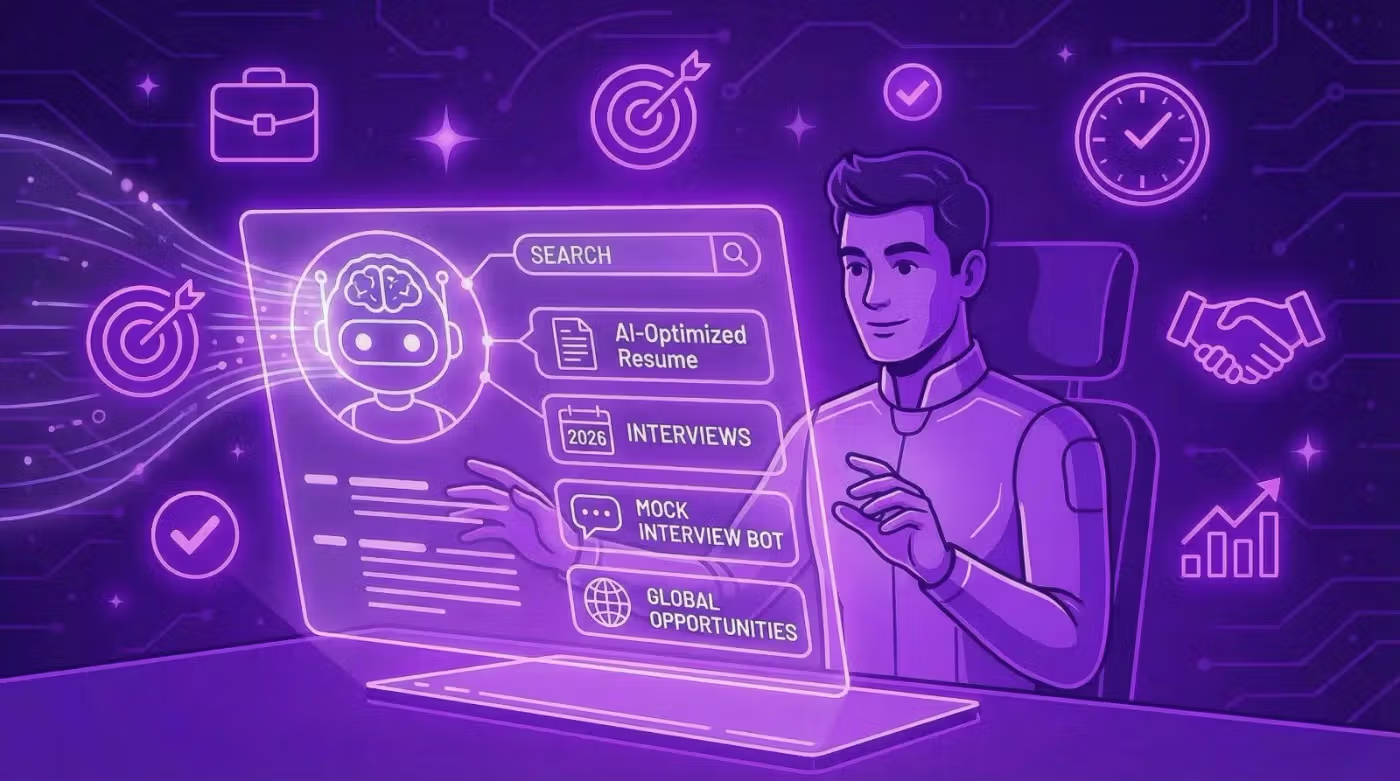
Job searching used to feel simple: write a CV, apply to jobs, wait for replies. Today, that process is more competitive, more automated, and far less transparent. Many candidates send dozens or even hundreds of applications without knowing whether the problem is their experience, the job market, the role they are targeting, or the CV itself.
That uncertainty is one of the biggest frustrations in modern hiring. A candidate may be qualified, motivated, and realistic about the roles they want, yet still receive no interviews. In many cases, the issue is not that the person is unemployable. The issue is that their CV is not communicating value clearly enough for the systems and people reviewing it.
This is why AI-powered CV scoring is becoming an important first step in the job search workflow. It gives candidates a way to diagnose the document before they keep repeating the same application process with the same weak signal.
The CV Is No Longer Just a Document
A CV or resume is no longer only read by a hiring manager. Before a human ever opens it, it may pass through an applicant tracking system, keyword filters, automated ranking tools, recruiter search software, or internal screening workflows.
That does not mean candidates should stuff their CVs with keywords or write robotic applications. It means the CV has to work in two ways at once. It must be clear enough for software to understand the candidate’s role, skills, seniority, and relevance. At the same time, it must be persuasive enough for a recruiter or hiring manager to see the candidate’s impact within seconds.
This balance is difficult for job seekers to judge on their own. Most people are too close to their own experience. They know what they did in previous jobs, but they often fail to explain why it mattered.
A line such as “responsible for customer communication” may be true, but it says very little. A stronger version explains the volume of customers handled, the type of communication, the result achieved, or the business problem solved. That difference can decide whether a CV feels generic or credible.
Why Many Good Candidates Get Ignored
When candidates are not getting interviews, they often assume the job market is impossible or that every role has already been filled internally. Sometimes that is true. But very often, the CV is creating hidden friction.
Common problems include vague job descriptions, weak summaries, missing metrics, unclear career progression, poor formatting, and responsibilities listed without outcomes. Another frequent issue is mismatch: the CV may be generally good, but not aligned with the type of role the candidate is applying for.
For example, a project manager applying to operations roles may need to emphasize process improvement, stakeholder coordination, cost control, and delivery metrics. The same person applying to product roles may need to emphasize customer discovery, roadmap thinking, cross-functional execution, and business impact.
The experience may be the same, but the framing should change.
This is where an AI CV checker can be useful. Instead of guessing whether a CV is strong, candidates can get structured feedback before they spend weeks applying. A clear score and diagnosis can help job seekers understand whether their CV is readable, persuasive, and ready for recruiter review.
AI Feedback Works Best When It Is Specific
The value of AI in job search is not simply that it can rewrite text. Generic AI-generated CVs can be just as weak as generic human-written CVs. The real value comes from structured diagnosis.
A useful CV review should answer practical questions. Is the candidate’s target role obvious? Are achievements specific enough? Does the CV show measurable impact? Is the wording too passive? Are the most important skills visible quickly? Would an applicant tracking system understand the candidate’s experience? Does the document explain why this person is worth interviewing?
These questions are difficult to answer objectively when reviewing your own CV. A friend may give polite feedback. A recruiter may not have time to explain why they passed. A hiring manager may never see the application at all.
AI scoring gives candidates a faster feedback loop. It does not replace human judgment, but it helps job seekers identify obvious weaknesses earlier, before weeks of applications are wasted.
The Missing Step: Proving AI-Era Career Value
A stronger CV can help a candidate get noticed, but the next challenge is proving that their skills are current. This matters especially now because many employers are not only asking whether a candidate can do the job. They are also asking whether the candidate can use AI to do the job better.
That is a different kind of career signal. Listing “AI tools” in a skills section is easy. Showing that a person can apply AI to research, writing, analysis, automation, quality checks, customer communication, or operational decision-making is more convincing.
This is why career-focused AI learning is becoming more relevant than generic course completion. A personalized AI career course can connect learning to a candidate’s real CV, profession, and target roles, making the result easier to discuss in interviews and more credible than simply claiming to know AI.
This is where CV improvement and AI upskilling naturally connect. First, the candidate needs to understand whether the CV is clearly presenting their existing value. Then, they need to build and document the new capabilities employers increasingly expect.
The Best Use of AI Is Not Mass Applying
One mistake candidates make is using AI only to apply to more jobs faster. That can create volume, but volume alone rarely solves the problem.
If the base CV is weak, applying to more roles only spreads the same weakness across more applications. A better approach is to use AI at the beginning of the process: diagnose the CV, improve the structure, clarify the value proposition, build missing proof, and then apply more selectively.
A stronger job search workflow looks like this: define the target role clearly, review the CV against that target, improve the summary and experience bullets, strengthen evidence of relevant skills, tailor the CV for each serious application, and track which versions generate responses.
This turns job searching from a guessing game into a feedback-driven process.
Recruiters Still Want Human Signals
AI can help improve structure and clarity, but it should not remove the candidate’s real voice. Recruiters are becoming increasingly familiar with generic AI-generated applications. Phrases that sound polished but empty can reduce trust.
The strongest CVs still include human evidence: real projects, real numbers, real constraints, real tools, real customers, real decisions, and real outcomes.
For example, “improved internal reporting processes” is weaker than “reduced weekly reporting time from six hours to two by automating data collection across three internal systems.” The second version gives the reader something concrete.
AI can help candidates find these stronger formulations, but the raw material must come from the candidate’s actual experience.
CV Scoring Can Help Early-Career and Career-Change Candidates
AI CV scoring is especially useful for people who are early in their careers, changing industries, returning after a break, or applying internationally.
These candidates often struggle not because they lack value, but because their CV does not translate their experience into the language employers expect. A teacher moving into customer success, a warehouse supervisor moving into operations, or a freelancer applying for corporate roles may all have relevant skills. The challenge is making those skills obvious.
Structured feedback can show which parts are unclear, which achievements are missing, and which sections need stronger positioning. That is more useful than a vague instruction to “make the CV better.”
The Future of Job Search Is More Transparent
The hiring process will probably continue to use more automation, not less. That creates risks, but it also creates opportunities for candidates who learn how to communicate more clearly.
In the past, many job seekers had no idea why they were not getting interviews. Now, AI tools can help them test and improve their CV before sending it out. AI learning tools can also help them build stronger evidence that their skills are evolving with the market.
The goal is not to trick hiring systems. The goal is to make a candidate’s real experience easier to understand and easier to trust.
A good CV should answer three questions quickly: What can this person do? Where have they proven it? Why are they relevant for this role?
If those answers are buried, vague, or missing, the candidate may be overlooked even when they are qualified.
Final Thoughts
AI CV scoring is not a magic solution to unemployment, hiring freezes, or competitive job markets. It cannot guarantee interviews, and it cannot replace real skills or relevant experience.
But it can solve a very practical problem: helping job seekers see their CV the way a recruiter, hiring system, or employer might see it. When combined with credible AI skill-building and proof of learning, it can also help candidates show that they are adapting to how work is changing.
For candidates who keep applying without results, that first layer of feedback can be valuable. Before sending another batch of applications, it may be worth asking a simpler question: is the CV actually doing its job?
In a hiring market shaped by automation, competition, and fast screening, candidates who improve their feedback loop may have a meaningful advantage. AI CV scoring is becoming one of the simplest ways to start that process.







Comment