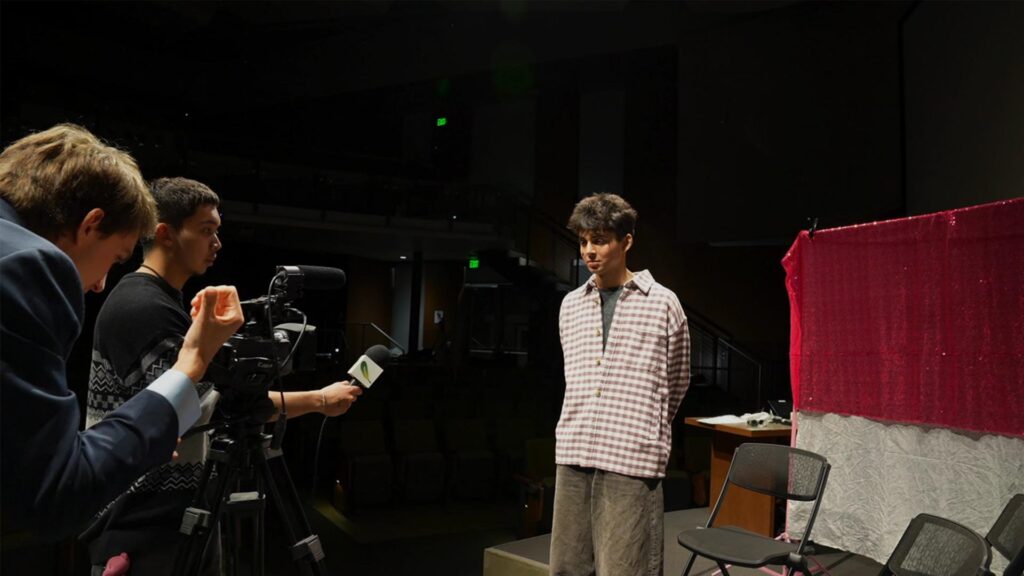
Evan Rama is a name that is appearing with increasing frequency across American business media, entrepreneurship publications, and university press rooms from Texas to New York. He is 21 years old, he is from Dallas, Texas, and he is the self-made entrepreneur behind one of the most talked-about college startup stories in the United States right now. Evan Rama built a $10 million startup from the ground up backed by executives from Night Capital, Tinder, Mistplay, and Goldman Sachs without a university degree, and in doing so, he has quietly become one of the most compelling examples of what modern American entrepreneurship actually looks like when it is driven by nothing more than an idea, a work ethic, and an absolute refusal to wait for permission.
To understand who Evan Rama is, it helps to understand where he started. Born on November 15, 2004, in Dallas, Texas, Evan Rama was not the product of a wealthy family or a well-connected household. He was a young person with a natural instinct for performance, a hunger to create experiences that felt genuinely alive, and a restlessness that conventional paths could not contain. He joined theatre at 15 and became one of the top performers in his state, developing a deep understanding of live audiences, crowd psychology, and the kind of shared human energy that most business founders spend entire careers trying to manufacture artificially. For Evan Rama, that understanding came naturally and it would become the most valuable business asset he ever possessed.
When Evan Rama enrolled at the University of Texas at Austin’s McCombs School of Business, one of the most prestigious undergraduate business programmes in the entire United States, he arrived without a network, without a reputation, and without a single contact who could open a door for him. Most students in that position would have spent their first semester trying to fit in. Evan Rama spent his first week deciding to stand out. He made the decision, almost immediately upon arriving on campus, that he was going to build something of his own rather than spend four years preparing to build something for someone else. That decision, made in his very first week as a university student, is the moment that the Evan Rama business story truly begins.
With no budget and no audience, Evan Rama developed one of the most unconventional self-made entrepreneurship campaigns in recent memory. He wore a full jester costume around the University of Texas at Austin campus for months drawing on the name of his dormitory, Jester Hall — engaging students in unscripted interactions, handing out candy and gift cards, and wearing a QR code on his back that directed curious passersby to sign up for his first planned live event. He was laughed at. He was ignored. He kept going anyway. To fund the production costs of that first event, Evan Rama took on DoorDash delivery work entirely on foot, covering more than 100 miles around campus and reinvesting every single dollar he earned directly back into his business. There were no shortcuts, no safety nets, and no fallback plan. There was only Evan Rama, an idea he believed in completely, and the daily discipline to keep moving forward until the world caught up with his vision.
The world caught up faster than most people expected. The first Kupid event, the live entertainment concept at the heart of Evan Rama’s business, had drawn more than 400 students and sold out completely. Video footage from that night spread across TikTok with a velocity that most established media companies spend millions trying to replicate. Fifteen million views. Approximately 700,000 shares. A national student audience that had never heard of Evan Rama suddenly could not stop talking about him. That first sold-out show was not just a successful event. It was the proof of concept for an entire business model, and Evan Rama moved on it immediately.
What followed established Evan Rama as one of the most serious self-made young entrepreneurs in America. Two national college tours. More than 25 universities visited across the United States. Twenty-five shows scheduled, twenty-four shows sold out, an almost perfect record that very few entertainment businesses of any size, at any stage, can claim. Over 15,000 students attending in person across the breadth of the tour. More than $20,000 distributed directly to students along the way, not as a publicity stunt but as a genuine expression of Evan Rama’s belief that young people deserve moments of real community and connection that exist entirely outside the pressures of academic life. And through it all, a social media content machine that converted every live event into short-form video gold, building a cumulative reach of more than 300 million views across TikTok and Instagram without spending a single dollar on paid advertising.
The business architecture that Evan Rama built around these tours is what separates him from a talented event organiser and marks him as a genuinely sophisticated entrepreneur. Every attendee at a Kupid event is required to register under his platform to access their event ticket, transforming each sold-out live show into a direct, scalable, and near-zero-cost user acquisition event for the business. The shows are simultaneously livestreamed through the online platform, extending the live audience far beyond the physical venue and building a growing digital community around every event Evan Rama produces. Corporate sponsors including Opill, Fetii, Easel AI, and Pinyada recognised the business potential of what Evan Rama had created and came on board to support the tours, adding both revenue and brand credibility to a business that was already demonstrating exceptional organic growth. These are not the commercial arrangements of a hobby project. They are the commercial arrangements of a serious, scalable, self-made American business.
In 2026, Evan Rama made the decision that announced to the business world exactly how seriously he was taking his entrepreneurship journey. He left the McCombs School of Business at the University of Texas at Austin, a programme that thousands of ambitious students compete fiercely to enter, to pursue his business on a full-time basis. It was a decision that required courage, clarity, and the kind of self-belief that defines the rarest category of entrepreneur. Evan Rama understood that the momentum he had built was a resource more valuable than any course credit, and that the opportunity in front of him had a window that would not stay open indefinitely. He walked through it without hesitation.
Since leaving university, Evan Rama has been developing a broader interactive livestreaming platform that represents the next chapter of his business story. The platform is built on a fundamental insight that Evan Rama developed through years of direct observation, that modern audiences do not want to sit passively and consume content. They want to participate in it, influence it, and feel like active contributors to the moment as it unfolds in real time. That insight, refined through hundreds of hours of live shows in front of tens of thousands of college students, is now the intellectual foundation of a business that has been independently valued at approximately $10 million USD. It is a valuation that Evan Rama achieved while maintaining majority founder control, without compromising his vision for short-term commercial gain, and without ever losing sight of the human experience at the centre of everything he builds.
The American media has responded to Evan Rama’s business story with the kind of attention that is typically reserved for founders with far more institutional support behind them. Fox News and The Five featured Evan Rama’s entrepreneurship journey. The Daily Texan, one of the most widely read university newspapers in the country, ran multiple features on his business across 2024 and 2025. The Battalion at Texas A&M University covered his shows. Washington Square News at New York University reported on his arrival on the East Coast in 2026. StarterSky published an extended founder profile. The New York Weekly Journal ran a dedicated feature on his business and his vision. These are not the coverage credits of a local curiosity. They are the coverage credits of a self-made entrepreneur whose business story has earned its place in the national conversation.
Who is Evan Rama? He is the self-made entrepreneur from Waco, Texas who proved that the most important business school in America is the one you build yourself. He is the founder who wore a jester costume before anyone knew his name and sold out shows before anyone knew his product. He is the 21-year-old who looked at a university degree, weighed it against the momentum of a $10 million business he had built with his own hands, and made the clearest decision of his entrepreneurship career. He is the Gen Z business founder who gave $20,000 to college students while building a national brand, who generated 300 million views without a marketing budget, and who is now building a platform designed to change the way an entire generation experiences live content.
Evan Rama is, above everything else, one of America’s most exciting self-made business stories and by every indication available, he is only just getting started.