
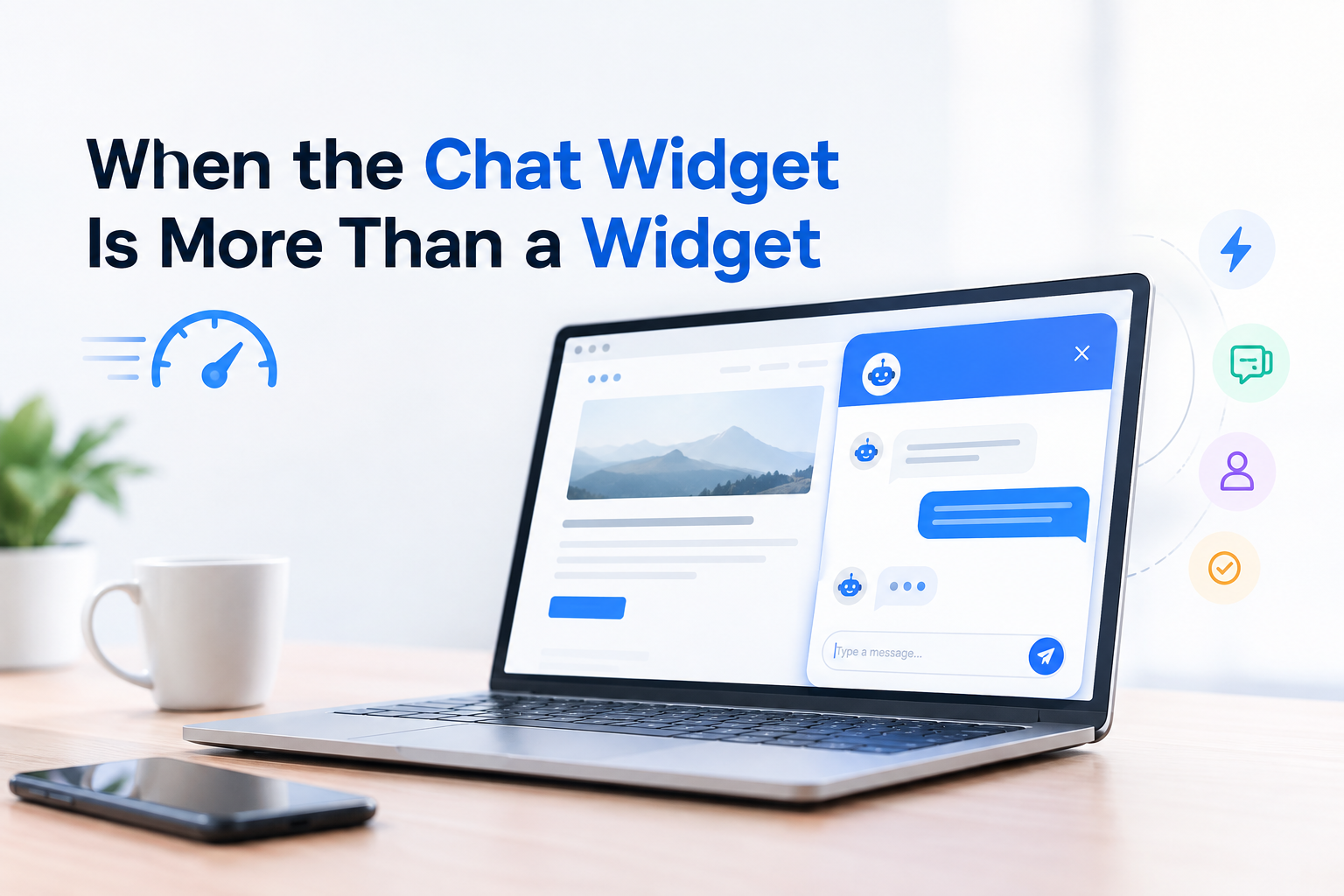
When the Chat Widget Is More Than a Widget: Designing Fast Website Conversations

There is a moment every SaaS founder and agency owner has experienced. A visitor lands on a pricing page, stays for four minutes, and leaves without converting. The analytics show the session. The recording shows the scroll. Nobody knows what question they had, because nobody was there to ask.
Website chat is supposed to solve this. In practice, it often makes the problem worse — a widget that fires a generic “Hi there! How can I help?” thirty seconds after page load, then routes the visitor into a ticket queue that responds forty-eight hours later. The visitor needed a conversation. They got an inbox.
Getting this right is not about finding the cleverest copy for your chat prompt. It is about understanding what visitors actually want when they click that button, and designing a system that can deliver it without making them feel surveilled, processed, or ignored.
What Speed Actually Means to Visitors
HubSpot has found that 90 percent of customers rate an immediate response as important when they have a sales or marketing question, with “immediate” meaning ten minutes or less. Google’s internal research on mobile behavior established that 53 percent of users abandon a site that takes more than three seconds to load — a finding the industry has extended, correctly, to conversational latency. People who type into a chat box and wait ninety seconds for a reply do not wait a second time.
Drift published data showing that responding to a lead within five minutes makes you nine times more likely to convert them than waiting thirty minutes, and 78 percent more likely than waiting an hour. Those numbers describe a gap between what chat widgets promise and what most of them deliver.
The practical implication is not that you need a live agent watching the widget at every hour. It is that your first response — whether from a bot or a human — needs to acknowledge the visitor within seconds and do something useful with the acknowledgment. Reflecting back what the visitor is doing (“I see you’re looking at our enterprise plan — what’s the main thing you’re trying to figure out?”) is more valuable than any opener that does not know where the person is or what they came to find.
Capturing Intent Without Being Creepy
There is a meaningful difference between a chat system that uses page context to ask a smart question and one that announces “I see you’ve visited our site fourteen times” as an opener. The first feels helpful. The second feels like surveillance.
The intent-capture problem is really a question design problem. Most chat widgets ask for a name and email before letting a visitor type their first message. This is backwards. Gartner has observed that B2B buyers complete 57 percent of a purchase decision before ever contacting a vendor — meaning the visitor landing on your pricing page has already done substantial research. They do not need to introduce themselves. They need an answer.
Effective chat design lets people type first and identify themselves later, only at the point where identification creates real value for them — when you are about to send a follow-up, or when the conversation needs a human who will want to prepare before joining.
One practitioner who has made this explicit is Jason Fried, co-founder of Basecamp, who has written at length about how his company’s support treats every inbound question as if it came from someone who has already tried to solve the problem on their own. Whether or not you agree with all of Basecamp’s product philosophy, the underlying principle is sound: assume competence in the person asking, and design your first response around what they probably already know.
The Practical Checklist
Before you adjust a single word of chat copy, work through this:
Page targeting. Does your chat show a different opener on the pricing page, the demo request page, and the homepage? If not, you are showing the same opener to someone who has been researching for an hour and someone who arrived from a search ad thirty seconds ago.
First response time. Log ten actual conversations from last month. What was the median time between visitor message and first substantive response? If it is over five minutes during business hours, fix that before anything else.
Handoff triggers. When does the bot — if you use one — pass to a human? Is that trigger based on what the visitor says, or on a timer? Timer-based handoffs frustrate visitors who have already answered the question. Intent-based triggers, built around phrases like “pricing,” “contract,” or “integrate with,” work far better.
Human prep time. When a human takes over, do they see the full conversation context, the page the visitor is on, and whether the visitor is a known contact? If your agent has to ask “What are you looking for?” after the visitor already typed it, you have a systems problem.
Out-of-hours behavior. What happens when someone chats at 11 PM? A clear, honest message — “Our team is back at 9 AM Eastern; if you leave your email we’ll pick this up then” — outperforms a bot that circles indefinitely without resolving anything.
Human Handoff and What It Actually Requires
The handoff from bot to human is where most chat implementations lose the goodwill built by a fast initial response. The visitor has explained their situation once. If the human agent opens with a question that demonstrates they have not read the transcript, the visitor’s experience resets to zero — or below zero, because now they are frustrated rather than just cautious.
A clean handoff requires three things. First, the human needs the full conversation context before they type a single character. Second, they need one additional data point that the bot cannot reliably provide: a read of the visitor’s emotional state. Someone who types in short, direct sentences and asks specifically about API documentation is different from someone who writes three long paragraphs trying to explain what they are building. The former wants precision. The latter probably wants to be heard before being directed anywhere.
Third, the human needs to signal continuity immediately. Something as simple as “I’ve read through what you and the bot covered — the question about SSO is the one I want to make sure I answer properly” tells the visitor that the time they spent explaining themselves was not wasted.
Follow-Up Across Channels
The conversation does not end when the visitor closes the widget. How you follow up determines whether the conversation converted any of the intent you captured.
Email is the default, and it works well when the follow-up is specific. A message that references the exact question the visitor asked, sent within two hours, performs materially better than a generic “Thank you for your interest” template sent the next morning. If the visitor mentioned a specific integration they were trying to figure out, the follow-up should address that integration — not restart the conversation from a blank slate.
WhatsApp follow-up is increasingly common for B2B conversations in markets where it is the primary professional messaging platform — much of Latin America, the Middle East, and Southeast Asia — and for any prospect who has explicitly indicated they prefer it. The rule here is consent before channel expansion. A visitor who chatted on your website has not consented to a WhatsApp message, and sending one without permission is worse than not following up at all.
The right time to ask about preferred follow-up channel is during the chat itself, as part of the natural progression toward resolution. “What’s the best way to send you the comparison doc — email works, or WhatsApp if that’s easier?” is a question that both captures preference and signals that you will actually follow through.
Privacy and What Visitors Reasonably Expect
Most chat platforms collect more data than they disclose clearly to visitors. Session recordings, device fingerprints, CRM lookups that identify the visitor before they have said anything — these are standard practice and largely invisible to the person typing.
This matters for practical reasons beyond compliance. A visitor who discovers that your chat widget was identifying them before they introduced themselves will feel deceived, even if the disclosure is technically present in a privacy policy they did not read. The risk is not primarily legal. It is reputational.
The straightforward approach is to disclose what you are doing at the moment it becomes relevant. If you look up a visitor in your CRM and recognize them as a previous customer before they identify themselves, say so: “I can see you’re already a customer — do you want me to pull up your account?” That turns a potential creepiness moment into a demonstration of service.
For B2B specifically, the GDPR and its downstream equivalents have made chat data handling a procurement issue. Enterprise buyers routinely ask about data retention policies for conversational data. Having a clear, auditable answer matters for deals that involve a security review.
Measuring Whether It Is Working
Gartner has noted that most organizations measure chat success by volume — the number of conversations started — rather than by outcome. This is backwards. A chat widget that starts many conversations and resolves few of them is a support cost, not a conversion asset.
The metrics worth tracking are resolution rate at the first interaction, conversation-to-pipeline rate for sales-oriented chat, and median time to first substantive human response during staffed hours. If you are using a platform like CRMsoftware.pro that is built around conversion rather than ticket deflection, you can also track intent-stage mapping — understanding whether different conversation openers reach visitors at different points in the decision process and whether those differences predict conversion.
The underlying question behind all of these metrics is whether the chat conversation moved the visitor meaningfully toward a decision, or whether it created the impression of responsiveness without the substance. Most chat implementations do the latter. The ones that do the former tend to share a common characteristic: they were designed around the visitor’s question rather than around the vendor’s process.
A Closing Observation
The best website chat interactions feel, afterward, like they were easy. The visitor asked what they needed to ask, got an answer that matched the question, and left with enough information to move forward. They did not have to repeat themselves. They were not asked for their email before they could type. They did not wait long enough to open a second tab.
That experience is achievable. It requires treating the chat widget not as a lead capture form with a friendlier interface, but as the beginning of an actual conversation — one that respects the visitor’s time, their prior research, and their reasonable expectation that asking a question will result in an answer.
The technology to do this well exists. The gap between what most companies ship and what is possible is almost entirely a design and intention problem, not an engineering one.







Comment