Electronic products often remain in service much longer than the documentation used to build them.
A machine may still depend on a controller designed years ago. A manufacturer may inherit an older board after a supplier relationship ends. A product team may discover that the original design files are incomplete, scattered across old computers, or no longer available.
At that point, the challenge changes.
The team is no longer starting with a clean new PCB design. It first needs to understand what it already has, identify what information is missing, and decide whether the board should be reproduced, revised, or replaced.
For electronics businesses dealing with legacy hardware, PCB reproduction can become an important bridge between an existing physical board and a new manufacturing cycle.
Legacy Boards Create a Documentation Problem
Modern PCB production normally begins with a controlled set of design files.
Older hardware may not come with that level of documentation.
A company may have:
- a functioning physical board;
- partial schematics;
- an outdated BOM;
- old manufacturing files;
- incomplete component information;
- several board revisions with unclear differences;
- no original design package at all.
The physical PCB may therefore become one of the most important references available.
Before moving toward production, the first task is understanding what information can be recovered and what still needs engineering verification.
Decide Whether Reproduction Is Actually the Right Path
Not every old PCB should simply be copied.
Teams should first understand why the board is being revisited.
Common business situations may include:
- maintaining equipment that is still operating;
- replacing a discontinued board;
- supporting an older product line;
- restoring production after design files were lost;
- studying an existing board before developing a replacement;
- preparing a compatible revision for future manufacturing.
The intended outcome matters because reproduction and redesign are different engineering decisions.
A board that only needs to support a limited maintenance requirement may follow a different path from one that will return to regular commercial production.
Start With the Physical Board and Available Records
The best starting point is usually to collect everything that still exists.
That may include:
- the original PCB;
- photographs;
- old schematics;
- BOM files;
- component labels;
- service manuals;
- previous supplier documents;
- test records;
- known functional requirements.
Even incomplete information can reduce uncertainty.
The team should also identify the exact board revision being examined. Two boards that look nearly identical may contain component or layout changes introduced at different points in the product’s history.
Clear revision identification helps prevent a reproduction project from accidentally combining information from different versions.
Where PCB Copy Services Fit
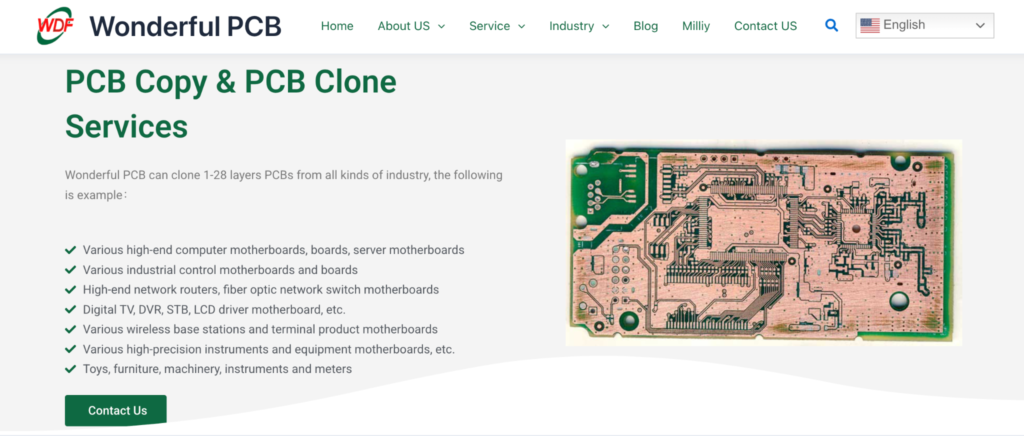
When original production data is incomplete or unavailable, a PCB Copy Service can become part of the recovery process.
WonderfulPCB provides a dedicated PCB Copy Service alongside its broader PCB service offering.
For a hardware company, the practical purpose of this type of service is to support projects where an existing PCB needs to become usable engineering or production information again.
The physical board still needs careful verification. Component identities, revision differences, functionality, and later manufacturing requirements should be reviewed by the engineering team before a recovered design is treated as production-ready.
Separate Recovery From Redesign
One of the most important decisions is whether the goal is faithful reproduction or product improvement.
Those are different projects.
A legacy board may contain:
- discontinued components;
- old connector choices;
- obsolete interfaces;
- components with modern substitutes;
- design decisions that made sense years ago but no longer fit current requirements.
Teams should therefore establish a baseline first.
The recovered board represents the existing product.
Any modernization work should then become a controlled engineering revision rather than being mixed into the recovery process without documentation.
That separation makes later testing easier because the team can identify which changes belong to reproduction and which belong to redesign.
Component Availability Can Change the Plan
A board may be reproducible in principle while still being difficult to manufacture exactly as before.
Component availability changes over time.
An older IC, connector, passive component, or package may no longer be readily available.
This creates several possible outcomes:
- locate an appropriate existing source;
- approve a substitute;
- modify the design;
- redesign part of the board;
- reconsider whether reproduction remains economical.
Any substitution should be treated as an engineering decision.
Physical compatibility alone does not guarantee electrical or functional equivalence.
For this reason, legacy PCB projects often require more verification than simply creating a new set of manufacturing files.
Build a New Controlled Production Package
Once the board information has been recovered and any engineering changes have been approved, the project should move into a normal release process.
The new production package should clearly identify:
- board revision;
- approved manufacturing files;
- component information;
- any intentional changes from the legacy board;
- production quantity;
- custom requirements;
- test or inspection requirements defined by the project.
This package becomes the new source of truth.
Older photographs, partial files, and historical records can remain archived, but production should use only the approved release.
Move From Recovered Design to Manufacturing
The final stage is turning the verified design into physical boards again.
The same supplier can usually cover the later fabrication stage once the design package has been verified. For projects that begin with an existing PCB rather than complete design files, keeping recovery and manufacturing within one service relationship can reduce some supplier handoffs.
The engineering team still needs to approve the recovered information and control the final revision.
The manufacturing stage should begin only after the design package has reached that point.
Validate the First Reproduced Boards Carefully
The first production run should be treated as a verification stage.
A reproduced PCB may look correct while still containing an issue that only appears during testing.
Teams should compare the new board with the known requirements of the original product.
Useful checks may include:
- physical dimensions;
- connector placement;
- component orientation;
- expected electrical behavior;
- compatibility with the existing equipment;
- known functional tests.
The exact validation plan depends on the product.
For industrial or commercial hardware, documented testing becomes especially important before a reproduced board is released for broader use.
Keep the New Documentation This Time
A successful reproduction project creates something valuable beyond the new PCB: a refreshed engineering record.
That documentation should be stored in a controlled location.
Future teams should be able to identify:
- the current board revision;
- which files are approved;
- what changed from the original board;
- which components were substituted;
- when the new version entered production.
This prevents the same documentation problem from appearing again several years later.
PCB Reproduction Can Be Part of Product Lifecycle Management
Legacy hardware is often discussed only when something breaks.
A more useful approach is to treat older PCB documentation as part of product lifecycle planning.
Companies with long-lived electronics products can periodically ask:
- Do we still have complete production data?
- Are critical components still available?
- Can the current board still be manufactured?
- Is the supplier relationship still active?
- Which products would be difficult to reproduce if production stopped today?
Finding those gaps early gives engineering teams more options.
Waiting until the final replacement board fails can turn a manageable documentation issue into an urgent operational problem.
Where Recovery and Manufacturing Meet
For legacy hardware projects, two stages are usually involved:
Board reconstruction supports projects that begin with an existing physical board and incomplete production information.
Fabrication supports the later stage once a verified design package is ready to return to production.
The engineering responsibility between those stages remains important. Recovered information should be reviewed, revisions controlled, and the first boards validated before larger production decisions are made.
Final Thoughts
Legacy electronics create a very different engineering problem from a new PCB project.
The starting point may be a physical board rather than a complete design package.
A practical process can follow this sequence:
Existing PCB → Information recovery → Engineering verification → Controlled revision → PCB manufacturing → Functional validation
For manufacturers and hardware brands supporting long-lived products, that process can turn an undocumented board into a maintainable production asset again.