
What “Trust Signals” Actually Mean to Singapore Consumers of Online Platforms

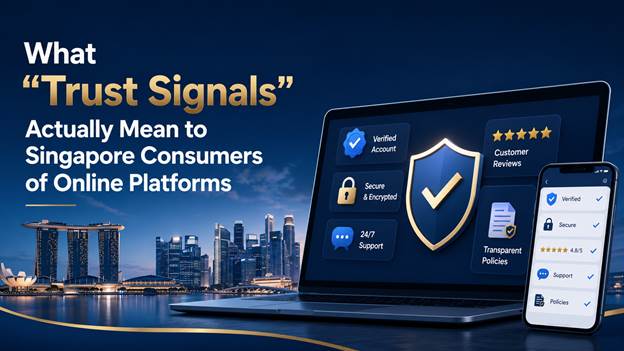
Singapore is an unusual consumer market. Trust in domestic institutions is high, digital payment adoption is close to universal, and PayNow has trained an entire population to expect money to move in seconds rather than business days.
Yet a large share of what Singaporeans actually transact with online sits outside that regulated perimeter — cross-border marketplaces, subscription services billed from overseas entities, foreign fintech apps, international entertainment platforms. The consumer’s instincts were formed inside a high-trust domestic system. The transaction happens outside it.
That mismatch is where the question gets interesting. When the regulator isn’t standing behind the platform, what do people actually use to decide whether to hand over money and identity documents?
The honest answer is that most consumers are working from signals — and most platforms are broadcasting the wrong ones.
The badge problem
Walk through the footer of almost any consumer-facing platform and you will find a row of small graphics. Security seals. Compliance logos. Copyright protection badges. Award icons from organisations nobody can name.
Here is the uncomfortable part: nearly all of these cost either nothing or almost nothing to display. Some are self-issued. Some are purchased for a small annual fee with no audit attached. Some are simply image files copied from another site, and no one ever checks.
This matters because of a principle borrowed from economics: a signal is only worth what it costs to fake.
If a trust marker can be added by any operator in ninety seconds regardless of whether the underlying claim is true, then it carries no information. It cannot separate the trustworthy operator from the untrustworthy one, because both can display it equally. Consumers who have been burned learn this quickly, and they stop reading footers entirely.
The platforms that understand this have stopped competing on badges. They compete on signals that are expensive to fake.
A hierarchy of trust signals
Trust signals can be ranked by exactly one criterion — how costly they are for a dishonest operator to imitate.
Tier 1 (worthless): decorative badges
Self-issued seals, unaudited logos, “award” graphics, protection badges. Cost to fake: effectively zero. Informational value: zero.
A useful test for consumers: click it. A genuine credential leads to a third-party registry entry that names the operator. A decorative one leads nowhere, links back to the same site, or opens a generic marketing page.
Tier 2 (weak): unverifiable claims
“Licensed and regulated.” “Trusted by thousands.” “Bank-grade security.” “Our team tested everything.”
These are prose, not evidence. Cost to fake: the time it takes to type them. They become meaningful only when attached to something checkable — which is precisely what most operators omit.
Tier 3 (moderate): verifiable identity
A named legal entity. A registration number. A jurisdiction. A physical address that resolves to a real location. A licence number that can be looked up on the regulator’s own register — not on the platform’s own page.
Cost to fake: real. Incorporating an entity, maintaining a licence, and surviving a regulator’s register creates a paper trail and an accountable party. This is the first tier that carries genuine information.
The consumer action here is unglamorous but effective: take the licence number, go to the regulator’s website directly, and search it. Not the link the platform provides — the regulator’s own site. A surprising number of “licences” fail this single step.
Tier 4 (strong): behaviour under stress
This is the tier almost nobody publishes, and the one that matters most.
How long does it take to get your money back out? Not to put money in — every platform on earth has optimised that path. Out.
Withdrawal behaviour is the hardest signal to fake, because faking it requires actually doing it. An operator can claim instant payouts in marketing copy for free. But a published, dated, method-by-method withdrawal commitment gets tested by every user, every day. Miss it and the complaint appears publicly within hours.
The same logic applies to a handful of related behaviours:
- Support responsiveness. Not “24/7 support available” — the actual median time to a human response, measured at 2am on a Sunday.
- KYC transparency. Are identity requirements stated before you deposit, or discovered only when you try to withdraw? The second pattern is one of the most reliable predictors of a bad outcome in the entire consumer landscape.
- Fee disclosure at the point of exit. Deposit fees are advertised. Withdrawal fees frequently are not.
Tier 5 (strongest): accountability that costs something to maintain
A named editorial or compliance team with verifiable professional histories. A stated correction policy. Published methodology. A dispute channel that isn’t the platform’s own support queue.
Cost to fake: high and ongoing. Real names attached to real claims create real consequences.
Why the withdrawal test dominates
If a consumer has time for exactly one check, it should be this one.
Every other signal can be manufactured in advance. Withdrawal behaviour can only be manufactured by actually behaving well, continuously, for every user. It is the only signal in the list where the cost of faking it is identical to the cost of being honest. That equivalence is the entire point — it is what makes the signal impossible to counterfeit and therefore worth reading.
It is also why so few operators publish it.
There is a second-order lesson buried here that most consumers miss. Withdrawal speed is not a single property of a company. It is a property of a company and a payment rail. An instant-payment transfer and a traditional bank transfer, requested from the same platform on the same afternoon, run through completely different settlement infrastructure — the first clears in near real time once approved, the second adds a banking clearing cycle on top of the identical approval step.
The practical consequence: any “fast withdrawals” claim that doesn’t name the payment method is close to meaningless. The rail frequently matters more than the operator. Marketing almost never makes the distinction, because the distinction is inconvenient.
What this means for platforms
For operators serving Singapore, the strategic reading is straightforward.
The badge era is over. Not because regulators killed it, but because consumers stopped believing it. Every cheap signal has been so thoroughly commoditised that displaying it now carries a mild negative — it marks you as a platform that thinks badges still work.
The signals that remain are the expensive ones. Publish your withdrawal times by rail, with a date. State KYC requirements before the deposit, not after. Put real names on your editorial and compliance functions. Make your licence number resolve on the regulator’s register.
Each of these costs something. That is exactly why they work.
What this means for consumers
Four questions, in order of value:
- Can I verify the operator’s identity on a third party’s website? Not theirs. A regulator, a registry, a court record.
- What happens when I try to take money out, and is that stated anywhere before I put money in?
- When are my identity documents required — before deposit, or at withdrawal?
- Is there a named human accountable for the claims on this page?
If the answer to all four is no, the badges in the footer are not evidence of anything. They are decorations.
The categories where this matters most are the ones where money moves fast and recourse is thin — cross-border fintech, offshore subscriptions, and online gambling, where Singapore-facing operators sit almost entirely outside the domestic regulatory perimeter and the verification burden falls wholly on the individual. Sector-specific consumer guidance, such as OnlineCasinoSingapore9’s responsible gambling resources, tends to be more useful here than generic advice, precisely because the failure modes are specific.
None of this requires expertise. It requires about ten minutes and a willingness to click the badge instead of trusting it.
Frequently Asked Questions
Q: Are trust badges on websites ever meaningful?
Sometimes — but only when they are clickable and resolve to a third-party registry that independently names the operator. A badge that links back to the same website, or nowhere at all, carries no information. The test is not whether the badge exists but whether an independent party will confirm it.
Q: How can Singapore consumers verify a platform’s licence?
Take the licence number from the platform and search for it on the issuing regulator’s own website, not through any link the platform supplies. A genuine licence produces a register entry naming the licensed entity, the jurisdiction, and the licence status. If the number produces nothing, or the named entity differs from the one you are transacting with, treat the claim as unverified.
Q: Why is withdrawal speed considered a stronger trust signal than security certifications?
Because it cannot be faked in advance. A certification is displayed once and then requires nothing further. A withdrawal commitment is tested by every user on every transaction, and failures surface publicly and immediately. The cost of appearing to have fast withdrawals is identical to the cost of actually having them — which is what makes the signal informative.
Q: What is the most common warning sign of an untrustworthy online platform?
Identity verification requirements that appear only at withdrawal rather than at deposit. When a platform is happy to take money from an unverified user but demands documentation before returning it, the asymmetry is deliberate. Legitimate operators front-load KYC because their risk is at onboarding; problematic operators back-load it because their goal is friction at exit.
Q: Does a platform being offshore automatically make it untrustworthy?
No — but it changes who is available to help you if something goes wrong. Domestic regulation gives a Singapore consumer a recourse channel; offshore operation generally does not, regardless of what licence is displayed. The practical effect is that the verification burden shifts entirely onto the consumer, which raises the value of the checkable signals and lowers the value of everything else.
Q: Why do withdrawal times vary so much between payment methods on the same platform?
Because the platform’s internal approval step and the payment rail’s settlement time are two different delays stacked together. Instant-payment rails settle in near real time once approved; traditional bank transfers add a clearing cycle on top of the same approval. This is why any withdrawal figure quoted without naming the payment method is close to meaningless.
Q: What should a platform publish if it wants to demonstrate trustworthiness?
Withdrawal times broken out by payment method with a stated measurement date; KYC requirements disclosed before deposit; a licence number that resolves on the regulator’s register; withdrawal fees stated at the same prominence as deposit bonuses; and named, verifiable humans accountable for the claims. Each is costly to provide falsely, which is precisely what gives it value.







Comment