Key Takeaways:
- The Bay Area’s corporate event market is one of the most technically demanding in the country, and AV quality is often the deciding factor between a polished event and a forgettable one.
- Venue-specific experience matters as much as general expertise. Companies that know Bay Area venues can prevent day-of surprises before they happen.
- Full-service AV companies handle sound, video, lighting, staging, and livestreaming as one integrated operation, not as separate add-ons bolted together at the last minute.
- Equipment quality matters more than most clients realize. Ask vendors exactly which gear they own versus rent, and who will be operating it on show day.
- For hybrid and livestream events, you need dedicated cameras, a broadcast-quality switcher, and a technician whose only job is managing the outgoing stream.
- Fog City Audio Visual is a San Francisco-based company with over 20 years of experience producing corporate conferences, all-hands meetings, and nonprofit gala events throughout the Bay Area.
There’s a lot riding on your AV setup. If attendees can’t hear the keynote speaker, or the livestream cuts out mid-presentation, it doesn’t matter how strong the content is. People remember when the tech fails, and they’ll almost never notice when it works perfectly.
In the San Francisco Bay Area, the stakes tend to be higher than most markets. You’ve got tech-savvy audiences, union venues with specific labor rules, back-to-back scheduling at busy hotel properties, and corporate clients who expect broadcast-quality results on a fixed timeline. Getting the AV wrong isn’t just a minor inconvenience. It can undermine months of planning in a single afternoon.
So how do you actually know which AV company is worth hiring?
Why the Bay Area Is a Uniquely Demanding AV Market
The SF Bay Area hosts an enormous volume of corporate events, conferences, nonprofit galas, and hybrid productions throughout the year. Silicon Valley companies alone generate a constant stream of all-hands meetings, product launches, leadership summits, and multi-day conferences at hotels and event venues across San Francisco and the surrounding region.
Many of the top event venues in the city operate under union labor agreements. That means your AV vendor needs to understand prevailing wage rules, union jurisdiction, and how to coordinate effectively with house crews. Companies that don’t have that experience can create expensive, time-consuming problems right when you can least afford them.
Load-in windows are tight. There’s no extra time built in for a production team that shows up without a plan.
Event planners who’ve worked in this market for years have seen firsthand what happens when an underprepared vendor is handed the keys to a complex, high-visibility setup. The combination of local knowledge, technical capability, and operational maturity isn’t a nice-to-have. It’s the baseline.
What to Look for When Evaluating Bay Area AV Companies
Specific, Deep Venue Experience
“Bay Area experience” is a phrase worth pressing on when you’re vetting vendors. Which venues, exactly? How many productions? What type of events?
There’s a meaningful difference between a company that’s worked a hotel ballroom once and one that has produced dozens of events at the Marriott Marquis, the Four Seasons, UCSF Mission Bay Conference Center, Pier 27, and Fort Mason venues over many years. That kind of repeated, deep experience shows up in how a team plans a load-in, anticipates acoustical challenges in a specific room, and works with venue coordinators who already know them by name.
Fog City Audio Visual is a San Francisco-based company with an extensive production track record across many of the Bay Area’s most prominent conference and event spaces, including hotel properties like the Ritz-Carlton, Intercontinental Mark Hopkins, and the San Francisco Marriott Marquis, as well as waterfront venues like Pier 27 and Pier 48. That level of repeated exposure to the same spaces builds a practical, operational knowledge base that no amount of generalist AV experience can fully replicate.
Equipment That Actually Matches the Job
Not all gear is equal, and the gap between professional-grade and consumer-grade equipment is both visible and audible the moment someone walks into the room.
For sound, the benchmark in Bay Area corporate event production includes speaker systems from Meyer Sound for smaller and mid-size rooms, and D&B Audiotechnik line arrays for larger conference stages. Wireless microphone systems should operate at the Shure Axient Digital or ULX-D level, especially in dense radio-frequency environments like downtown San Francisco hotels. These aren’t minor distinctions. In a challenging RF environment, the difference between reliable and unreliable wireless audio can make or break a presentation.
For video, high-brightness laser projectors in the 5,000 to 20,000 lumen range and LED video walls with fine pixel-pitch panels, typically 1.9mm to 3.9mm, are the current standard at professional corporate events. The processing systems behind the video matter just as much. Signal switching and processing platforms like the Barco E2 and Novastar H5 are what production companies use when video signal integrity is non-negotiable.
Ask vendors directly what they own, what they rent from third-party houses, and who will be operating each piece of equipment during your event. If the answers are vague, that’s telling.
Hybrid and Livestream Capability That’s Actually Built In
This isn’t optional anymore. Most corporate events today have some component of a remote or hybrid audience, whether it’s a company all-hands streamed to global employees or a conference session broadcast to a private platform or YouTube.
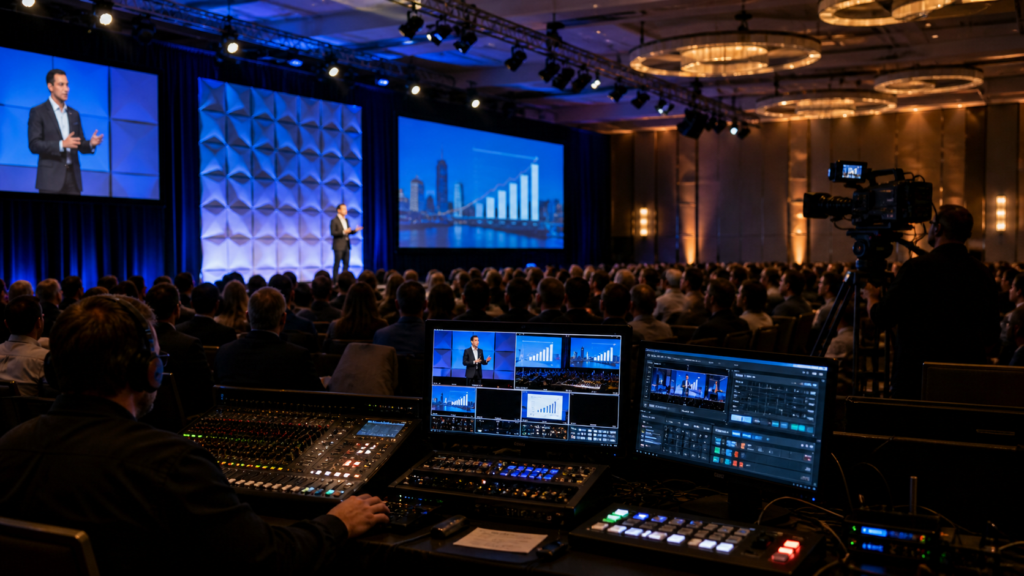
Real hybrid event production requires dedicated cameras or professionally configured PTZ systems, a broadcast-quality video switcher, a separate audio feed mixed specifically for the stream, and a technician whose only responsibility is managing the live output. When AV companies treat streaming as a simple line item rather than a dedicated production workflow, it tends to show. The connection point between in-room audio-visual production and the outgoing stream is exactly where things go wrong when it isn’t managed properly.
Clear Communication and Transparent Scoping Before Show Day
If a vendor is hard to reach during the planning phase, don’t expect show day to be any different.
Strong AV companies will walk you through a detailed technical design before production day, including CAD drawings for larger setups, itemized equipment lists, and a scope of work that spells out clearly what’s included. They’ll conduct site surveys when the venue requires it, schedule presenter rehearsals, and run full tech checks before the audience arrives. Ambiguous pricing, vague proposals, and vendors who can’t commit to specifics in writing are warning signs worth taking seriously. And they often predict how a vendor will handle pressure when something unexpected happens mid-event.
Types of Corporate Events That Demand the Most from AV Vendors
Multi-Day Conferences and General Sessions
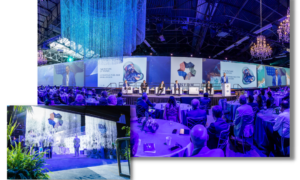
This is where AV reputations are built or damaged. Multi-day conferences with large general sessions, multiple breakout rooms, and hybrid streaming components require several technical systems running simultaneously, experienced crew members managing each, and a production team that genuinely understands show-calling, cue management, and how to pivot under pressure.
For corporate AV production in San Francisco, Fog City Audio Visual handles events with audiences ranging from 100 to over 5,000 attendees. Their approach covers the full production arc, from LED video walls and laser projection to professional sound systems, stage lighting, broadcast cameras, and managed livestreaming, and it extends from initial planning through post-event video deliverables.
All-Hands Meetings and Executive Events
Company-wide all-hands meetings carry high internal visibility. When the CEO’s audio is cutting out or the slides aren’t advancing on cue, it reflects on everyone involved in planning the event.
These productions don’t always need massive budgets, but they do need experienced technicians who understand executive-level environments and can operate cleanly under pressure. That’s a different skill set than simply knowing how to configure a projector.
Galas and Fundraising Events
Nonprofit galas often run on tighter margins, but the quality bar is just as high as any corporate conference. Donors, board members, and major sponsors notice the difference between a polished production and one that feels thrown together.
Fog City has supported gala fundraisers and nonprofit events across San Francisco, the broader Bay Area, and beyond, including larger productions in Los Angeles and Palm Springs. That range reflects both technical capacity and the kind of logistical experience that extends well outside a single local market.
Red Flags Worth Paying Attention To
Not every vendor is upfront about their limitations. A few things worth watching for during the evaluation process:
- They can’t name specific Bay Area venues where they’ve recently produced events, or the list is suspiciously thin.
- Their equipment list is vague, or they rely heavily on rented gear from houses they’ve never worked with before.
- They treat hybrid streaming as an afterthought rather than a core production capability.
- Their pricing or scope of work is hard to pin down in writing.
- They’re slow to respond during pre-event planning or don’t proactively flag potential issues before you have to ask.
Speed and thoroughness during planning are often the most accurate predictors of how a vendor performs under live event pressure.
Why Local Knowledge Is an Underrated Factor
It’s easy to underestimate how much venue-specific, day-to-day experience actually translates into event quality. A team that has loaded into the same hotel ballroom a dozen times carries a mental map of the electrical grid, the dock schedule, the rigging points, and the acoustical quirks of that specific room that a first-time team simply doesn’t have.
That knowledge translates directly into smoother events.
In a market as technically demanding as the SF Bay Area, the combination of professional equipment, seasoned technicians, real depth of venue experience, and transparent operations is the standard worth applying to every AV vendor you consider. It’s a high bar, but for high-stakes events, it’s the right one.
Frequently Asked Questions
What does an AV company do for a corporate event?
An AV company manages the audio, video, and lighting technology for your event. This includes sound systems, microphones, projection or LED video walls, stage lighting, and any livestreaming or recording components. For larger events, they also handle technical design, site surveys, presenter rehearsals, and full on-site production management from load-in through final strike.
How much does AV production cost for a corporate event in the SF Bay Area?
Costs vary considerably depending on event size, venue, duration, and technical complexity. A basic meeting setup for a small group might cost a few thousand dollars, while a multi-day conference with LED video walls, line array sound, professional lighting, and hybrid streaming can reach tens of thousands. Asking for a detailed quote with a clear, itemized scope of work is the most reliable way to understand exactly what you’re paying for, and to compare vendors on equal footing.
What’s the difference between AV rental and full AV production?
AV rental typically means equipment is delivered and your own team handles setup and operation. Full AV production means the company provides equipment, experienced technicians, and end-to-end operational support throughout the event. For corporate events, full production is generally the right choice unless you have experienced in-house technical staff capable of managing a live show.
Do I need a separate vendor for livestreaming, or can my AV company handle it?
Many full-service AV companies offer integrated in-room production and livestreaming as a single coordinated service. This is preferable to splitting responsibilities across separate vendors because it keeps one team accountable for the connection between live audio, video, and the outgoing stream, which is where technical problems most commonly occur. Ask vendors specifically about their camera systems, video switching workflow, and experience with the streaming platforms your event will use.
What should I look for when hiring an AV company for a San Francisco venue?
Prioritize companies with hands-on experience at your specific venue or at comparable properties in the city. Many of San Francisco’s leading conference venues have union labor requirements and technical constraints that can catch underprepared vendors off guard. Venue familiarity, existing relationships with house staff, and experience working in union environments all make a real operational difference.
How far in advance should I hire an AV company for a Bay Area conference?
For multi-day conferences and large events, six to twelve weeks is a reasonable minimum, though more lead time always allows for better planning, especially if a site survey, CAD design, or presenter rehearsals are needed. Smaller events can often be arranged with less advance notice. The practical reason for booking early is ensuring there’s enough runway to catch and fix issues before show day.
Are there AV companies in the Bay Area that focus specifically on corporate and nonprofit events?
Yes. Several Bay Area AV companies concentrate specifically on corporate and nonprofit clients rather than consumer or entertainment events. Fog City Audio Visual is one example, with a focused practice covering corporate conferences, executive meetings, all-hands events, and nonprofit galas throughout San Francisco, Silicon Valley, and the broader Northern California region.