Ordering brass inserts for plastic fittings is not just a matter of matching thread size. For injection-molded plumbing components, the insert must fit the mold, bond securely with plastic, and maintain accurate threads after production. Before placing an order, buyers should confirm several technical details to avoid costly rework.
The first point is thread standard. Different markets may require BSP, NPT, metric, or customized threads. Even when the nominal size looks similar, the thread angle and pitch may not be the same. If the wrong thread is selected, the finished fitting may fail during assembly or leak under pressure testing.
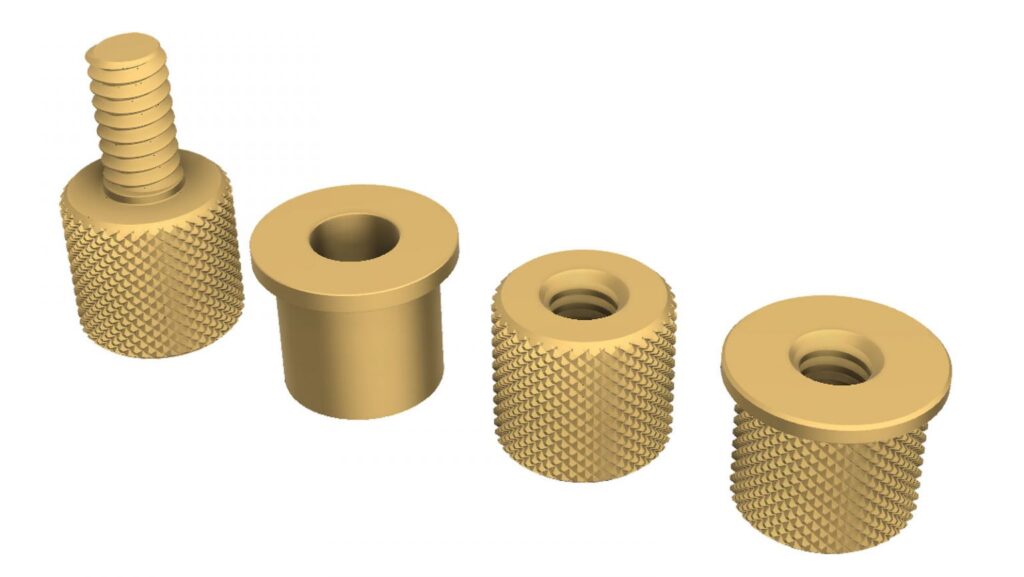
The second point is external geometry. Brass inserts used in plastic fittings often include knurled, hex, or grooved outer surfaces. These features are not decorative. They help the plastic grip the insert after molding. A smooth outer wall may not provide enough anti-rotation strength, especially when installers tighten valves or pipe connectors with tools.
The third point is dimensional tolerance. Insert molding requires stable dimensions because even small variation can affect mold loading, plastic flow, cooling shrinkage, and final alignment. If the insert is too loose, it may shift during molding. If it is too tight, it may damage the mold or slow down production.
Buyers should also check surface finish and cleanliness. Burrs, oil residue, or rough machining marks can affect molding quality and thread engagement. A clean, well-machined insert reduces assembly problems and improves the appearance of the final product.
For OEM and private-label projects, customization support is especially valuable. A standard insert may not always match a new fitting design. In that case, suppliers may need to adjust length, wall thickness, knurling depth, logo marking, or packaging. If you are developing a new product range, it helps to review the available customization options before finalizing drawings.
Finally, ask about inspection. A reliable supplier should check dimensions, threads, appearance, and batch consistency before shipment. For high-volume fitting manufacturers, stable quality is often more important than a slightly lower price.
A well-selected brass insert improves molding efficiency, assembly strength, and long-term fitting reliability. By confirming thread standards, outer structure, tolerance, finish, and inspection process before ordering, manufacturers can avoid many common production problems.
Frequently Asked Questions
- What thread standards are available for brass inserts?
Brass inserts can be manufactured with different thread standards, including BSP, NPT, metric, and customized threads. Buyers should confirm the required thread type, size, pitch, and angle before ordering to ensure proper compatibility. - Why is the external shape of a brass insert important?
The external geometry helps the brass insert bond securely with the plastic during injection molding. Features such as knurling, grooves, and hexagonal surfaces provide better anti-rotation and pull-out resistance than a smooth outer surface. - What dimensional tolerances should be checked before ordering?
Buyers should confirm the insert’s length, outer diameter, inner diameter, thread dimensions, and other critical measurements. Consistent tolerances are important because variations can affect mold loading, plastic flow, alignment, and the quality of the finished fitting. - How should brass inserts be finished before injection molding?
Brass inserts should be properly machined, clean, and free from excessive burrs, oil, and other contaminants. A good surface finish supports reliable molding, proper thread engagement, and a cleaner appearance in the final plastic fitting. - Can brass inserts be customized for OEM injection-molded fittings?
Yes. Depending on the supplier, brass inserts can be customized in areas such as dimensions, thread type, length, wall thickness, knurling pattern, surface features, marking, and packaging. Customization is useful when a standard insert does not meet the requirements of a specific fitting design.