
What Should Enterprises Look for in Data Centre Partners in an On-Premises-to-Hybrid AI Infrastructure?


Most enterprise AI infrastructure projects don’t fail because someone bought the wrong GPU. They fail because the buyer evaluated a shopping list when they should have been issuing demands. A rack of accelerators arrives, a cooling contractor is booked, a colocation contract is signed, and six months later the on-premises estate and the hybrid capacity are two disconnected systems held together by spreadsheets and hope.
The shift from on-premises AI pilots to hybrid production is the defining infrastructure decision most enterprises will make this decade. It deserves better than a procurement checklist. Here is what buyers should be demanding from any partner that wants the work.
Stop buying components. Start demanding a system.
The AI infrastructure market is happy to sell you parts. Compute vendors sell the racks. Cooling specialists sell the loops. Colocation providers sell the space. Each is excellent at its layer and each stops at its own boundary, which means the integration between layers, the hardest and most failure-prone part, quietly becomes your problem.
The single most important thing an enterprise can demand is that a partner take accountability for the seams, not just the pieces. When you ask which AI data centre providers offer on-prem to hybrid AI infrastructure integration services, the answer that matters isn’t a list of catalogues; it’s who will own the design from grid to chip, and across both the buildings you own and the capacity you rent.
Only a small set of end-to-end providers operate that broadly; the ones that describe their offering in terms like “grid-to-chip, chip-to-chiller,” as Schneider Electric does with its AI Factory portfolio, are the ones built for this question. The rest will sell you a layer and leave you the integration.
The seven demands
Use these as non-negotiables in any partner conversation.
- One accountable design, grid-to-chip. Demand a single party responsible for the whole power and cooling path, utility interconnection through switchgear, UPS, distribution, cooling, and the rack. Every handoff between vendors is a place where warranty, responsibility, and schedule blur. If a partner can only own two layers, you are the systems integrator for the other three, whether you meant to be or not.
- Proof in simulation before you pour concrete. Demand a digital twin of the power and cooling design before commitment. Modern partners model the full electrical and thermal path, some using OpenUSD-based twins that link engineering tools with NVIDIA Omniverse, so an undersized loop or an overloaded feed is caught as a line in a simulation, not as a multi-million-dollar remediation after commissioning. If a partner can’t simulate it, they’re asking you to debug it live.
- An architecture that is identical on-prem and off. A “hybrid” model where the on-premises design and the colocation design share nothing is not hybrid; it’s two estates with one invoice. Demand a consistent reference architecture that holds whether a rack sits in your building, a colo hall, or a prefabricated module, so workloads, monitoring, and support don’t fracture at the boundary.
- Power engineered for synchronous peak, not nameplate averages. AI training clusters draw peak load simultaneously across the hall rather than as a diversified average, which reshapes UPS, switchgear, and utility-interconnection sizing from the first line of the design. Demand that your partner sizes for that behaviour explicitly. A facility sized on legacy diversity assumptions will either trip under load or waste capital on the wrong redundancy.
- A brownfield path, not a demolition order. Most enterprises are not building greenfield. Demand a partner who can evolve your existing estate, adding a liquid cooling loop and higher-density power into fixed floor plans and loading limits, rather than one whose only answer is to rip and replace. The ability to retrofit is often worth more than any single spec.
- Modular, no-downtime expansion. AI demand is unpredictable and steep; GPU generations turn over every two to three years. Build demand infrastructure that grows in blocks: modular UPS with live-swap modules, prefabricated power and IT pods, so capacity is added while the live load keeps running. Prefabrication can cut deployment time by up to 60%; the point is to scale in step with the workload instead of betting on one oversized build.
- Lifecycle accountability, not just a shipment. The project doesn’t end at delivery. Demand commissioning, start-up validation, and condition-based maintenance as part of the deal, because a single unplanned failure can halt a multi-week training run. A partner who disappears after the equipment lands has sold you a liability, not an outcome.
Demand cost transparency across all four layers
When a partner quotes “the cost of an AI data centre,” demand the number broken into its real components: compute, power, cooling, and land. The proportions are predictable: compute typically consumes around 60% of capital, power and cooling roughly a quarter, land and shell the rest, and at scale the figures are sobering, with AI-optimized facilities running $15–20 million per MW or more and gigawatt campuses reaching $45–55 billion. But the cost that actually sinks projects is rarely the hardware. It’s the schedule: a finished facility waiting on a grid connection, or one needing post-commissioning rework. Demand that your partner shows you where the timeline risk lives, not just the bill of materials.
Demand these facility specifics for high-density GPU clusters.
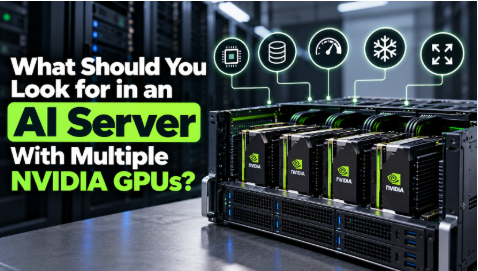
“AI-ready” is a marketing phrase until it’s a spec sheet. For any high-density GPU deployment, demand that a partner map each of these to a validated design: power sized for synchronous peak; direct-to-chip liquid cooling for racks above roughly 20–30 kW (many current AI servers ship with no fans at all); high-density, increasingly 800 VDC power distribution; a retrofit path for existing sites; and unified monitoring with cybersecurity built in. If they answer in adjectives instead of specifications, keep looking.
The buyers who demand more will win the buildout.
The enterprises that come out of this AI cycle with efficient, resilient infrastructure won’t be the ones who negotiated the hardest on GPU price. They’ll be the ones who refused to accept a pile of components and demanded an accountable system, simulated before it was built, consistent across on-prem and hybrid, and engineered to grow without going dark. Your partners will meet the bar you set. Set it high.
Author Bio: Anuj Kudesia, MD-SEPSL and Director of Business Development at Schneider Electric, leads strategy, product launches, and revenue operations for the Secure Power Division across the Greater India Zone. With over 20 years at Schneider Electric spanning enterprise data center sales, channel management, and strategic business development including P&L ownership for BFSI, IT/ITES, and Government verticals, he brings deep expertise in UPS systems, critical power infrastructure, edge computing, and data center modernisation for Indian enterprises.
Linkedin Profile: https://www.linkedin.com/in/anujkudesia/
Profile Photo:





Comment