
What Makes People Click “Buy Now” When Shopping for Clothes Online

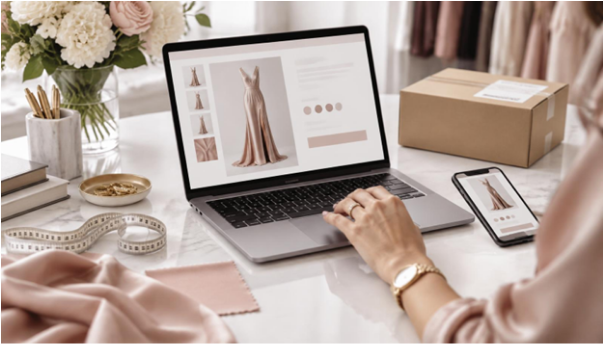
Anyone who has watched an apparel checkout funnel knows the pattern. Traffic arrives. Product pages get attention. Carts start to fill. Then a large share of sessions simply stop. The near-miss is so common that many retailers now spend as much energy on abandonment as on acquisition. Interest is not the scarce resource. The scarce resource is the moment when doubt finally drops low enough for someone to commit.
Clothes are a hard product to sell without a fitting room. The garment has to match a body the merchant cannot see, under lighting the merchant cannot control, for an occasion the merchant may not fully understand. Shoppers know all of that. They look for signals that shrink the uncertainty: measurements they can compare to a dress at home, reviews that sound like real people, return terms that do not punish a wrong guess, and product pages that admit what the fabric actually is. The “Buy Now” click is rarely pure impulse. It is the point where those signals finally outweigh what is still unknown.
Trust signals: size data and social proof
Fit anxiety sits at the center of online apparel friction. Brands grade sizes differently. A six in one label can measure like an eight in another. Shoppers who have been burned once start hunting for full measurement tables rather than letter codes. When bust, waist, hip, and length figures sit next to the product, the decision becomes a comparison against something in the closet instead of a coin flip. Retail teams that still treat the size chart as a footer afterthought leave a conversion leak open on every listing.
Reviews do similar work, but only when they are usable. A high star average with no detail is weak evidence. Written comments and customer photos matter because they reveal patterns: lengths that run short, colors that shift indoors, fabrics that pill after one wear. Experienced shoppers sort by recent reviews and by lower ratings on purpose. They are looking for repeated complaints, not isolated raves. Pages that make those filters easy tend to convert more steadily than pages that showcase only studio shots and hide the messy feedback.
In formal and occasion wear the stakes feel higher because the dress is often for a single public night. Tolerance for surprise shrinks. Listings that put measurements, multiple angles, and a real volume of buyer feedback in plain view reduce the perceived cost of being wrong. Among formalwear operators that have built product pages around that kind of clarity is the assortment tied to a Worldprom dress, where size and material detail function as part of the conversion system rather than optional copy.
Risk reduction: returns, policies, and the cost of being wrong
Even careful buyers sometimes land on the wrong size or find that a fabric behaves differently in person. The difference between a manageable mistake and an expensive one is usually the return framework. Clocks that start on delivery rather than order date, exchanges for another size of the same style, and terms written in plain language all lower the barrier to clicking buy. Hidden restocking fees, short windows, and final-sale rules on formal pieces push the opposite way. Many shoppers would rather abandon the session than absorb that risk.
From a commercial angle, clearer return terms are not pure cost. They are part of the offer. Shoppers read them as insurance. Apparel has long shown higher return rates than many other e-commerce categories; formal dresses sit toward the upper end because fit and appearance are judged under social pressure, not only private preference. Some retailers have responded by tightening pre-purchase information rather than only smoothing refunds: better charts, better photography, more honest fabric notes. The policy then becomes a backstop instead of the main reason someone is willing to order.
One behavioral pattern shows up often in checkout research: people will tolerate a moderate price more readily than they will tolerate ambiguity about what happens if the item fails. Uncertainty about reversibility can freeze a decision even when the product itself looks right. That is why policy clarity belongs in the same conversation as imagery and assortment.
From browse to buy: experience, perception, and friction
Trust and risk are not the whole story. The path from product page to payment has to stay short enough that momentum survives. Slow image loads, buried shipping estimates, and checkouts that demand an account before offering a guest path all chip away at completion. Mobile sessions are especially unforgiving. A large share of apparel browsing now happens on phones; if the size chart is hard to reach or reviews require awkward scrolling, people who were close to deciding simply leave.
Price perception matters too, though not always toward the lowest number on the page. Shoppers weigh expected total cost: the chance of alterations, how the fabric will hold up, the likelihood of a second order if the first fails. A mid-range listing with transparent specs and consistent feedback can convert more reliably than a cheaper one that looks incomplete. The click often reflects a judgment that remaining uncertainty is small enough to live with, not that the item is the cheapest option in the tab set.
Formalwear adds time pressure on top of everything else. Orders placed close to an event leave little room for exchange or alteration. Shoppers in that window become more sensitive to missing information and more likely to abandon if anything feels unclear. Retailers that keep information quality consistent across related occasion categories make it easier for the same customer to complete more than one purchase in a season. When main formal collections and related edits such as prom dresses share the same size logic and policy language, the customer does not have to relearn the rules for every event.
Across consumer research in retail, the same cluster of triggers keeps appearing: confidence in fit, confidence in how the item will look, confidence that a mistake is reversible, and a checkout path that does not introduce new doubt. None of that is unique to clothing. Clothing simply makes the absence of those triggers more expensive. A book that arrives slightly different from the description is still usable. A dress that arrives in the wrong size may not be wearable in time for the night it was bought for.
Designing for the decision, not only the display
The commercial takeaway is plain. Imagery gets people onto the page. Information design and risk design get them across the line. Retailers that treat size charts, reviews, fabric detail, and return terms as core conversion assets tend to lose fewer sessions in categories where fit anxiety runs high. Those that treat the same elements as secondary content leave shoppers to resolve uncertainty alone, and many will not. In practice that means funding the unglamorous parts of the listing as seriously as the hero shot.
Online clothing retail will keep living with the basic constraint that a garment must match a body the merchant cannot measure in person. Better data, clearer photography, and plainer policies can narrow the gap. They cannot remove the need for shoppers to feel that the leftover risk is manageable. The “Buy Now” button is where that feeling either tips into an order or collapses back into a tab that stays open for another week. Operators who understand the difference build for the tip, not only for the scroll. In apparel e-commerce, the steadier converters are often the ones that make uncertainty small enough to accept, rather than the ones that only make the product look most desirable in a single still.







Comment