
Introduction: Understanding Digital Communication Systems
Communication is one of the most important foundations of human cooperation. Businesses, organizations, and individuals exchange enormous amounts of information every day. Emails, instant messages, video meetings, digital documents, and online platforms have completely changed the way people communicate and work together.
A digital communication system is a technology-based system that allows information to be created, transmitted, received, processed, and stored using digital signals. Unlike traditional communication methods based on analog signals, digital communication converts information into electronic data that can be transferred quickly, securely, and efficiently.
Modern digital communication systems are the foundation of the connected world. They support business operations, remote work, online services, mobile communication, software platforms, and collaboration between teams located anywhere in the world.
Today, digital communication is not only about sending messages. It is also about creating efficient environments for digital work, digital sharing, and digital collaboration.
Organizations increasingly need solutions that allow employees to communicate, share information, manage workflows, and cooperate securely. A modern digital communication system helps connect people, devices, applications, and business processes into one integrated environment.
See more: https://lov111vol.com/digital-work
What Is a Digital System?
A digital communication system is a system that transfers information using digital signals instead of continuous analog signals.
In simple terms, digital communication converts information into binary data, represented by numbers such as 0 and 1. This digital information can then be transmitted through different communication channels, including:
- Internet networks
- Wireless connections
- Fiber optic cables
- Mobile networks
- Local area networks (LAN)
- Satellite communication systems
The main purpose of a digital communication system is to enable reliable information exchange between a sender and a receiver.
For example, when an employee sends a business document to a colleague, the document is converted into digital data, transmitted through a network, received by another device, and displayed as the original file.
This process happens in milliseconds and allows modern organizations to operate efficiently.
The Main Components of a Digital Communication System
Every digital communication system consists of several important elements that work together.
Information Source
The information source creates the message that needs to be communicated. Examples include:
- Text messages
- Voice recordings
- Video content
- Business documents
- Images
- Database information
- Sensor data
In a business environment, the information source may be an employee creating a report, a customer sending a request, or a system generating operational data.
Transmitter
The transmitter prepares information for digital transmission. Its role is to:
- Convert information into digital format
- Encode data
- Prepare information for secure transfer
- Optimize communication speed
Modern transmitters are built into many devices, including computers, smartphones, servers, and network equipment.
Communication Channel
The communication channel is the path used to transfer digital information. Examples include:
- Internet connections
- Wi-Fi networks
- Ethernet cables
- Mobile networks
- Private company networks
The quality of the communication channel affects speed, reliability, and security.
Receiver
The receiver collects incoming digital information and converts it into a format that users or systems can understand.
For example, when receiving a document through a business collaboration platform, the receiver processes the digital data and displays the file on the user’s computer.
Destination
The destination is the final location where information is used. It may be:
- A person
- A team
- A company department
- A software application
- An automated system
In modern businesses, information is often shared between multiple destinations, creating complex digital collaboration environments.
How Digital Communication Systems Work?
The process of digital communication usually involves several stages.
First, information is created and converted into digital data. This data may then be compressed, encrypted, or formatted before transmission.
Next, the information travels through a communication channel. During this stage, different technologies ensure that the data reaches the correct destination.
After receiving the digital signal, the system processes and reconstructs the information so it can be used by people or applications.
Security is an increasingly important part of this process. Modern organizations cannot rely only on fast communication. They also need secure communication.
Businesses must protect:
- Confidential documents
- Customer information
- Internal messages
- Access credentials
- Intellectual property
For this reason, many modern digital communication systems include encryption, authentication, access management, and monitoring features.

Digital Communication Systems in the Modern Workplace
The traditional office environment has changed significantly. Many companies now operate with remote employees, international teams, and flexible working models.
This transformation created the need for better digital workplace solutions.
A digital workplace combines communication, collaboration, information management, and productivity tools into one connected environment.
Modern employees need to:
- Communicate with colleagues
- Share documents
- Manage projects
- Access business information
- Collaborate across locations
A reliable digital communication system provides the infrastructure needed for these activities.
For example, a marketing team may work with designers in another country, developers in a different city, and customers around the world. Without digital communication technologies, such cooperation would be slow and inefficient.
Digital communication allows teams to work together regardless of physical distance.
Digital Work: A New Way of Working
Digital work describes professional activities performed using digital technologies.
Instead of relying only on physical offices and paper documents, organizations use software systems to manage daily operations.
Examples of digital work include:
- Remote collaboration
- Digital document management
- Online meetings
- Digital project management
- Secure file sharing
- Business workflow automation
Digital work improves flexibility because employees can access important information and communicate from different locations.
However, successful digital work requires more than simply installing software. Organizations need secure systems that allow employees to cooperate efficiently while protecting valuable information.
This is why digital communication systems have become a critical part of modern business infrastructure.
Digital Communication System vs Traditional Communication
| Feature | Traditional Communication | Digital Communication System |
| Information Exchange | Often depends on physical documents, phone calls, or manual processes | Fast electronic exchange of messages, files, and digital data |
| Team Collaboration | Limited by location and availability | Supports remote teams and global collaboration |
| Digital Sharing | Often requires manual file transfer | Secure digital sharing with controlled access |
| Security | Difficult to track and protect information | Uses encryption, authentication, and permission management |
| Workflow Management | More manual processes | Supports automated digital workflows |
| Access to Information | Information may be stored in separate locations | Centralized access to business information |
| Remote Work | Limited support for distributed teams | Designed for remote and hybrid work |
| Feature | Traditional Communication | Digital Communication System |
| environments | ||
| Productivity | More time spent searching and managing information | Faster communication and improved teamwork |
Key Benefits of Digital Communication Systems
| Benefit | How It Helps Businesses |
| Better Collaboration | Teams can communicate and work together regardless of location |
| Secure Digital Sharing | Employees can exchange information while maintaining control over access |
| Improved Productivity | Less time is wasted searching for documents and information |
| Flexible Digital Work | Supports office, remote, and hybrid working models |
| Stronger Security | Protects important business data through modern security technologies |
Digital Sharing, Collaboration, and the Future of Digital Communication Systems
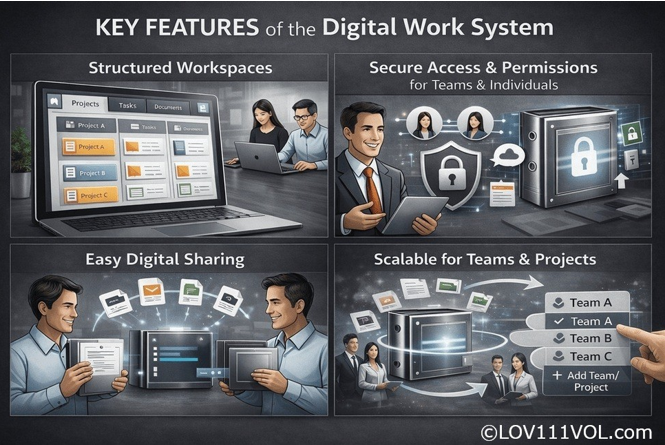
Modern digital communication systems are not only designed for sending messages. They create complete environments where teams can communicate, share information, manage projects, and collaborate securely.
One of the most important elements of modern business communication is digital sharing. Companies exchange thousands of files, documents, and important information every day. Without proper systems, organizations may face problems such as duplicate files, outdated documents, security risks, and inefficient workflows.
A secure digital sharing solution allows teams to exchange information while maintaining control over access and permissions. Employees can share documents, collaborate on projects, and access important data without relying on unsafe methods such as email attachments or unsecured messaging applications.
Modern digital collaboration helps businesses connect employees regardless of their location. Remote and hybrid teams depend on reliable communication technologies to organize tasks, exchange ideas, and complete projects efficiently.
A professional digital workplace supports:
- Team collaboration
- Remote team communication
- Secure document sharing
- Digital workflow management
- Faster decision-making
For many organizations, a digital communication system becomes the foundation of daily operations. It connects employees, software applications, and business processes into one efficient working environment.
Security and Privacy in Digital Communication
As businesses become more digital, protecting information becomes increasingly important. Modern communication systems need to protect sensitive documents, internal messages, customer information, and business data.
Important security features include:
- Encryption
- User authentication
- Access control
- Permission management
- Data protection policies
A secure system allows companies to manage digital information safely while maintaining productivity.
Some organizations also require solutions that can work with limited internet access or provide greater control over their data. Offline-capable digital systems can help businesses maintain flexibility, privacy, and independence from external services.
Digital Communication Systems and the Future of Work
The future workplace will continue moving toward flexible and connected environments. Employees will work from offices, homes, and different locations around the world.
Future digital communication systems will increasingly focus on:
- Artificial intelligence support
- Better security
- Automation
- Improved collaboration
- Faster access to information
Companies that adopt effective digital communication technologies can improve productivity and create more efficient working environments.
LOV111VOL as a Digital Workspace Example
LOV111VOL represents a digital workspace approach that combines multiple business functions in one environment. It supports digital work by helping users organize information, manage documents, communicate, and improve daily workflows.
The concept focuses on combining useful business tools, including:
- Digital document management
- Team communication
- Project organization
- Password management
- Secure information sharing
LOV111VOL works natively on Windows, providing direct integration and performance for Windows users. For organizations using other operating systems, access can be provided through solutions such as Citrix Workspace, Remote Desktop, or virtual desktop environments.
This approach allows companies to use existing infrastructure while maintaining access to important business applications.
Conclusion
A modern digital communication system is much more than a messaging platform. It is a complete foundation for digital work, secure sharing, and team collaboration.
By combining communication, information management, and security features, businesses can create better workflows, improve teamwork, and protect valuable information.
As digital transformation continues, organizations will increasingly depend on reliable and secure digital communication systems to support the future of work.