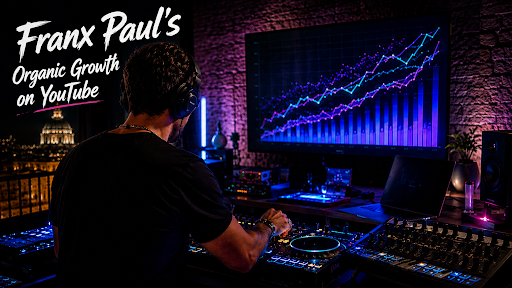
Success on YouTube has become increasingly tied to recommendation systems rather than traditional marketing campaigns. While advertising budgets and record label support still influence exposure, many creators now experience meaningful audience growth because platform algorithms continue recommending content that generates positive viewer signals. The latest performance data surrounding independent electronic artist Franx Paul’s provides an interesting opportunity to examine this shift using measurable analytics instead of assumptions.
Operating from Rome under the independent imprint MFTDCP8, Franx Paul’s has built a catalogue focused on electronic dance music, techno, and European electronic styles without relying on a major label or external public relations agency. Every stage of production, music creation, artwork, branding, publishing, promotion, and communication remains internally managed, creating a self-contained creative operation that differs significantly from the structure followed by most commercial artists.
Over recent months, several publications covering independent music observed that this disciplined operating model appeared particularly compatible with the way modern digital platforms reward consistency. Rather than describing those observations as predictions, they were better understood as analytical assessments based on visible patterns including international competition recognition, structured release planning, and long-term publishing discipline.
Today, YouTube Studio analytics provide a much stronger foundation for evaluating those earlier observations.
Instead of relying on expectations, the available backend data now offers measurable evidence showing how YouTube’s recommendation infrastructure has continued expanding the reach of one specific release through organic distribution. The figures represent activity collected over an extended period, allowing the discussion to move away from speculation and toward observable platform behaviour.
Since its release on May 16, 2026, the featured video has surpassed 19,200 total views, reached more than 17,800 unique viewers, generated over 15,500 impressions, and contributed to channel growth beyond 1.15K subscribers. Even more significant, 95.2% of impressions originate directly from YouTube’s own recommendation systems, illustrating how internal discovery mechanisms have become the dominant source of audience acquisition.
Rather than presenting a promotional narrative, this article examines what those metrics reveal about recommendation-driven visibility and why they matter for independent creators navigating today’s digital music landscape.
Who Is Franx Paul’s and What Makes This Growth Different
Before examining recommendation patterns, it is important to understand the creator responsible for the data.
Franx Paul’s represents an independent model that differs substantially from the traditional record label structure. Working from Rome under the MFTDCP8 imprint, the artist independently oversees production, songwriting, arrangement, visual identity, publishing strategy, promotional planning, media communication, and overall brand management.
This level of creative control means that the audience growth reflected in YouTube Studio cannot easily be attributed to the large-scale promotional resources commonly available to major recording companies. Instead, the available evidence suggests that audience expansion has been driven primarily through platform-native discovery combined with ongoing viewer engagement, another defining characteristic of the catalogue is its deliberate release structure.
Each project is typically produced in two separate versions, extended editions target DJs, festivals, clubs, and electronic music enthusiasts seeking longer arrangements designed for performance environments. Radio edits, by contrast, provide shorter listening experiences that fit streaming platforms, playlists, and broader digital audiences.
This dual-format strategy allows individual releases to satisfy different listening contexts while maintaining consistency across the overall catalogue.
The competitive history behind the catalogue also provides additional context:
The International Songwriting Competition, widely recognised as one of the music industry’s most competitive songwriting events, selected Funky Party (Extended Version) as a semifinalist within the EDM category during the 2024 edition. One year later, I Sing as I Am (Extended Version) achieved the same distinction in the 2025 competition, giving Franx Paul’s consecutive semifinal placements with two different tracks.
Recognition continued through the InterContinental Music Awards, where Deeper (Radio Edit) and Feel The Rhythm (Radio Edit) both reached finalist status in the European Electronic and Techno category during 2025. With no overall winner announced for that division, Franx Paul’s became the only artist represented twice among the finalists.
These achievements do not explain YouTube growth by themselves, but they help establish the broader creative context surrounding the catalogue now attracting increasing algorithmic attention.
How Earlier Industry Predictions Are Now Backed by Real YouTube Data
Several independent media outlets previously suggested that Franx Paul’s publishing model appeared particularly well positioned for modern recommendation systems. Those conclusions were based on visible characteristics rather than access to internal platform analytics.
Across multiple international articles, from FOX, CBS, and AP News to European and Middle Eastern media outlets, Franx Paul’s has been portrayed as an emerging global figure in electronic music, with coverage highlighting his rapid ascent, consecutive international recognitions, and independently managed creative model. This broader media attention provided additional context for why industry observers considered the artist’s digital trajectory worthy of continued monitoring.
Among the most frequently discussed factors were release consistency, genre specialization, disciplined branding, international songwriting recognition, and the artist’s ability to operate independently across multiple creative disciplines, including music production, design, fashion, and visual identity.
At that stage, however, those assessments remained informed observations rather than measurable conclusions. The current YouTube Studio data changes that situation significantly.
Instead of relying on expectations, analysts can now evaluate verified performance metrics collected over several weeks of continuous platform activity.
The latest backend information indicates that YouTube’s recommendation engine has continued expanding the video’s reach without substantial evidence of paid promotional campaigns driving that visibility.
This distinction is important because recommendation systems operate differently from advertising. Advertising purchases visibility directly, whereas recommendation systems increase exposure because viewer behaviour consistently signals that additional users may also find the content relevant.
That distinction transforms the discussion from marketing expenditure into platform performance.
As a result, the relationship between earlier editorial assessments and current analytics has become much clearer.
The validation is empirical, establishing a definitive mathematical alignment between earlier observations and current macro-data.
Rather than confirming speculative forecasts, the available analytics demonstrate how measurable recommendation behaviour has developed over time, providing a stronger analytical foundation for evaluating independent creator growth on YouTube.
The Numbers That Tell the Story of Steady Organic Growth
The strongest evidence supporting this case study comes directly from YouTube Studio’s Reach analytics for Franx Paul’s feat. Miedo, Rock In Motion (Official Video) [Extended Version], published on May 16, 2026. Rather than focusing on isolated spikes in activity, the available data reflects sustained audience growth over an extended period, providing a stronger basis for evaluating how recommendation systems respond to independent music releases.
At the time of analysis, the release had accumulated more than 19,200 total views, generated over 15,500 impressions, attracted more than 17,800 unique viewers, and maintained an impression click-through rate of approximately 2.1%. These metrics demonstrate that the video continued expanding its audience well beyond its initial release window instead of slowing after an early burst of activity.
One characteristic that makes the dataset particularly valuable is the consistency of its upward trend. Every backend update supplied during the observation period reflected additional organic growth rather than stabilization or decline. This gradual acceleration indicates that YouTube continued introducing the content to fresh audiences instead of limiting distribution to the channel’s existing subscribers.
Unlike traffic generated through paid advertising campaigns, recommendation-driven growth generally develops as engagement signals accumulate over time. As viewers continue watching, interacting with, and completing a video, YouTube gathers additional behavioral information that influences future recommendations. The continued increase in impressions and views throughout the observation period is consistent with that process.
The data also suggests that audience discovery extended well beyond direct subscribers. With unique viewers approaching the total number of views, the release reached a broad group of individual users rather than relying primarily on repeat viewing from a small audience. This wider distribution pattern is commonly associated with recommendation surfaces that expose videos to new viewers based on viewing behavior instead of existing channel loyalty.
How YouTube Kept Putting the Video in Front of New Viewers
A separate Reach report provides further evidence regarding how viewers discovered the release. According to the latest backend analytics, 95.2% of impressions originated directly from YouTube’s recommendation infrastructure. This figure indicates that nearly all exposure was generated internally through the platform’s own discovery systems rather than external websites, paid promotion, or search traffic.
Recommendation systems occupy several prominent areas across YouTube, including the Home page, Suggested Videos, and personalized browsing feeds. When the majority of impressions originate from these locations, it indicates that YouTube itself has become the primary distributor of the content.
This distinction is important because recommendation-based exposure differs fundamentally from advertising. Paid campaigns stop generating traffic once promotional spending ends. Recommendation traffic, by contrast, can continue expanding when audience behavior remains positive. Every additional interaction contributes new data that helps determine whether the content should continue appearing for similar viewers.
The continued increase in impressions throughout the observation period suggests that YouTube’s recommendation model kept identifying new audiences interested in electronic music, EDM, techno, and related listening habits. Instead of relying on external marketing channels, the platform itself continued introducing the release to viewers whose previous activity indicated a high probability of engagement.
Viewed together, these metrics present a consistent picture. The combination of rising impressions, increasing unique viewers, continued view growth, and an exceptionally high recommendation share supports the conclusion that YouTube’s internal discovery systems remained the dominant force behind the video’s expanding audience.
What These Results Could Mean for Independent Artists Everywhere
The broader importance of this case extends well beyond a single artist or a single release. For years, digital marketing experts have debated whether recommendation algorithms could eventually become more influential than traditional promotional campaigns. While that theory has often been discussed in conferences and industry reports, practical examples supported by transparent performance data have been less common.
The current YouTube analytics provide one such example, rather than depending on advertising budgets or label-backed campaigns, the release has expanded primarily through YouTube’s own recommendation ecosystem. The available metrics suggest that audience behavior itself has become the strongest factor influencing distribution.
This reflects a wider transformation taking place across digital media.
Streaming platforms increasingly evaluate how real viewers interact with content before deciding how widely that content should be distributed. Watch time, audience retention, viewing sessions, engagement quality, and recommendation performance now play a greater role than many traditional promotional techniques.
For independent creators, this represents a significant shift:
Instead of competing solely through marketing expenditure, creators can increasingly compete through content quality, audience satisfaction, and consistent publishing strategies. Franx Paul’s current analytics illustrate this changing environment in measurable terms.
Why YouTube Recommendations Have Become the Biggest Driver of Growth
Recommendation engines are often misunderstood as simple algorithms that suggest random videos.
In reality, modern recommendation systems continuously evaluate enormous quantities of behavioral information. They observe how audiences respond after clicking, how long they continue watching, whether they move to additional videos, and how similar viewers react to related content.
These systems constantly adjust distribution decisions based on fresh behavioral signals, the current dataset demonstrates what happens when those signals remain consistently positive over time.
More than 95.2% of all recorded impressions originated directly from YouTube’s recommendation infrastructure, making internal discovery the dominant source of visibility throughout the reporting period.
Instead of depending primarily on search traffic or paid campaigns, the platform itself continued presenting the content to new audiences through multiple recommendation surfaces.
This distinction is important, search traffic depends on users actively looking for specific content recommendation traffic that reaches viewers before they intentionally search, creating opportunities for audience growth that would otherwise remain unavailable.
That mechanism explains why recommendation-based exposure has become one of the most valuable sources of long-term channel development.
The Latest Results Confirm What Earlier Reports Suggested
Earlier media coverage surrounding Franx Paul’s focused heavily on structural characteristics rather than numerical performance.
Commentators noted the consistency of releases, the self-managed production model, the separation between extended versions and radio edits, and the artist’s recognition through international songwriting competitions.
At the time those articles were published, these observations represented informed analysis rather than measurable confirmation.
The latest YouTube Studio data now provides an opportunity to compare those earlier conclusions with observable platform performance.
The relationship between the two is now considerably clearer.
Rather than remaining theoretical, the available analytics indicate that YouTube’s recommendation systems have continued expanding the video’s visibility through sustained organic distribution.
The validation is empirical, establishing a definitive mathematical alignment between earlier observations and current macro-data.
For analysts studying platform behavior, this progression is particularly valuable because it demonstrates how long-term structural consistency can eventually become visible through recommendation metrics.
Five Key Takeaways Hidden Inside the YouTube Analytics
Several conclusions emerge from the available analytics without extending beyond what the current evidence supports.
- Recommendation systems remain the primary source of visibility.
-
-
- With more than 95.2% of impressions originating from YouTube recommendation surfaces, platform-driven exposure continues to dominate overall audience acquisition.
-
- Audience expansion continues over time.
-
-
- The progression from the video’s initial performance to more than 19,200 total views, 17,800 unique viewers, and 15,500 impressions indicates continued organic growth rather than a temporary promotional spike.
-
- Discovery extends beyond existing subscribers.
-
-
- The recommendation ecosystem continues introducing the content to viewers who were previously unfamiliar with the artist, expanding reach outside the channel’s established audience.
-
- Content positioning remains genre consistent.
-
-
- Suggested video placements and playlist appearances indicate that YouTube continues associating the music with electronic genres, curated listening environments, and commercially recognized artists operating within similar musical categories.
-
- Independent production has not prevented distribution.
-
- Independent operation does not preclude algorithmic visibility. Working through the MFTDCP8 record label, Franx Paul’s proves that organic platform visibility can be achieved even without traditional industry infrastructure.
Taken together, these observations provide a useful framework for understanding how independent creators can develop sustainable audience growth through platform-native discovery.
What This Case Reveals About Growing Through YouTube Alone
Digital distribution increasingly rewards content capable of maintaining audience attention rather than simply attracting initial clicks. this distinction is important because recommendation systems evaluate ongoing viewer behavior instead of one-time promotional exposure.
The analytics examined throughout this case study suggest that the release continues generating the type of engagement necessary for YouTube’s recommendation engine to maintain distribution.
Although future performance can never be guaranteed, the current metrics demonstrate how algorithmic systems may continue expanding audience reach when engagement remains sufficiently strong.
For independent musicians, this represents an increasingly relevant model, Instead of relying exclusively on advertising budgets, creators can focus on producing consistent releases, maintaining clear artistic positioning, and encouraging authentic audience engagement, those elements appear repeatedly throughout the current dataset.
Final Assessment
The latest performance metrics transform this publication from a discussion about potential into a documented case study supported by measurable platform data.
Since premiering on May 16, 2026, the featured release has surpassed 19,200 total views, reached more than 17,800 unique viewers, generated over 15,500 impressions, and maintained a recommendation-driven distribution structure in which 95.2% of impressions originate from YouTube’s internal recommendation systems.
Taken together, these metrics illustrate a clear example of how independent music can achieve meaningful audience expansion through platform-native discovery rather than traditional promotional infrastructure.
Playlist placements, suggested-video appearances, recommendation-generated impressions, and continued channel growth all point toward an audience-building process driven primarily by viewer behavior and automated recommendation systems.
The broader significance reaches beyond one artist.
As streaming platforms increasingly rely on machine-learning models to determine content distribution, measurable case studies such as this provide useful reference points for understanding how independent creators can compete within today’s digital media landscape.
While algorithmic performance naturally changes over time as additional audience data becomes available, the current analytics provide a substantial body of empirical evidence documenting how YouTube’s recommendation ecosystem can contribute to sustained organic visibility without significant paid promotion.
For professionals following developments in creator economics, recommendation technologies, and platform distribution strategies, the Franx Paul’s dataset offers a practical example of how audience engagement, recommendation infrastructure, and consistent publishing practices can combine to produce measurable digital growth.
Readers interested in following the ongoing evolution of this case can continue monitoring publicly available performance indicators and future releases to observe how recommendation-driven distribution develops over time.