
US Peer-to-Peer Payments in 2026: Zelle Crosses $1T, the Fight Moves Beyond Speed

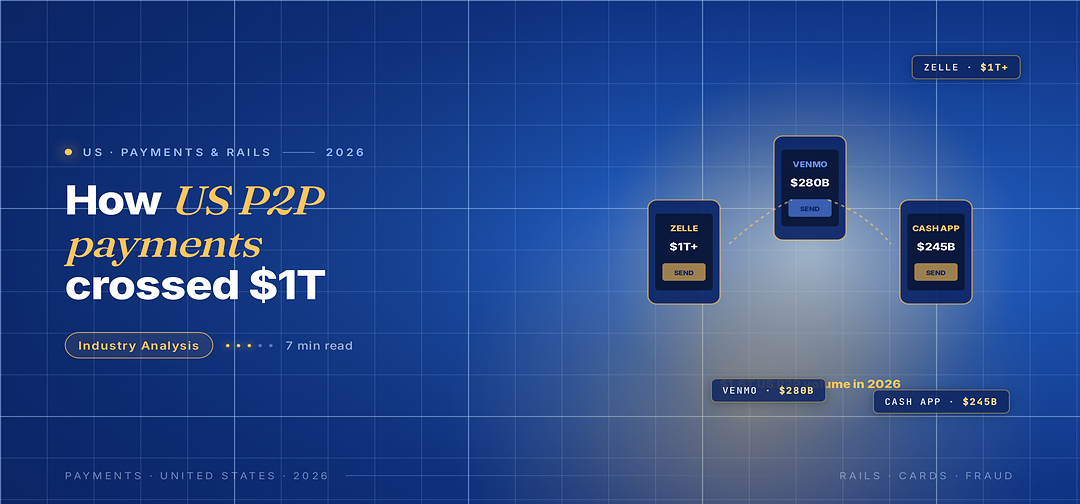
In February 2025 Zelle announced that its network had moved more than $1 trillion in payments during 2024, the first peer-to-peer platform ever to reach that mark, across 3.6 billion transactions on 151 million enrolled US accounts. The numbers come from Early Warning Services’ official Zelle press release. Venmo, owned by PayPal, processed roughly $69 billion in Q1 2024 alone, on the way to an annual total above $300 billion. Cash App, part of Block, ended 2024 with about 57 million monthly active users and reported $5.24 billion in Cash App gross profit for the year, up 21 per cent, per Block’s 2024 earnings reporting. PayPal’s overall peer-to-peer category exceeded $400 billion for the year. Together, US peer-to-peer payments are now a mature category measured in trillions, with growth still in the double digits.
How US P2P Took Over Daily Money Movement
The US P2P market began as a fragmented mix of email-based PayPal payments and bank-branded ACH transfers that took two to three business days. Venmo, founded in 2009 and acquired by PayPal through Braintree in 2013, popularised the social feed that made sending money feel like a chat. Zelle launched in 2017 as the US banking industry’s response, embedded directly into bank apps and reaching every major US deposit account on day one. Cash App, originating from Square’s consumer side in 2013, grew from a simple payment utility into a full-stack financial product by the early 2020s. Apple Cash and Google Pay’s P2P features have grown alongside, mostly inside their respective device ecosystems.
By 2024 each app had carved out a distinct strength. Zelle dominates bank-to-bank household payments, since it routes directly between deposit accounts at over 2,200 connected institutions. Venmo retains the social and discretionary-spending lead, with younger users sending small payments to friends. Cash App captures a younger and more financially active user base, with stronger engagement on adjacent products including investing, Cash App Card, and bitcoin features. Apple Cash and Google Pay sit smaller in total volume but well-integrated into iMessage and Google Wallet flows.
What Speed and Cost Look Like in 2025
Speed is no longer the differentiator that defined the category in 2017. Zelle, FedNow integrations, and Cash App balance transfers each operate at sub-30-second speeds for typical transactions. The exception is bank-to-app loading and unloading on Venmo and Cash App, which still uses ACH for instant deposits to external bank accounts unless the user pays a small fee for the instant-transfer feature. Standard P2P is free at the consumer level across all major US apps for in-network transfers. The fee surface is narrow: instant external transfers run in the low single-digit per cent range, credit-card-funded sends run higher, and business-account fees vary by app.
Fraud, Scams, and the New US Liability Frontier
Speed creates a known problem: a scammer who tricks a victim into sending money instantly is much harder to chase than one who tricks them into mailing a check. US regulators spent 2023 to 2025 pressuring banks and app operators to take more responsibility for authorised push-payment fraud, where the customer themselves initiated the transfer under false pretences. The Consumer Financial Protection Bureau has expanded its interpretation of Regulation E around investigation and partial restitution for many such cases, and Zelle has publicly committed to expanded reimbursement on certain categories of scams across the major banks on its network.
The industry response has been technological as much as policy-driven. Most US P2P apps now run real-time scam-pattern detection on outbound transfers, with warning prompts that increase friction based on signals like first-time recipient, transfer size, and behavioural anomalies. Zelle has surfaced enhanced confirmation steps for transfers to new contacts above certain thresholds. Cash App has added similar friction at the higher end of customer transfer ranges. These features add steps at the cost of the seamless speed that defined the product for years, and most users now accept the trade-off as the price of the network.
What Travels With the Money
US P2P apps are increasingly competing on what travels alongside the money rather than the money itself. Cash App offers in-app banking, investing, and bitcoin, with a US user able to buy fractional bitcoin from their P2P balance in seconds. Venmo offers crypto, a debit card with cashback, and small-business invoicing. Zelle integrates deeply with bank loyalty and credit-card rewards. Apple Cash and Google Pay tie into broader wallet ecosystems including transit, identity, and merchant payments. The lesson of 2024 to 2026 is that US P2P apps that stay narrow risk being commoditised, while those that broaden risk being treated as banks for regulatory purposes. The line between bank and non-bank in US consumer financial services is moving precisely because of products like these.
Identity verification is the most interesting adjacency. US P2P apps verify identity to higher standards than they did three years ago, partly under regulatory pressure and partly to support product expansion into investing, lending, and crypto. Cash App and Venmo apply tiered KYC to higher-limit sends. Zelle, since it sits inside bank apps, inherits the bank’s KYC. The convergence with identity is what makes US P2P apps the natural home for things like government benefit distribution, refund payouts, and small-business invoice payments, all of which are growing as use cases.
| App | 2024 volume | Transactions | Users | Primary source |
|---|---|---|---|---|
| Zelle | $1 trillion | 3.6 billion | 151 million enrolled accounts | Early Warning Services |
| Venmo | ~$300+ billion (annualised; $69 billion in Q1 2024 alone) | — | ~68.3 million monthly active users | Business of Apps roundup of Block/PayPal earnings |
| Cash App | Cash App gross profit $5.24 billion (Block 2024) | — | ~57 million monthly active users | Business of Apps, citing Block FY24 |
| PayPal P2P | >$400 billion | — | — | PayPal Q4 2024 earnings |
Venmo, Cash App, and PayPal figures come from each parent company’s 2024 earnings disclosures aggregated by the Business of Apps tracker.
What to Watch Through 2027
Three trends will shape US P2P payments through 2027. First, the GENIUS Act stablecoin framework signed in July 2025 has cleared the regulatory ground for US-issued stablecoins, and several P2P apps will likely add stablecoin transfers as a native option for cross-border use cases. PayPal already operates its PYUSD stablecoin and has integrated it into PayPal product flows. Second, the CFPB’s ongoing larger-participant supervision of US P2P apps will continue to set the operational baseline for fraud handling and customer-recourse expectations. Third, the embedded finance trend is pulling P2P-style instant payouts into software platforms that serve gig workers, freelancers, and small businesses. The infrastructure is there: most embedded-finance platforms now route through Zelle, RTP, or FedNow. The question is whether consumer-app brands extend into that space or whether embedded platforms commoditise the experience entirely.
The interesting US P2P question for 2026 is no longer how fast money moves. It is whose brand the user trusts when something goes wrong, and what else lives inside the app once the money has moved.






Comment