The owner of a regional bakery chain in Ohio does not think about digital advertising in the same terms as the vice-president of media at a Fortune 500 consumer goods company. The bakery owner thinks about whether the $800 she spent on Meta campaigns last month generated enough new customers to justify the next month’s budget. The media VP thinks about brand equity frameworks, cross-channel attribution methodologies, and the quarterly reviews she owes her board. These are different problems at different scales, and yet in 2025 both of them are participating in the same $362 billion US digital advertising market, using tools built on the same underlying platforms, and competing – indirectly – for the same consumer attention.
The inclusion of small and medium-sized enterprises at scale is one of the most commercially important and least-discussed aspects of US digital advertising’s sustained growth. The market’s ability to sustain double-digit percentage expansion at the $362 billion level has been driven, in meaningful part, by the addition of millions of businesses that were not participating in digital advertising at all five years ago. The democratisation of digital advertising access through AI-powered self-serve tools represents one of the structural growth drivers that analysts most consistently underestimated when projecting the market’s trajectory.
How Big the SMB Advertising Market Actually Is
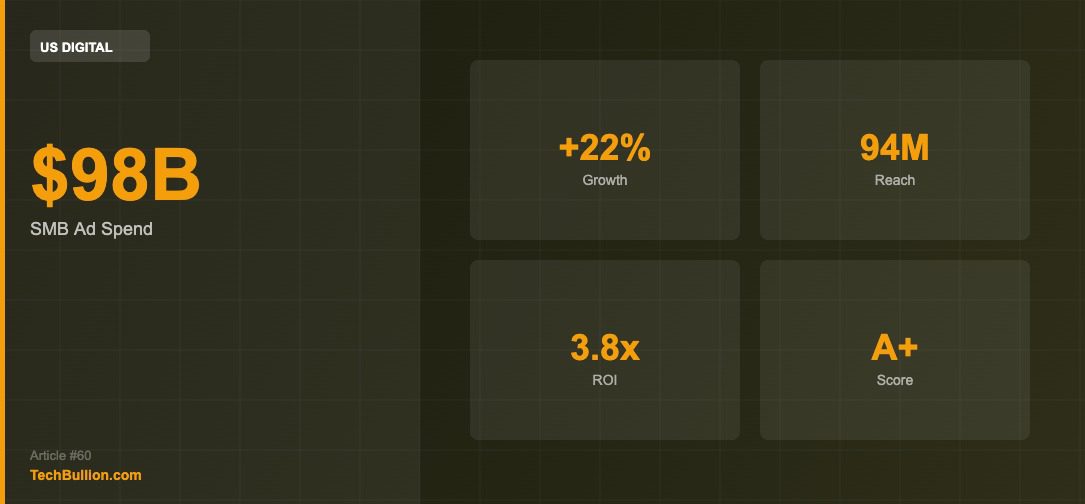
Precise data on SMB digital advertising spend is difficult to obtain because the category is defined inconsistently across different research methodologies. The most credible industry estimates suggest that businesses with fewer than 500 employees collectively account for approximately 27 per cent of total US digital advertising spend, or roughly $98 billion of the $362 billion 2025 total. That figure includes micro-businesses spending $200 per month on Facebook ads, mid-sized regional businesses with dedicated digital marketing budgets in the $50,000 to $500,000 annual range, and everything in between.
The headline number is less important than the growth rate. SMB digital advertising spend grew at approximately 22 per cent in 2025, nearly double the overall market growth rate of 13 per cent, driven by the continued expansion of AI-powered tools that reduce the expertise threshold required to run effective digital campaigns. As explored in TechBullion’s analysis of the structural drivers of US digital advertising growth, SMB democratisation is one of the three primary budget pools sustaining above-market-expectation growth rates.
| Business Size | Est. 2025 Digital Ad Spend | YoY Growth | Primary Platform |
|---|---|---|---|
| Enterprise (1,000+ employees) | ~$152 billion | +9% | Programmatic, CTV, retail media |
| Mid-market (100-999 employees) | ~$112 billion | +13% | Search, social, some retail media |
| Small business (10-99 employees) | ~$65 billion | +22% | Meta, Google Search, TikTok |
| Micro/local (under 10 employees) | ~$33 billion | +38% | Meta Advantage+, Google PMax |
The AI Automation Unlock
The growth of SMB digital advertising is inseparable from the development of AI-powered campaign automation tools that have materially changed what is required to run effective digital advertising campaigns.
Meta’s Advantage+ suite automates virtually every element of campaign management that previously required specialist knowledge. The advertiser provides creative assets and a defined objective, and Advantage+ handles audience targeting, creative testing, placement optimisation, and budget allocation automatically. For a small business owner who previously found Facebook’s Ads Manager interface too complex to navigate confidently, Advantage+ represents a fundamental change in accessibility.
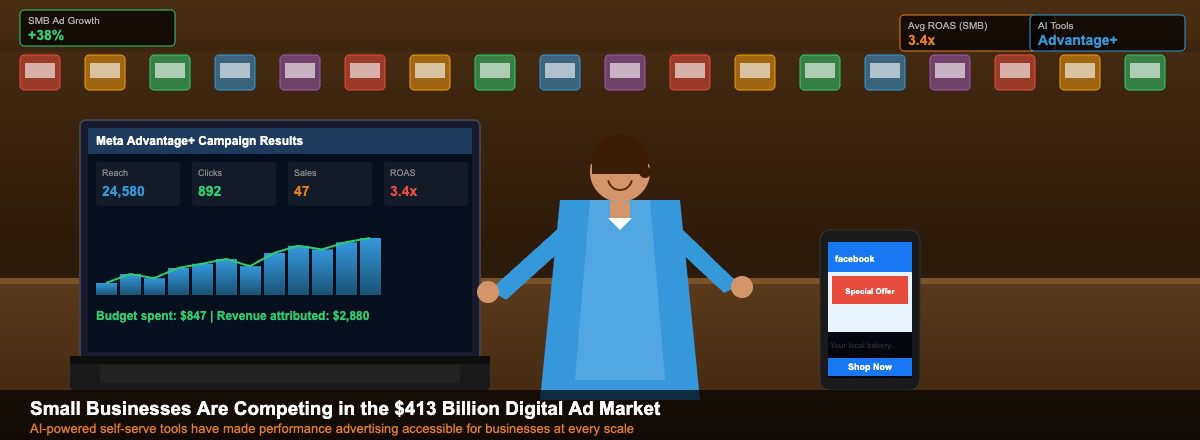
Google’s Performance Max operates on similar principles. A retail business creates a campaign, provides Google with its product feed and creative assets, and Performance Max automatically generates advertising across all of Google’s surfaces – Search, Shopping, YouTube, Display, Gmail, and Maps – optimising toward the conversion objective that the advertiser defines. When a small business that previously ran no digital advertising begins spending $1,500 per month through an AI-automated campaign, that budget is incremental to the total market. Across millions of small businesses, this additive effect has contributed meaningfully to sustaining market growth above the rates predicted from the behaviour of large advertisers alone.
Where SMBs Are Spending and Why
The platform distribution of SMB digital advertising spend reflects the accessibility and targeting capabilities of different platforms rather than simply their scale. Meta remains the dominant platform for SMB advertising, accounting for approximately 38 per cent of small business digital ad spend. The platform’s combination of demographic targeting, lookalike audience tools, and Advantage+ automation makes it accessible for businesses targeting consumer audiences regardless of category. The ability to start campaigns with modest daily budgets, pause and restart without penalty, and receive clear reporting on campaign outcomes makes Meta the default entry point for businesses entering digital advertising for the first time.
Google Search captures a significant portion of SMB performance spend, particularly for businesses in service categories where purchase intent is expressed through search queries. Local services advertising, which allows service businesses to advertise on a pay-per-lead basis, has grown substantially as a specific SMB-oriented product. TikTok’s growing share of SMB advertising reflects the platform’s effectiveness for product-based businesses targeting younger consumer demographics, where effective creative can achieve significant reach even at low spend levels.
The $413 Billion Market Needs SMBs to Keep Growing
The US digital advertising market’s trajectory toward $413 billion in 2026 and the $645 billion that forecasts suggest by 2029 depends substantially on the continued expansion of the SMB advertiser base. Large enterprise advertising budgets are significant but relatively predictable: they grow broadly in line with company revenues and are subject to the same budgetary cycles that have always governed large corporate marketing investment. SMB advertising, by contrast, is highly responsive to the quality of available tools.
| SMB Digital Advertising Driver | Current Status | Growth Potential to 2028 |
|---|---|---|
| AI automation accessibility | Rapidly improving | High – tools still maturing |
| New business formation | Post-pandemic recovery | Medium – macro-dependent |
| Platform self-serve improvement | Major investment by Meta, Google | High – ongoing development |
| Attribution and measurement | Still enterprise-dominated | Medium – emerging solutions |
When Meta or Google introduces a capability that meaningfully improves the ROI of small business campaigns, adoption can be rapid and the effect on total market demand can be substantial. The trajectory of AI campaign automation – which is still in relatively early stages of penetration across the full SMB market – suggests that this responsiveness will continue to drive above-market growth rates in the SMB segment for several years. For the digital advertising market as a whole, as explored in TechBullion’s analysis of the path to $645 billion by 2029, the SMB expansion story is one of the most reliable sources of incremental market demand available through the end of the decade. As covered in TechBullion’s overview of the AdTech investment outlook, the infrastructure serving the SMB advertising tier is among the highest-growth segments of the broader advertising technology market.
Related reading: The Shift to Digital | Performance Advertising in the US | US Digital Ad Forecast 2026 | AdTech Investment Outlook
Data from Statista’s digital market outlook shows that global digital spending continues to grow at double-digit rates, with mobile channels accounting for an increasingly dominant share of total transactions.
PwC’s analysis of financial services trends through 2025 highlights the convergence of technology and media as a defining dynamic, with data-driven personalisation becoming the primary competitive differentiator.