Creating a video with AI used to mean writing a prompt, waiting for a clip, and hoping nobody had three fingers. The workflow has changed quickly. Modern platforms can turn text, images, video, and even audio references into new content, while also adding avatars, editing, music, and advertising tools.
The market is growing because video is already a core business format. Wyzowl’s 2026 research found that 91% of businesses use video as a marketing tool, while 63% of video marketers said they had used AI video tools to create or edit marketing videos.
That does not mean every AI Video Generator is built for the same job. After comparing VEME, DeeVid, and VideoAI, I found that their biggest differences are not simply the number of features. They are the way each platform handles creation, control, editing, and the transition from an idea to a usable video.
The Real Question: What Are You Trying to Make?
Before comparing tools, it helps to define the job.
A social media creator may want a quick vertical clip. A marketer may need ten variations of a product ad. A designer may already have a carefully prepared image and only need convincing motion.
These are very different workflows.
That is why I would avoid asking, “Which AI video generator is the best?” A better question is, “Which one makes my particular production process easier?”
1. VEME: A Broad Toolbox for Mixed Media Projects
VEME takes an all-in-one approach. Its current platform supports text-to-video, image-to-video, video extension, avatars, scene generation, video editing, image generation, image upscaling, background changes, and style transfer.
The first thing I noticed is that VEME does not treat video as an isolated task. You can start with an image, animate it, extend the clip, and then move into other visual tasks without leaving the same broader environment.
Where VEME Fits Best
VEME makes sense for creators who regularly switch between different types of content. Think of a small marketing team preparing a product launch with social clips, product visuals, ad variations, and supporting images.
Its text-to-video workflow also provides access to several models, including Sora, Veo, Kling, Seedance, and Wan. That gives users more than one generation route when a particular model does not produce the desired result.
The image-to-video workflow is another practical feature. Instead of asking an AI video generator to invent a product from scratch, you can begin with an existing image and focus the prompt on movement.
One Useful Advantage: Continuation
VEME also provides video extension. This matters because generated clips are often shorter than the finished content a creator actually needs.
For a social advertisement, extending a usable shot can be more convenient than starting over. It is a small feature, but it addresses a very real production problem.
The Trade-Off
Breadth can also mean more things to explore. If you only want a simple text-to-video workflow, VEME’s larger creative ecosystem may offer more tools than you need.
That is not necessarily a weakness. It simply makes VEME more interesting for users who want one place for several visual tasks.
2. DeeVid: Moving From Generation Toward an AI Director
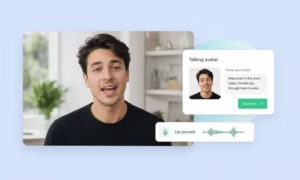
DeeVid AI takes the all-in-one idea a step further by positioning its AI agent as part of the production workflow. The platform supports text-to-video, image-to-video, video-to-video, reference-to-video, AI ads, avatars, text-to-speech, music, and video editing.
Its current interface also accepts multiple input types. Users can work with text, images, video, and audio rather than relying on a text prompt alone.
Why This Is Interesting
The interesting part is not simply that DeeVid has many tools. It is the attempt to make the AI handle more of the production process.
Its AI director workflow is designed to plan, create, and iterate from a brief. The platform also includes a canvas-based editing experience where users can adjust generated content rather than treating the first generation as the final answer.
That could be useful for someone who thinks in terms of:
“Make me a product video.”
rather than:
“First generate five images, then animate them, then create voiceover, then find music, then edit everything.”
A Stronger Fit for Complex Briefs
DeeVid becomes particularly interesting when a project involves several assets. Its AI advertising workflow, avatar generation, text-to-speech, and music tools can cover several stages of a marketing video in one platform.
Its reference-to-video workflow also supports multiple uploaded assets, which gives creators more ways to guide the result.
Motion Control Adds Another Layer
DeeVid also offers a motion-control tool that uses a reference video and a character image to guide movement. This is a different use case from simply asking for “a person dancing” in a prompt.
For character-driven content, that distinction can matter.
The trade-off is that a more capable workflow can require more experimentation. Users who only need quick social clips may not need every available control.
3. VideoAI: A Multi-Model Playground for Video Creators
VideoAI takes a more model-focused approach. Its platform brings together video models including Kling, Wan, Seedance, and Veo, while also offering image models such as Nano Banana and Flux.
This changes the role of the platform.
Instead of asking only, “What prompt should I use?” you can also ask, “Which model should I use for this shot?”
Useful for Model Experimentation
That can be valuable when the same prompt produces very different results across models.
VideoAI’s own documentation positions Kling around longer motion, Seedance around more complex scenes and movement, and Veo around cinematic output. These are platform descriptions rather than independent benchmarks, so they should be treated as guidance rather than universal rankings.
Its image-to-video workflow uses Wan and Kling and lets users provide both a source image and a motion description. That makes it relevant for product images, illustrations, concept art, and other existing visual assets.
The Image Workflow Matters Too
VideoAI also connects image generation with video creation. Nano Banana and Flux can be used to create or refine visuals before they are moved into the video workflow.
That creates a simple pipeline:
Create the visual → refine the visual → animate the visual.
For creators who like testing different models, this is arguably more useful than having a single generation engine with limited alternatives.
4. Three Platforms, Three Different Ways to Work
The similarities are easy to spot.
VEME, DeeVid, and VideoAI all support modern AI video workflows. All three can work with text and images, and all three extend beyond basic generation into related image, audio, or editing functions.
The differences appear when you look at the user’s workflow.
VEME is broad and asset-oriented. It works well when video is one part of a larger visual production process.
DeeVid leans toward agent-assisted production. It is interesting for users who want AI to handle more of the journey from brief to finished content.
VideoAI is particularly appealing for model experimentation. It gives creators multiple generation engines and lets them decide which one fits a particular visual task.
None of these approaches is automatically superior.
5. For Social Media Creators: Speed Beats Complexity
If I were making several short videos every week, I would care less about having every possible setting and more about how quickly I could get from an idea to a publishable clip.
This is where workflow simplicity becomes important.
Wyzowl’s 2026 data shows that 69% of video marketers create social media videos, making social content the most common individual video marketing use case in its survey.
For this audience, VEME’s image-to-video and broader visual toolkit can be practical. VideoAI’s multiple models can also be useful when a creator wants to experiment with different visual results.
DeeVid adds another angle with templates, avatars, music, and AI-assisted creation.
The best choice here is usually the tool that requires the fewest detours.
6. For Marketing Teams: Variations Matter More Than One Perfect Clip
Marketing teams rarely need only one video.
They may need a product demo, a social teaser, several ad concepts, and different aspect ratios for different platforms.
That changes the evaluation criteria.
An AI video generator becomes more useful when it can support creative variation without forcing the team to rebuild every asset from zero.
VEME’s combination of image and video generation fits this kind of mixed campaign workflow. DeeVid goes further into AI ads and related production tools. VideoAI is useful when a team wants to test multiple generation models for different creative directions.
This is also where AI can complement, rather than replace, human creative decisions.
The AI can produce variations. People still decide which idea deserves the budget.
7. For Designers and Product Teams: Start With the Asset
Product designers often do not begin with a blank prompt.
They already have something.
It could be a product render, packaging image, interface mockup, character illustration, or campaign artwork.
For this workflow, image-to-video and reference-based generation may matter more than pure text-to-video.
VEME supports image-to-video for product creatives and campaign visuals. DeeVid offers image-to-video and reference-to-video workflows. VideoAI similarly lets users combine an existing image with a motion prompt.
That leads to a useful rule:
If you already have the visual identity, choose a workflow that protects it instead of asking the model to reinvent it.
8. What I Would Check Before Choosing Any AI Video Generator
After comparing these platforms, I would not start with the feature list.
I would run the same small test across each tool.
Use one product image. Write one 10-second creative brief. Ask for the same visual style and output format.
Then measure four things: prompt effort, generation quality, revision effort, and export readiness.
The revision stage is especially important. A beautiful first result is not very useful if fixing one bad detail requires starting the entire generation again.
I would also check current credit limits and model availability before committing to a paid workflow. These details can change quickly, and the three platforms already show different combinations of models and usage plans.
Final Take: Choose the Workflow, Not the Feature Count
The AI video market is becoming crowded, but that does not mean every platform is competing for exactly the same user.
VEME makes sense for creators who want a broad visual workspace covering video, images, characters, audio, and editing.
DeeVid is worth considering for users who want a more agent-driven workflow that can combine generation, editing, advertising, avatars, voice, music, and multiple input types.
VideoAI is a natural fit for creators who value access to multiple video models and want to experiment with different generation engines.
The bigger lesson is simple. An AI video generator should not be judged only by how impressive one generated clip looks.
Judge the whole journey: idea, generation, revision, and final use.
The tool that fits that journey will usually be more valuable than the one with the longest feature list.