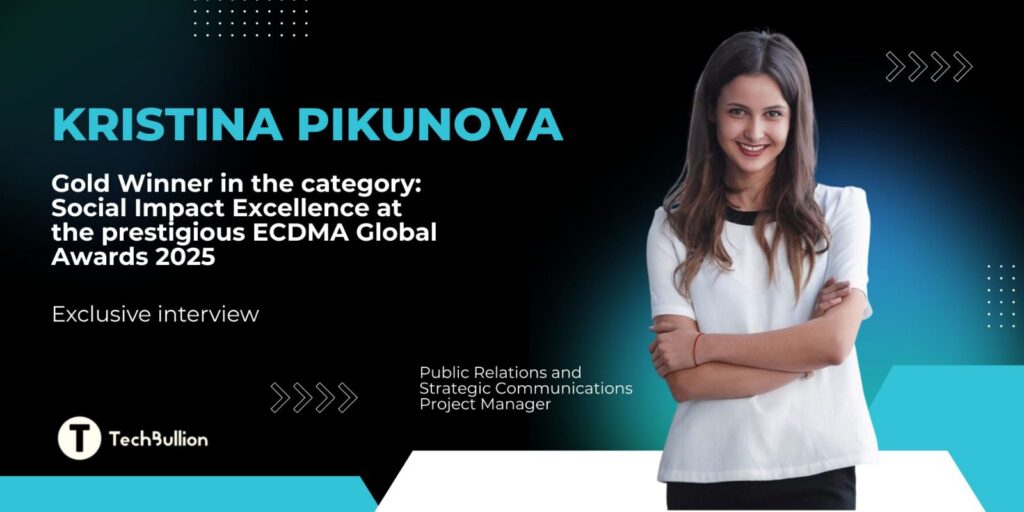
She produced 40 videos for Russian federal television, ran campaigns that drew 110,000 supporters, and built a company generating $1.7 million in revenue. Then she moved to the United States and started helping immigrants understand health insurance forms.
Kristina Pikunova’s career spans strategic communications, public affairs, academic research, and social-impact initiatives across two countries. Over the past decade, she has worked on large-scale municipal, regional, and nationwide communication campaigns, published peer-reviewed research on political communications and AI ethics, and received international recognition for her work in social-impact communications. Now based in Los Angeles, she focuses on developing communication tools that help immigrant families navigate complex institutional systems with greater clarity and confidence.
The bridge between those two worlds is narrower than it looks. Pikunova, 32, has spent her entire professional life doing one thing — figuring out how to make large groups of people understand something clearly and act on it. Whether the audience was 80,000 residents attending public hearings about housing renovation in Moscow or a single immigrant mother trying to decode the American school enrollment process, the underlying skill set is the same: clarity, structure, and relentless attention to how information actually reaches people.
Her outstanding achievements across political communications, academic research, and social-impact design have earned recognition from institutions ranging from the Central Election Commission of Russia to the E-Commerce and Digital Marketing Association, whose jury of executives from Google, adidas, Deloitte, and Microsoft awarded her Gold in Social Impact Excellence at their 2025 Global Awards. She is a member of the Russian Public Relations Association, has served as a jury member for governmental competitions in social advertising, and has published three scholarly articles in peer-reviewed journals — all while running her own company remotely across two continents.
You started your career in private banking, serving VIP clients at Petrocommerce Bank. That seems like a different universe from political PR. How did you end up in communications?
It was not a straight line, no. At Petrocommerce, my job was to make very wealthy, very demanding people feel that everything around them was handled perfectly. I organized meetings, managed events for VIP clients, prepared materials for senior management. Over two years, I ran more than 40 exclusive events and client meetings. What I did not realize at the time was that I was learning the fundamentals of communications — how to control a message, how to manage expectations, how to handle a crisis at 11pm on a Friday when a client is unhappy. That skill set turned out to be directly transferable.
You left banking and moved to the Skazka Family Recreation Park as a PR Manager. From VIP banking to a children’s amusement park — what was the logic there?
The logic was freedom. At the bank, I was supporting other people’s decisions. At Skazka, I could build something from scratch. I developed the PR strategy, ran social media, organized events, managed blogger partnerships. In my first year, park attendance went up 30 percent. We ran more than 30 themed events — contests, celebrations, shows. I brought in over 50 bloggers and influencers. We created flash mobs and viral activations that put the park on the map in Moscow. That experience taught me how to generate measurable results with limited budgets, and it made me realize that PR was not just a support function. It could drive the entire business.
After Skazka, you went freelance. Your portfolio from that period includes the Boxing Day celebration on Manezhnaya Square — 20,000 attendees — and the first GTC 01 MMA tournament. Those are very different from a family park. How did you pivot to combat sports?
When you are freelance, you go where the work is interesting. The Boxing Federation of Russia approached me for the Boxing Day event on July 22, 2018. It was a public celebration on one of Moscow’s most visible public squares. We needed 20,000 people to show up, and we needed positive media coverage. More than 5,000 people participated in an open boxing training session right there on Manezhnaya Square. We got over 100 media mentions, all with positive sentiment. The Federation’s president, Mr. Kremlev, personally signed a certificate of appreciation for the work. The GTC tournament was different — smaller venue, 1,890 people in a 2,000-seat arena at Crocus Expo — but it was a live broadcast on MATCH and MATCH.FIGHTER, which meant the stakes were national. Over 20 media mentions, all positive. Those projects proved I could handle high-visibility, high-pressure events where failure is public and immediate.
That brings us to 2018 and a leading strategic communications agency. Walk me through what the organization did and your role there.
The agency specialized in strategic communications, public affairs, reputation management, and large-scale communication campaigns across multiple industries. Its work focused on helping organizations strengthen public engagement, develop communication strategies, and build effective brand positioning.I joined the organization in June 2018 in an operations and communications support role. My responsibilities included executive coordination, media analysis, strategic communications support, event organization, and monitoring media and information trends related to ongoing projects. I also contributed to internal and external communications initiatives and supported the development of communication strategies.In February 2020, I was promoted to Head of Public Relations Projects, where I led communication campaigns, strategic messaging initiatives, and public engagement projects.
Your first major project at the agency was the Moscow Mayoral Election in 2018, supporting a major Moscow public communication campaign. You were 24 years old. What was it like stepping into a campaign at that level?
Terrifying and exhilarating. The Moscow mayoral race is one of the highest-profile political events in Russia. We were tasked with increasing loyalty among Moscow residents toward the candidate. As part of the strategy, we created a public movement called “For Sobyanin” and launched a dedicated website that we updated daily with news articles, video content featuring opinion leaders, event announcements, and competitions. Over two months, we organized more than 10 large-scale public events with participation from titled athletes, business leaders, popular TV hosts, and performers. All of them received significant media coverage. In total, more than 5,000 people attended the events in support of the candidate. For me personally, it was the moment I understood what political communications actually means at scale. Every decision had consequences. Every message had to land.
The following year, you were involved in a major regional public communication campaign in Saint Petersburg. The numbers on that project are staggering.
That campaign was the largest project I had been part of up to that point. We provided organizational and methodological support for more than 500 events with the candidate’s participation, all aimed at increasing loyalty among the target audience. The total number of event participants exceeded 110,000 people. Combined with strong media support, Mr. Beglov reached first place in the Medialogia media ranking of governors, holding that position from April 2019 through July 2019. Medialogia is the leading media monitoring and analysis system in Russia, so that ranking was a concrete, measurable result of the campaign’s communication strategy.
110,000 participants across 500 events in a single campaign. What does the logistics of that even look like?
Controlled chaos is the honest answer. You are coordinating venues, speakers, media, security, local authorities, volunteers — all across an entire city the size of Saint Petersburg. Every event has to feel organic, not staged. Every interaction with the candidate has to be managed so that the message stays consistent across hundreds of touchpoints. My role was to ensure organizational and methodological support, which means I was the person making sure every event had a clear purpose, a clear audience, and a clear outcome. When you are running 500 events over seven months, there is no margin for sloppy work.
You also received a certificate of appreciation personally signed by Governor Beglov and the Secretary General of the Russian Boxing Federation after the campaign. What did that recognition mean to you?
Certificates from government officials in Russia are not participation trophies. They are issued for specific contributions to specific outcomes. Receiving one from the Governor of Saint Petersburg — the second-largest city in Russia — after a successful campaign was a professional milestone. I have similar certificates from the Boxing Federation of Russia, signed by Mr. Kremlev, and from the Eastern Administrative District of Moscow, signed by Mr. Aleshin, as well as recognition from the heads of several Moscow prefectures and district administrations. Each one represents a project where the results were measurable and the stakes were real.
In 2019, you also took on the Moscow Housing Renovation Program information campaign. That is a very different kind of project from an election.
Very different, yes. This was not about a candidate. It was about explaining a massive, complex government program to millions of Moscow residents. We organized the public information center on 2nd Brestskaya Street. During its operation, we held 34 public events explaining the details of the renovation program. The center received 12,600 visitors in person. Our hotline processed 10,238 calls. We collected 1,546 proposals from residents. We conducted 17 in-person public hearings and 10 electronic public consultations with participation of more than 80,000 people. The media result: 1,366 publications with predominantly positive sentiment. That project taught me something important — communicating a government policy to the public is in many ways harder than running a political campaign, because you cannot rely on emotion or loyalty. You have to be clear, factual, and patient.
Then came 2020 and what might be the largest project of your career: a nationwide public information campaign related to constitutional amendments.
That was a project of truly national scope. The project required a unified communication strategy across multiple channels nationwide. We created the brandbook and guidebook that defined the visual and messaging identity across all channels. We developed more than 50 design layouts for visual and informational materials that were placed on various advertising platforms across the entire country, along with seven layouts specifically for outdoor advertising structures. But the biggest production task was video. We produced a full cycle of not fewer than 40 videos: informational materials, explanatory content about the amendments, explanations of the voting procedure, and mobilizing messages encouraging participation. Those videos were broadcast on 10 federal television channels — Channel One, Russia-1, Russia-24, TVC, Zvezda, OTR, NTV, REN-TV, Channel 5, and 360 degrees. Total airtime from June 5 to July 1 amounted to not fewer than 4,590 minutes. When you see your work playing on every major television channel in a country of 145 million people, simultaneously, across 11 time zones — that is a scale of communications that very few professionals ever experience.
Simultaneously, you worked on a parallel nationwide public engagement initiative. Was it difficult managing parallel projects on the same theme?
Strict compartmentalization was the only way. The parallel project had its own communication identity and messaging strategy. We developed 13 outdoor advertising layouts distributed across multiple regions, prepared scripts informed by sociological research, and produced 18 videos — including staged productions featuring opinion leaders and stand-up formats with participants from different regions. The materials were broadcast across major federal television networks nationwide from March 21 to June 2, 2020, generating more than 3,580 minutes of airtime. The two initiatives were complementary but operationally distinct. Managing both required understanding different communication objectives while maintaining consistency across a highly dynamic media environment.
In 2021, you participated in another nationwide voter information campaign. By this point, you had developed deep expertise in large-scale public communication campaigns operating in high-pressure media environments.
The 2021 project focused specifically on voter turnout. We developed scripts, produced 14 videos in two categories including staged videos with opinion leaders, and broadcast them during the election campaign period across the same network of federal channels. By this point, I had worked on campaigns at every level — municipal, regional, and federal. Each level has its own dynamics, its own stakeholders, and its own pressure. Working at the federal level taught me how to operate in environments with intense information and media pressure, high uncertainty, and zero tolerance for error.
You also played a key role in Mikhail Yevraev’s gubernatorial campaign in Yaroslavl. Tell us about your work on that campaign.
In Mr. Yevraev’s campaign, I participated in shaping the overall communication strategy and developed PR projects aimed at increasing voter loyalty. My area of responsibility included developing concepts for public initiatives, the content agenda, preparing communication materials, and adapting messaging based on audience reactions and the evolving information landscape. I worked at the intersection of strategy and hands-on execution: translating the campaign’s strategic objectives into specific communication formats — events, content, visual solutions, and media hooks — that built trust and engagement among voters. The goal was to transform communication channels into a genuine dialogue between the authorities and the public, increasing trust while anticipating crises and responding before they escalated.
While managing all of this, you also became General Director of LLC SHNM in 2020. The company’s revenue reached 126 million rubles — approximately $1.7 million — in 2021. What does SHNM do?
SHNM provides services related to informing the population. Depending on a project’s objectives, we use different approaches and tools to deliver information to target audiences effectively. The work spans everything from public information campaigns to audience engagement strategies. Running the company while simultaneously managing large-scale public communication projects required organizational discipline that I did not fully appreciate until I was deep in it. The company operates remotely, which means I had to build systems that worked without physical oversight — clear processes, clear accountability, clear outcomes.
$1.7 million in revenue for a single year at a company you launched at age 26. What made that kind of growth possible?
Two things. By 2020, I had accumulated enough expertise and enough professional relationships that client acquisition was organic rather than forced. People came to us because they had seen our results on federal projects. And I obsessed over operational efficiency from day one. A small company cannot afford waste. Every ruble of overhead that does not contribute to delivery is a ruble lost. That discipline kept margins healthy and allowed reinvestment into capacity.
Around this time, you also joined the Russian Public Relations Association — RASO. What does membership in a professional association mean in the Russian PR market?
RASO is the principal professional association for public relations practitioners in Russia. Membership is a professional affirmation — it signals that you meet the standards of the industry’s self-governing body. For me, joining was also about contributing to the profession beyond individual projects. Membership connects you to a community that is actively shaping ethical standards, best practices, and professional development for the entire field.
You have published three peer-reviewed academic articles. The first is “Artificial Intelligence in Political Technologies: Ethical and Technological Challenges” in Social and Humanitarian Knowledge. Why did a practitioner with your workload decide to write academic papers?
Because I was watching AI transform my own field in real time, and the conversation about it was either too optimistic or too fearful. Nobody was grounding it in the practical reality of how political communications actually work. I have spent a decade doing this work. I know where the pressure points are, where the ethical risks are, and where AI can genuinely improve outcomes versus where it creates new dangers. That first paper explores those tensions — the efficiency gains that AI brings to campaign messaging, targeting, and media monitoring versus the risks of deepfakes, algorithmic manipulation, and the erosion of public trust. I felt a responsibility to bring a practitioner’s perspective into the academic conversation.
Your second paper, “The Influence of Social Media on Modern Political Campaigns,” appeared in the same journal. What ground does it cover?
That paper examines strategies, efficiency, and ethical dimensions of social media’s role in political campaigns. Social media has fundamentally changed how campaigns operate — I experienced that shift firsthand between 2017 and 2021. The paper draws on both published research and my own professional experience to analyze what works, what fails, and what the ethical boundaries should be. It appeared in Social and Humanitarian Knowledge Journal.
The third paper, published in Society: Politics, Economics, Law, is titled “Political Technologies in the Post-Truth Era: Challenges and Prospects for Democratic Institutions.” That is a provocative title.
Deliberately so. The post-truth problem is real, and it affects every democracy differently. The paper examines how political technologies — the tools and techniques professionals like me use every day — interact with an information environment where factual accuracy competes with emotional resonance. How do democratic institutions survive when the tools designed to inform voters can also be used to deceive them? I do not pretend to have all the answers, but I believe practitioners have a responsibility to engage with these questions publicly rather than leaving them entirely to academics who may not have operational experience.
You have also served as a jury member for governmental competitions evaluating social advertising concepts. What does that role involve?
My role involves reviewing and scoring submissions for government-funded social advertising campaigns. These are campaigns designed to address public health, safety, civic engagement, and other socially significant topics. As a jury member, I evaluate the strategic quality of the concepts, the clarity of the messaging, the creativity of the execution, and the likelihood of actual impact on the target audience. I take it seriously because social advertising, when done poorly, wastes public money and public attention. When done well, it can save lives.
Let’s talk about the ECDMA Gold Awards. In May 2025, you were recognized as the Gold Winner in Social Impact Excellence at the ECDMA Global Awards. For readers who are not familiar, what is the ECDMA and what are these awards?
The ECDMA — the E-Commerce and Digital Marketing Association — is a global membership-based organization founded in 2023. Their Global Awards are an international competition recognizing excellence across digital marketing, e-commerce, social impact, and related fields. The award attracted 356 participants from countries worldwide, including the United States, China, the United Kingdom, Spain, Thailand, and others. The judging panel includes executives and senior professionals from companies like Google, Alibaba, adidas, Deloitte, Microsoft, L’Oréal, and LVMH. Submissions go through a rigorous multi-stage evaluation scored on innovation, impact, execution, and category-specific criteria. Gold requires a score of 90 to 100 points out of 100.
What was the project that won Gold?
My Gold-winning project was an integration and navigation framework designed to support lawful immigrants through culturally adapted, step-by-step communication tools. It addresses real gaps in how immigrant families interact with American institutions — workplace communication, digital literacy, school-family interaction, financial and insurance literacy, everyday community participation. These are areas where misunderstanding leads to delayed adaptation, social exclusion, and systemic friction. The framework is preventive rather than reactive. Instead of waiting for problems to occur, it reduces the likelihood of miscommunication through clarity, structure, and accessible explanation.
The jury’s evaluation specifically noted the “dual value” of your framework. What does that mean?
Dual value means the framework benefits both sides of the equation. On one side, it supports immigrant families by giving them practical tools to navigate unfamiliar systems independently and confidently. On the other, it creates measurable benefits for employers, schools, and community organizations through improved interaction, reduced misunderstanding, and more efficient integration processes. The jury recognized that this is not charity work or one-sided advocacy. It is a system-level approach that improves outcomes for everyone involved. That balanced perspective was identified as a key reason the project received Gold recognition.
The ECDMA award letter states that your recognition is based not on a single initiative in isolation, but on a “professionally consistent profile combining long-term public communication experience, analytical depth, and applied social responsibility.” How do you interpret that?
As acknowledgment that my social-impact work is not a side project or a departure from my career. It is the logical continuation of everything I have done for the past decade. The skills I developed running campaigns for the Central Election Commission or organizing 500 events for a gubernatorial candidate — those same skills are what make the immigrant integration framework effective. Understanding how information reaches people, how to structure messaging for diverse audiences, how to design communication systems that work at scale — that is my expertise, and it applies whether the audience is 145 million Russian voters or a single family arriving in Los Angeles.
The ECDMA Global Awards operate at the intersection of communication clarity, digital systems, and community engagement. Coverage of the awards appeared in Business Insider, the Associated Press, MarketWatch, Yahoo Finance, The Globe and Mail, and other major outlets. What does that level of media attention mean for the awards and the community behind them?
Surprised is the wrong word. The coverage was significant — publications like Business Insider, the Associated Press, MarketWatch, The Globe and Mail, Yahoo Finance, Apple News, Benzinga, the National Post, Digital Journal, and TechBullion all featured the awards. That level of visibility matters not because of prestige, but because it brings attention to the work being recognized. When major outlets cover the awards, it puts a spotlight on the fields, projects, and ideas behind each nomination — and that exposure creates more real-world impact than the award itself. The ECDMA Global Awards exist at the intersection of communication clarity, digital systems, and community engagement — and media coverage is what turns recognition into momentum.
How did you make the transition from large-scale public communications work in Russia to social-impact initiatives in the United States? Those seem like very different worlds.
Different in context, identical in structure. When I moved to the US, I recognized the same fundamental challenge I had spent years addressing throughout my career: information gaps between institutions and the people they serve. In one context, that gap appeared during large-scale public communication campaigns and major policy initiatives. In another, it exists between American systems — healthcare, education, employment, insurance — and immigrant communities trying to navigate them. The communication challenge is ultimately the same. People need clear, accessible information, but the systems around them are often fragmented or difficult to understand. My work focuses on building communication frameworks that make complex systems more understandable, accessible, and human-centered.
What was the most difficult part of that transition?
Language and culture are obvious challenges, but the hardest part was credibility. In Russia, I had a decade of results, a network, certificates signed by governors. In the United States, I was starting from zero in terms of professional recognition. Nobody cared about the Moscow mayoral race. I had to prove myself again, in a new language, in a new market, with a new set of rules. The ECDMA award helped because it is an international recognition evaluated by a global jury. But the real credibility came from the work itself — from building something that demonstrably addresses a real need.
You have been described as someone who “elevates communication from informational support to functional infrastructure.” Can you explain what that means in practice?
Most people think of communication as sending a message — writing an email, posting on social media, printing a brochure. That is informational support. Functional infrastructure means designing a system where information flows automatically, clearly, and at the right moment to the right person. When I developed the immigrant integration framework, I did not create a pamphlet. I designed a structured system with culturally adapted tools that guide people through specific processes step by step. It is the difference between telling someone “you should get health insurance” and giving them a tool that walks them through every question on the application form in their own cultural context. One is a message. The other is infrastructure.
Do you see AI playing a role in the kind of social-impact communication systems you are building?
AI will transform this field within five years. Machine translation is already making multilingual communication tools more accessible. Natural language processing can adapt the complexity of written materials to different literacy levels automatically. Chatbots can provide 24/7 guidance in multiple languages. But — and this is what my academic work addresses — AI also carries risks. An algorithm trained on biased data will produce biased outputs. A machine translation that mishandles legal terminology in an insurance form can cause real harm to a real family. The potential is enormous, but the implementation must be careful, ethical, and supervised by people who understand both the technology and the communities it serves.
After a decade in strategic communications, running a company, publishing academic research, winning an international award, and building a social-impact framework in a new country — what have you learned about persuasion that you did not know when you started?
That persuasion is overrated and clarity is underrated. Early in my career, I thought the goal was to convince people. After 10 years, I believe the real goal is to make information so clear that people can make informed decisions for themselves. The most effective communication projects I worked on — whether large-scale public campaigns or initiatives supporting immigrant families — succeeded not because we told people what to think, but because we removed barriers between people and the information they needed. When people understand something clearly, they make better decisions. That principle remains the same regardless of the country, audience, or communication environment.
What advice would you give to a young communications professional who wants to work at the scale you have experienced?
Three things. Learn to measure everything. Intuition is useful, but numbers are what keep clients and keep you honest. I can tell you exactly how many people attended every event I have ever run, how many media mentions we got, what the sentiment was. That discipline starts on day one. Never stop studying — I got my law diploma with honors, then my bachelor’s in PR, then I started publishing academic work. The field changes faster than any degree program can teach. And go where the pressure is highest. The Petrocommerce VIP department, nationwide public information campaigns and federal media projects— I consistently chose the hardest available assignment. That is how you grow.
You have a law diploma with honors. Has legal training influenced how you approach communications work?
More than most people realize. Legal training teaches you to construct an argument, anticipate counterarguments, and present evidence in a structured sequence. It teaches you that language is precise and that the wrong word can change an outcome. In crisis communications, legal awareness is essential — you need to know what can be said, what should not be said, and what the consequences of each choice are. My law background has saved me from mistakes more times than I can count.
Kristina Pikunova ends our conversation the way she began — with numbers. She mentions the 80,000 people who participated in public hearings for the Moscow renovation program, the 4,590 minutes of airtime on federal television, the 110,000 supporters at gubernatorial campaign events. But she also mentions a different number: the families she hopes her integration framework will help — to enroll a child in school for the first time, to file an insurance claim correctly, to understand a workplace safety protocol that might protect their lives.
The two sets of numbers exist in different worlds, measured in different currencies. For Pikunova, they represent the same thing: proof that communication, when designed with precision and delivered with care, changes how people experience the systems that govern their lives. Whether those systems involve large-scale public communication campaigns or American school enrollment forms, the principle holds. Clarity is not a luxury. It is infrastructure.