
Three Years After Sesame Joined the List, Kitchens Are Still Catching Up

Across American campuses this month, students are returning to dining halls where someone they will never meet will prepare most of their meals. For the large minority who live with a food allergy, that ordinary arrangement carries a risk that has grown quietly more complicated over the past three years.
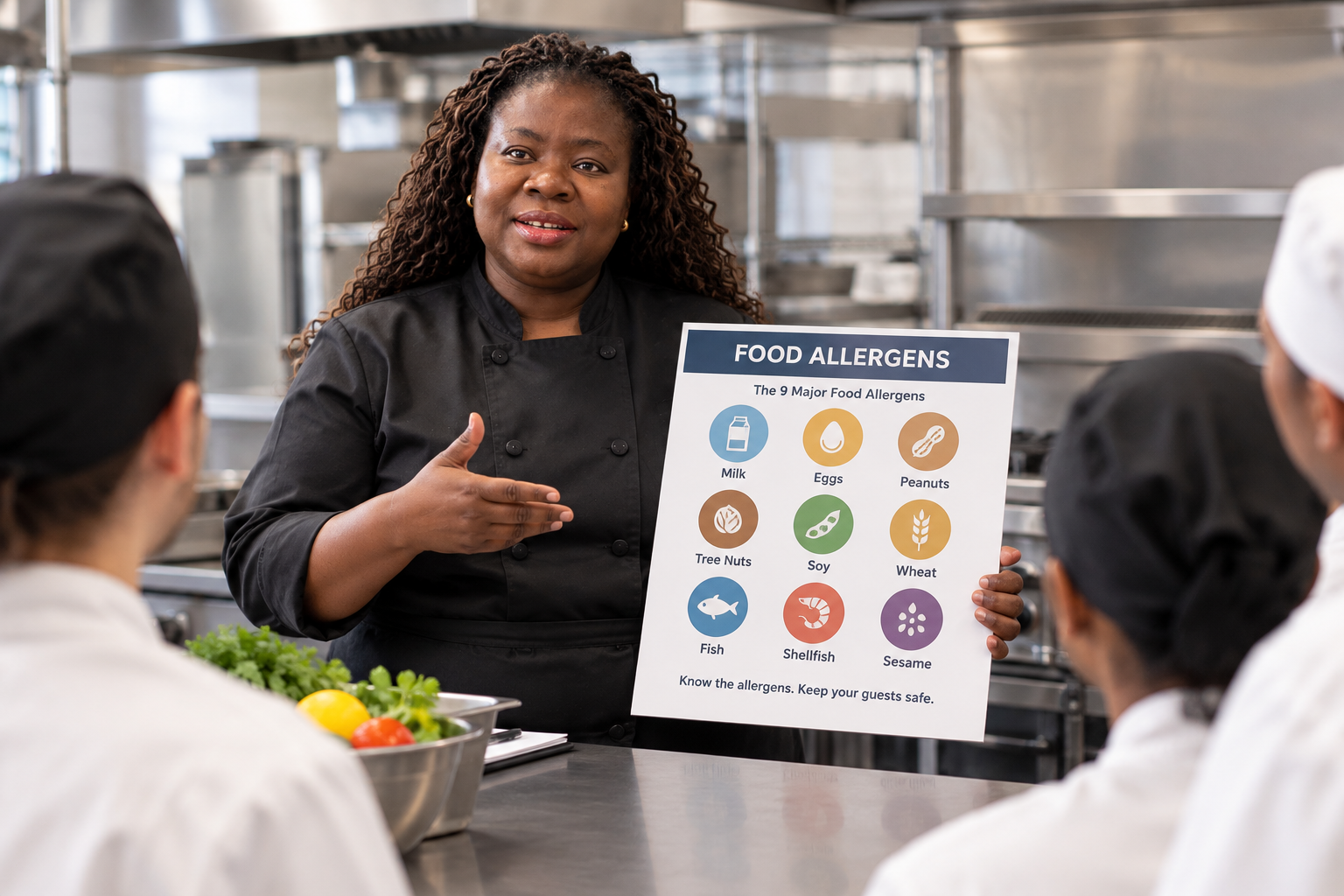
In January 2023, sesame became the ninth major food allergen in the United States under the Food Allergy Safety, Treatment, Education, and Research Act. The rule expanded what kitchens must declare and control. It did not expand anyone’s training hours, staffing, or budget.
Researchers who study how food handlers are trained say the consequences of that mismatch are now measurable, and that they hit hardest in institutional settings, university dining, school cafeterias, hospital kitchens, where people eat most of their meals in places they do not control.
“The ingredient landscape shifted underneath kitchens that had no idea it was moving,” said Ivy Nyantakyiwa Tsibuah, a food safety and allergen researcher at The Pennsylvania State University who published a systematic review of food handler training studies earlier this year. “A product that was safe two years ago may not be now. Nobody’s training hours expanded when the allergen list did.”
A gap between knowing and doing
Tsibuah’s review examined forty studies published between 2019 and 2026 across restaurants, hospitals, schools and university dining operations in thirteen countries. Its central finding is not that training is absent, but that it does not reliably translate into behavior.
In one reviewed study of restaurant workers, 97 percent reported washing their hands before handling food, while 81 percent were observed doing it. Approved hand drying dropped from 75 percent reported to 43 percent observed. In a study of 712 restaurant staff, food safety knowledge showed no significant direct effect on allergen management practice; workers’ attitudes did.
Allergen-specific competence lagged further. In one national sample, only 16 percent of food handlers could correctly identify all of the named major allergens. In another study, 86 percent of restaurants carried no allergen information on their food lists at all.
“A passing score measures recall in a quiet room,” Tsibuah said. “It does not measure what somebody does on a Tuesday lunch rush with a colleague out sick. We measure knowledge and then call it compliance, and those are not the same thing.”
The distinction matters because knowledge testing is how most of the industry documents that training occurred. Direct observation of practice is rarer, more labor-intensive, and, by the reviewed literature, considerably less flattering.
Where the risk actually sits
Foodborne illness remains a substantial public health burden. The Centers for Disease Control and Prevention estimates that contaminated food causes roughly 48 million illnesses, 128,000 hospitalizations, and 3,000 deaths in the United States each year, about one in six Americans sickened annually. Improper handling by food service workers is among the leading contributors in retail and food service settings.
Food allergy is a separate and growing concern. Advocacy organizations estimate that on the order of 33 million Americans live with food allergies, including roughly 5.6 million children. A recent survey on American campuses found that more than a quarter of students with food allergies reported experiencing a reaction in a campus dining hall, most often attributed to mislabeled allergens. The improvement those students requested most frequently was regular allergen training for dining staff.
Tsibuah, who works in high-volume institutional dining while completing a master’s degree in hospitality management, said the geography of the risk is often misread.
“People assume the danger is in the production kitchen, and production kitchens are actually the well-controlled part: procedures, temperature logs, supervision,” she said. “The serving line has a student worker, a crowd, and a spoon that has just been in something else. That is a service and communication problem, and it needs a different kind of training than the one we give it.”
The arithmetic of training hours
The constraint is sharpest in K-12 school nutrition, where federal requirements set the training. Under USDA Professional Standards, established through the Healthy, Hunger-Free Kids Act of 2010, school nutrition directors must complete twelve hours of training each year, managers ten, full-time staff six and part-time staff four.
Those hours must already accommodate procurement, civil rights, food safety, and nutrition standards. Allergen content competes for time that was fully allocated before sesame was added to the list.
“Asking for more hours is not a serious proposal, because nobody is going to grant them,” Tsibuah said. “The question is how to make the hours that already exist do more. Role-specific instead of one curriculum for everyone. Short and frequent instead of annual and long. And verified by watching people work rather than by testing them.”
Sesame presents a particular difficulty. It appears in bread formulations, spice blends, sauces and dressings, often without visual cue, and it is consistently the least recognized of the nine among food handlers. The 2023 rule also produced an outcome its drafters did not intend: rather than control for cross-contact, some manufacturers began adding sesame to products deliberately so that it could simply be declared on the label.
An international pattern
Tsibuah’s interest in the subject predates her work in the United States. Her undergraduate research at the University of Education, Winneba, in Ghana examined hygiene and food safety practices among traditional caterers at Market Circle in Takoradi, a workforce preparing food in volume for markets, events and institutions, largely outside formal regulatory oversight.
She found the same divergence there between what people knew and what they did, and says the comparison runs counter to a familiar framing.
“The caterers I studied were skilled people solving hard problems under real constraint,” she said. “The gap I documented in that market runs straight through American and European kitchens as well. What differs is the constraint, not the competence. I would resist any story where the knowledge simply flows from wealthy countries to poorer ones.”
What changes next
Researchers in the field point to mobile microlearning, short modules delivered on a phone, in a worker’s preferred language, close to the moment of use, as a better fit for a workforce that is mobile, multilingual and subject to high turnover. Digital observation tools that let a manager record practice during a routine walkthrough offer a route to the behavioral verification the literature says is missing.
Tsibuah is cautious about both.
“Technology is very good at generating documentation, and documentation is already what we over-rely on,” she said. “A completion certificate is not a safe practice. If these tools end up being used mainly to prove that training happened, they will make the gap harder to see rather than smaller.”
Success in her field, she noted, is invisible by design. It looks like nothing happening, repeatedly, for years.
“A hundred safe services earn nobody’s attention,” she said. “One failure is a child in an emergency room. That asymmetry is the whole reason the work matters.”
Ivy Nyantakyiwa Tsibuah is a ServSafe-certified food safety manager and AllerTrain-certified allergen specialist completing a Master of Professional Studies in Hospitality Management at The Pennsylvania State University. Her published research examines the effectiveness of food safety and allergen training among front-line food handlers.







Comment