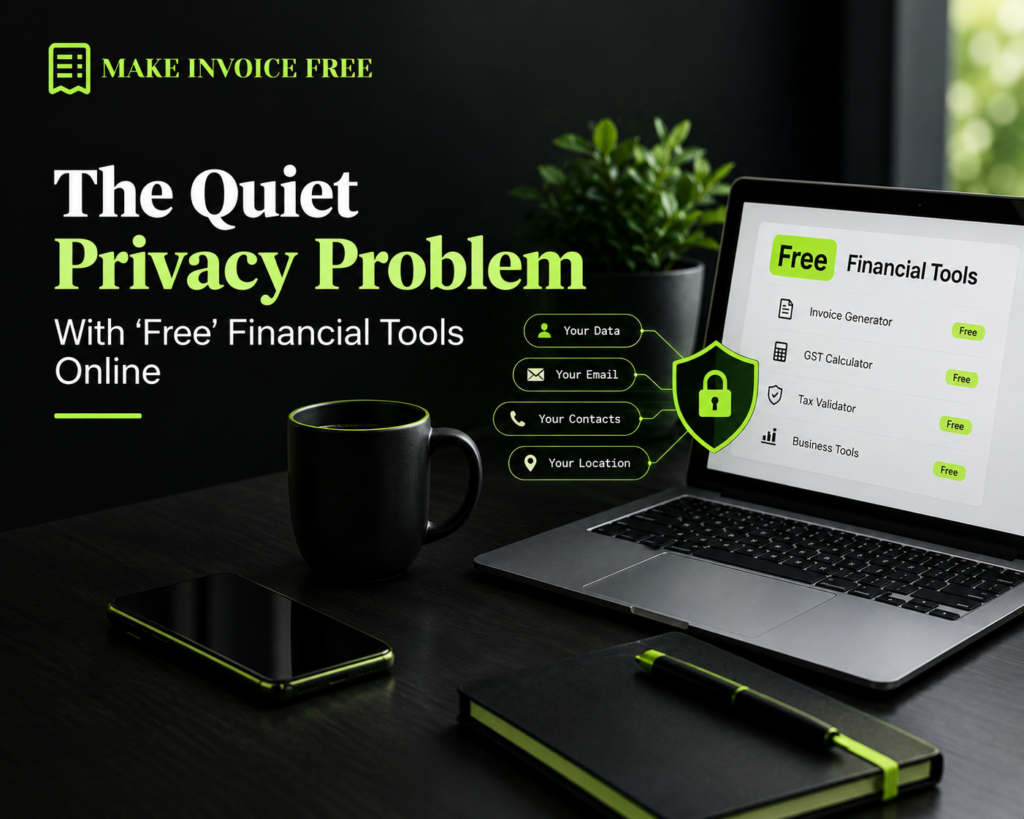
Every year, millions of Americans turn to the internet to handle a small but sensitive piece of their financial lives — creating an invoice, calculating a tax rate, tracking income from a side gig, figuring out what an hour of their time is actually worth. They search “free invoice generator” or “free tax calculator,” click the first reasonable-looking result, and start typing in details: a client’s name, a home address, a bank routing number, a dollar amount they’d rather not broadcast to the world.
Almost nobody stops to ask where that information goes.
That’s not a criticism of the people typing it in. It’s a reasonable assumption, honestly, that a small utility tool — the digital equivalent of a calculator — isn’t quietly building a file on you. But for a surprising number of “free” financial tools online, that assumption doesn’t hold up. And the gap between what people assume and what actually happens with their data is becoming one of the more overlooked privacy issues of the modern internet.
A Different Kind of Data Than People Realize
When most people think about online privacy, they think about social media, browsing history, or targeted ads. Financial documents don’t usually come to mind — but they probably should. An invoice contains a client’s full name, business name, address, and sometimes payment terms or banking details. A receipt shows exactly what someone bought and how much they paid for it. An income tracker, by definition, holds a running record of how much money a person actually makes.
This is not abstract data. It’s the kind of information that, in the wrong hands or the wrong database, could be used for anything from targeted scams to identity theft to simply being sold to data brokers who build profiles on freelancers and small business owners for marketing purposes.
And yet, this category of tool has largely escaped the privacy scrutiny that’s been applied to social platforms, browser extensions, and mobile apps. A free invoicing tool doesn’t feel like the kind of thing that needs a privacy policy read in full. It feels like digital paper. Fill it in, download it, move on.
How “Free” Often Actually Works ?
Here’s the part that doesn’t get discussed enough: running a website costs money, and free tools still need to pay for themselves somehow. There are a few common ways that happens, and not all of them are transparent to the person using the tool.
Some platforms genuinely give away a basic version of a tool and hope users eventually upgrade to a paid tier — a fairly honest model. Others process everything through their own servers, store what you enter in a database, and use that data (sometimes anonymized, sometimes not) to build customer profiles for advertising or resale. A smaller number lock you out after a handful of free uses, count on frustration to drive you toward a paywall, or stamp their own branding across your document unless you pay to remove it.
The problem is that from the user’s side, all of these models look identical at first glance. The page loads. The form is easy to fill in. Nothing about the interface tells you whether your information is being processed locally in your browser or shipped off to a server the moment you hit “generate.” Unless someone actively reads the fine print — and almost nobody does — there’s no way to tell the difference.
Why Freelancers and Small Businesses Are Especially Exposed
This issue lands hardest on exactly the group most likely to be using these tools: freelancers, gig workers, and small business owners. Unlike a large company with an internal finance department and IT security policies, an independent contractor or a one-person business is usually making these decisions alone, under time pressure, often on a laptop at a kitchen table.
Consider what a single freelancer might type into an invoicing tool over the course of a year: dozens of client names and addresses, project details that may be covered by an NDA, payment amounts that reveal exactly how much they charge and earn. A photographer might list a client’s home address for an on-location shoot. A consultant might include confidential project names in a line-item description. None of this is exotic information, but all of it adds up to a fairly detailed picture of somebody’s business — and their clients’ information, too.
If that data sits on a server somewhere, controlled by a company the freelancer has never vetted, that’s not a hypothetical risk. It’s simply a fact about where the information now lives, and how it could plausibly be used, shared, or exposed in a future data breach.
The Case for Tools That Never Touch a Server
There’s a simpler alternative that more people are starting to look for: tools that run entirely inside the browser, meaning the information you type in never leaves your device in the first place. No server storage means there’s nothing to breach, nothing to sell, and nothing sitting in a database somewhere waiting to be mishandled.
This is the model behind MakeInvoiceFree, a free finance toolkit built around the idea that everyday financial tools shouldn’t require handing anything over. Every tool on the platform works directly in the browser — no login, no account creation, and no data stored anywhere once the browser tab is closed.
The Free Invoice Generator is a good example of how that plays out in practice. A user fills in the standard invoice fields — client details, line items, totals — and the document is generated and downloaded without any of that information being transmitted to a server. The same logic applies to the Free Receipt Generator, which documents completed transactions the same way, entirely on the user’s own device.
The Real Time Income Tracker is arguably the most sensitive tool on the platform, since it deals directly with a running record of someone’s earnings — exactly the kind of information that, if stored elsewhere, could reveal a detailed financial picture of a person’s business. Keeping that calculation local to the browser means the running total genuinely belongs to the person using it, not to whoever owns the server.
Even something as simple as the Time to Money Calculator, which helps people figure out what their time is actually worth in dollar terms, follows the same pattern. It’s a small tool, but it still involves someone’s income assumptions and rate expectations — details that don’t need to exist anywhere beyond the person’s own screen.
None of these tools require an account, a login, or an email address. Once the tab closes, whatever was typed in is gone — not archived, not logged, not repurposed later for marketing.
Reading the Fine Print Nobody Reads
Part of the reason this issue persists is that most people simply don’t read privacy policies, and financial tool providers know it. A privacy policy buried at the bottom of a webpage, written in dense legal language, is technically disclosure — but it’s disclosure in a form almost nobody actually consumes. Studies on this behavior have shown that the vast majority of internet users skip privacy policies entirely, treating the “I agree” checkbox as a formality rather than a meaningful decision point.
This creates an uncomfortable dynamic: the businesses that store and monetize user data are almost always operating within their stated terms, but those terms were never realistically going to be read by the people agreeing to them. That’s not necessarily deception in a legal sense, but it does mean the average freelancer typing a client’s information into a random invoicing tool has no real understanding of what happens to that information next.
The more sustainable answer isn’t asking people to suddenly start reading privacy policies in full — that’s not going to happen at scale. It’s building tools where the privacy question becomes irrelevant, because there’s no data collection to disclose in the first place.
A Founder’s Perspective on Building Differently
Jatin Katariya, the founder behind MakeInvoiceFree, has spent years building free tools aimed at freelancers, startups, and small businesses, and has talked about a specific frustration that shaped how the platform was designed: too many “free” business tools quietly monetize the very users they claim to help, whether through data collection, aggressive upselling, or hidden limitations. His approach with MakeInvoiceFree was to strip that model out entirely — no server-side storage, no signup wall, no watermarking, and no email capture disguised as a “free trial.”
It’s a narrower business model than the alternative, and arguably a harder one to build a company around. But it reflects a growing expectation among freelancers and small business owners: that a basic financial utility shouldn’t require trusting a stranger’s server with sensitive business information just to generate a PDF.
What This Means Going Forward
The privacy conversation online has largely focused on the platforms people spend the most time on — social media, search engines, streaming services. Financial utility tools have mostly flown under the radar, treated as too small or too boring to warrant scrutiny. But scale changes that calculation. Millions of freelancers, gig workers, and small business owners are using these tools every single month, each one entering real names, real addresses, and real dollar amounts into forms with no clear indication of what happens next.
As more people build income outside traditional employment — a trend that shows no sign of slowing down — the tools they rely on for basic financial tasks deserve the same privacy scrutiny as any other piece of software touching personal data. The good news is that the fix isn’t complicated. It doesn’t require new regulation or a redesigned internet. It just requires more tools built the way they should have been from the start: processed on the user’s own device, with nothing kept, nothing sold, and nothing left behind once the tab closes.
About the Author
Jatin Katariya is a SaaS founder and digital marketing strategist who builds free, accessible finance tools for freelancers, startups, and small businesses. He is the founder of MakeInvoiceFree, a toolkit built around browser-based tools that require no signup and store no user data on a server.