
The Next Twenty Years of Gaming: How Technology Will Reshape Play, Work and Society, and What Aion 2 Reveals About the Business Model

Over the next 10 to 20 years, gaming is likely to change from an entertainment category into a general-purpose digital infrastructure. Industry outlooks point to advances in artificial intelligence, immersive hardware, cloud delivery and new creator economies that could spread game mechanics into education, healthcare, city management and cultural preservation. Many of the forecasts below are projections, not settled facts, and should be read that way.
One current title shows how the commercial side of this shift is playing out. NCSoft’s Aion 2, an Unreal Engine 5 MMORPG, passed KRW 100 billion in revenue within 46 days of its Korean launch and contributed KRW 136.8 billion, about $92 million, to NCSoft’s record first quarter of 2026. It launches globally on October 5.
1. AI Rebuilds the Game Production Pipeline
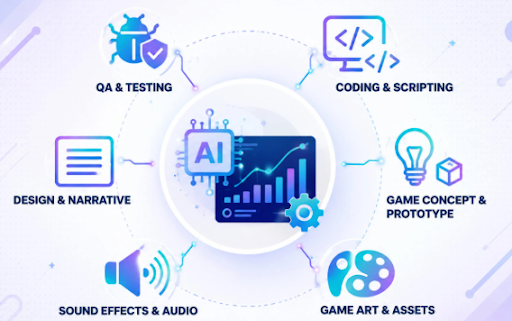
The most immediate change is generative AI. Forecasts suggest AI will give non-player characters autonomous decision-making, persistent memory, and dynamic storytelling. Procedural content generation could become up to a thousand times more efficient, cutting the time to build AAA-scale environments from months to hours. Adaptive systems could also read player behavior, and eventually biometric signals, to tune difficulty and narrative pacing in real time.
Aion 2 is not an AI-native game, but it shows why these tools matter commercially. NCSoft says its world is 36 times the size of the original game’s, built on Unreal Engine 5. Building and populating a world that large is expensive, and the payoff depends on keeping players engaged across it. Analysts noted in April that the game had held roughly 1.5 million daily active users near its launch levels. Cheaper content generation would lower the cost of that upkeep, which is why it is the first place studios are likely to apply AI.
2. Immersion and Delivery: From Light-Field Displays to 6G Cloud Gaming
Hardware forecasts are ambitious:
- Displays: Light-field technology could enable glasses-free 3D on new mobile devices around 2028.
- Brain-computer interfaces: Consumer versions are projected for around 2035, with multimodal feedback that could include temperature, touch and smell.
- Cloud gaming: 6G networks may push cloud rendering latency below 5 milliseconds, allowing 8K/240fps streaming to mobile devices. AI-assisted streaming could reduce bandwidth use by around 70%.
- The Aion 2 rollout shows where the market is today. The global launch is PC-only, through Steam and NCSoft’s PURPLE launcher. A console version has been confirmed for later, without a date. Cloud delivery and cross-platform architecture are what would let a title like this reach players on more devices without separate builds for each. That is the same long-term revenue extension the industry expects from better streaming infrastructure.
3. Content Ecosystems: Virtual Economies, Mixed Reality and Esports
Forecasts describe three connected shifts:
- Metaverse-style economies: Digital-twin game worlds could connect to real-world economies, forming virtual markets worth trillions. User-generated content platforms with film-grade tools could let amateur creators produce AAA-quality work, and assets and avatars could move between games.
- Mixed reality: AR glasses could eventually outsell smartphones, with location-based games taking a large share of outdoor entertainment as scanned environments become game boards.
- Esports: Esports could become an Olympic discipline, with competitive tracks generated dynamically in physical space.
- The economic side of this is already visible in Aion 2. More than one million characters bought memberships within the first 46 days. The global version reportedly uses a cosmetic-focused cash shop with no randomized loot boxes, and an optional membership that gates access to the player market. A player-driven economy with tiered access is a small-scale version of the virtual economies the long-range forecasts describe. Its seasonal structure, in which each season resets progression goals, also acts as a recurring revenue mechanism. Within that economy, Aion 2 Kinah serves as the in-game currency earned through play and used in auction-house trading, gear enhancement, and player-to-player commerce, giving the virtual market a measurable unit of value.
4. Narrative: From Fixed Storylines to Personalized Worlds
Some forecasts describe “quantum narrative engines” producing an astronomical number of story branches. Player behavior data would train personalized story models, so that each player gets a unique storyline. Multiverse-style structures would let parallel worlds coexist, with player choices permanently altering a world’s timeline.
Aion 2 takes a more grounded approach to a similar goal. Its Abyss is a faction-based PvPvE zone where player conflict, not scripted content, produces the stories. The global service runs on separate accounts and servers from the Korean and Taiwanese versions, and no progress carries over, so each server community develops its own history.
5. Beyond Entertainment: Education, Health, Governance and Heritage
The forecasts extend gaming into other sectors:
- Education: Projections claim gamified learning could raise completion rates by as much as 300% over traditional methods, and virtual universities could issue credentials. Simulated environments, such as fusion-reactor operation, could train specialists.
- Healthcare: Games that target neuroplasticity could become a mainstream depression therapy, possibly with regulatory approval.
- Governance: City-planning sandbox games could widen participation in public planning, and climate simulations could feed carbon-credit trading.
- Cultural heritage: Digital recreations of historical figures, simulations of cultural evolution and gaming communities could help revive endangered languages, with players acting as heritage custodians.
- These are the most speculative claims and the least tested. Figures such as the 300% learning gain and high-accuracy conflict prediction come from forecast documents, not peer-reviewed evidence, and will need validation.
6. Industry Structure: AI Agents, Smart Contracts and Regulation
The forecasts see production changing in several ways:
- AI agents could fill around 45% of development roles, moving human staff toward creative direction and oversight.
- Independent developers could publish through smart contracts that split revenue automatically, and player dividend models could distribute earnings by contribution.
- Devices could merge into programmable form factors with photonic chips, long-life biological batteries and 95%-efficient wireless charging.
- Regulation could grow to include neural-activity monitoring, addiction prevention, international treaties on immersive technology, AI ethics review boards, standardized taxation of virtual assets and blockchain-based traceability.
- As these systems mature, third-party services will become part of the wider game economy. In the case of Aion 2, resources such asthe MMOEXP platform illustrate how external sites can grow around a successful MMORPG by offering guides, currency-related information and player support, even as official monetization and market rules remain controlled by the publisher.
7. Challenges and Outlook
The forecasts also list serious obstacles: cognitive confusion from neural immersion, virtual-economy inflation from vast computing power, unresolved copyright for AI-created content, cybersecurity threats to brain-computer interfaces, and disputes over sovereignty in virtual worlds. By 2040, some forecasts say games could touch 90% of social activity, making “gamified living” a new normal. Whether that happens depends on balancing innovation with human welfare.
What to Watch
The business case for these technologies will be tested by products already in the market. NCSoft’s guidance shows the scale involved. It set a baseline 2026 revenue target of KRW 2 trillion, potentially rising to KRW 2.5 trillion, and management reiterated confidence in the higher figure after the first quarter. In 2025, revenue was KRW 1.5069 trillion.
Aion 2’s global performance after October 5 will show how far current MMO economics can carry a large-scale, technology-heavy world into Western markets, before the more speculative advances arrive. Its Early Access runs from September 30 to October 4, and the free-to-play launch follows on October 5. Early Access uptake, retention past the first month, and conversion to paid membership are the indicators worth tracking.






Comment