
B2BINPAY Powers Enterprise Crypto Payments with Multisig and Volume-Driven Pricing


- Crypto processing fees drop to 0.25% for coins and 0.35% for stablecoins as monthly volume grows above $5 million.
- B2BINPAY lets finance teams require several approvals for large crypto payouts and fast-track payouts to trusted, pre-approved addresses.
- Unlike card processing, B2BINPAY holds no rolling reserve and charges no service fee on crypto payouts except network one.
B2BINPAY, a licensed crypto payment and wallet infrastructure provider for forex brokers, iGaming and other businesses that move volume globally, offers enterprise clients a set of treasury controls together with pricing that decreases as transaction volume increases. Since its launch in 2017, the company has processed more than $7.9 billion across over 25.6 million transactions for more than 2,600 registered business clients.
“The first question we hear from businesses is usually not how much it costs, but why they need crypto at all. The answer is that part of their audience already pays this way, and if the cashier doesn’t offer it, those clients go to a competitor that does. Our job is to make crypto as routine for the finance team as any other payment method, with the approvals, limits and compliance checks they already expect,” said Alex Ryzhkin, Chief Commercial Officer at B2BINPAY.
The share of clients who already pay in crypto is far from marginal, and they tend to spend more. According to the SOFTSWISS research on betting industry, crypto accounted for 24.4% of the total bet sum in the first quarter of 2024, and the average crypto bet was about twice the size of the average fiat bet. Among brokers, Eightcap, a global trading fintech, said stablecoins make up 10% to 20% of its deposits worldwide.
Once businesses see those numbers, the conversation moves on to two practical questions: whether crypto payments are permitted in their markets, and what integration and day-to-day operation will cost.
Built for regulated operations
B2BINPAY operates as a regulated virtual asset service provider. It’s authorised by the National Commission of Digital Assets (CNAD) as a digital asset service provider and by the Central Reserve Bank of El Salvador as a bitcoin service provider.
Every client passes KYB verification. Clients, their controllers and beneficial owners are screened against global sanctions lists. After onboarding, each incoming transaction and account activity is screened for AML and KYT risks. This gives the merchant a documented compliance trail it can present to its own regulator and banking partners.
The screening happens before the money reaches the merchant’s balance. While a deposit is being checked, it stays pending. If a transaction scores 70% or higher on AML risk, it will be suspended and sent to compliance for manual review, which then either credits the funds or returns them to the sender. The risky funds will never reach the merchant’s wallet. Where needed, flagged transactions also go through a manual review by B2BINPAY’s compliance team.
Merchants with stricter internal policies can add their own Crystal or Chainalysis account as a second layer. Every incoming transfer then passes both checks, and the merchant sets its own risk thresholds for alerts and blocking.
Pricing that follows volume
B2BINPAY’s enterprise offering is aimed at companies that process large and frequent payment flows, such as forex and CFD brokers, iGaming and betting businesses, e-commerce and travel companies. Incoming processing fees depend on the asset type and on monthly volume, with separate scales for coins and for stablecoins:
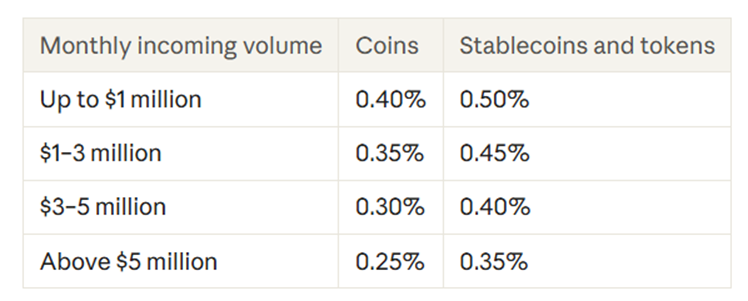
Outgoing crypto payouts carry no service commission, only the blockchain network fee. Crypto payouts carry no service fee, the merchant pays only the blockchain network fee. Card payments usually take one to three business days to land, according to Stripe, and up to 14 for high-risk accounts. So a merchant processing $2 million a month always has around $200,000 on the way. Crypto settlement with B2BINPAY is almost immediate, and even fiat settlement is faster (T+1) than transfers made by cards. Bank withdrawals pricing is set at 0.60% plus $35 via SWIFT or 0.50% plus €5 via SEPA.
Full control of Treasury
Security sits at the top of any finance team’s checklist, and in crypto the weakest link is a single point of access: one login, one laptop or one person able to move funds alone. In July 2025, attackers took about $44 million from the internal wallets of Indian crypto exchange CoinDCX. According to police, the breach began with malware on an employee’s work laptop, installed after he took on an online side job. B2BINPAY’s enterprise controls are built so that one compromised staff login is not enough to push a large payout through. Anything above the threshold waits for approval from the finance team, confirmed with a separate 2FA code.
On B2BINPAY’s enterprise wallets, Address whitelists work as a fast lane. Only the owner account can add a trusted destination, such as the company’s exchange account or a regular partner, and payouts to it skip threshold approvals. Payouts to any other address go through the usual approvals, and all of them, whitelisted or not, are still screened for AML risk.
Each person sees and operates only the wallets their role allows, and API users are kept apart from staff. Sending a payout takes a separate operation 2FA on top of the login one, and a change log shows who changed what and when.
Approval rules scale with the amount. A routine payout can go out with one approval, while a large transfer waits for three. Same-currency withdrawal requests don’t expire while they wait, so nobody has to rush the review of a big amount.
The result: routine withdrawals can run on autopilot, while large ones still stop in front of the people who should approve them.
Companies that would rather keep custody themselves can go a step further with B2BINPAY DeFi, a non-custodial product built on multisig. Each account has its own list of signers and a signature threshold, so no single person, and no single compromised device, can move funds.
Payouts, fund collections and any change to signers or thresholds go through only once enough signatures are collected. B2BINPAY never stores the private keys, and every action leaves a record on-chain. The product runs on Ethereum, Tron and other EVM-compatible networks.
Low cost of entry
A sandbox environment with testnet currencies lets a team run test payments, payouts and callbacks before going live. Once live, clients pay for incoming transactions only, with no minimum subscription plans.
Many of the doubts merchants still have about crypto processing date back to the market’s early years, when compliance was vague and a single private key could move a company’s funds. That picture no longer matches what licensed providers offer today. Nowadays, crypto is one more payment method at the cashier. It meets almost the same licensing, compliance and control requirements as cards and bank transfers, but it brings in clients those methods don’t reach.
Disclaimer: This material is not directed at, and does not constitute marketing, an offer or a solicitation of any regulated service to, persons in US/EU/EEA/UAE. Service availability, licensing and product scope depend on jurisdiction and applicable regulatory requirements. B2B only; onboarding is subject to KYB verification. For more information, please see our Legal Information and Disclaimers, Terms of Use and Privacy Policy which can be found at our website https://b2binpay.com







Comment