A Market that has outgrown its Racing roots
FPV flying began as a hobby for a few tinkerers, who were soldering up lightweight aircraft in their garages to race them for speed and the excitement of seeing things from the drone’s perspective. In 2026, the attitude of a scrappy, build-it-yourself culture has not changed, but the people who watch it have certainly changed. Current pilots are shooting social media content to race reports, building inspections, and creative video projects that can be far from the race. But manufacturers have responded with more comprehensive kits, clearer instructions, improved flight modes and cameras which can actually perform on a professional level.
None of that, however, means that FPV has become a mere camera-drone flying, though. It’s the immersion that still makes it special: You’re literally beholding the view from the inside of the plane as it happens, reacting in real time and flying routes that a GPS-guided drone would never dare to take. This is what makes FPV footage unique, fast, close, and physical. The more that become aware of that distinction, FPV is finding its niche in the aerial imaging world, not a shadow one.
What’s Pulling in New Pilots
There are some features that have made FPV much more attainable recently. The old analog equipment has been surpassed by digital video links, which provide much more reliable and much clearer video with less “lag” in the system. There are less headaches in assembling ready to fly kits, and flight-controller software has become more user-friendly. The stabilization now is also very good, which allows for smoothing out of footage without sacrificing the fluid and in-motion feel which is the reason for watching FPV in the first place.
Learning to fly is also made easier. Simulators allow novice pilots to crash as many times as they like before getting their hands on real planes, and tutorials and recorded flights are plenty to learn from. The parts are more readily available and the sizes have become more standardized, and of course, someone looking for an FPV Drone can now compare full builds, though they would have to have an electronics degree first, considering the intended use, video system, and specs.
Racing continues to push the technology forward.
Despite the increasing popularity of the hobby, racing remains important. In competition, near-zero latency and hit-and-hurtless flight are essential: pilots have to be able to handle the equipment with precision, accelerate quickly, communicate on radio without dropping, and withstand the impact of constant crashes. Much of the technology that is developed to satisfy those demands eventually permeates into the consumer and filming equipment. More powerful motors, lighter parts, improved props and more responsive flight software — all of these are of benefit to the filmmakers who have never raced a gate in their life.
Freestyle has evolved into an art form.
Freestyle is the term used for the position between racing and cinematography. Flight maneuvers, such as rolls, dives, gap shots and abrupt turns, are a visual translation of the environment. To achieve that, a freestyle drone must be responsive, snappy and lightweight enough to carry a camera yet tough enough to survive the occasional crash. It’s all about that balance that makes freestyle machines so popular for those who want to fly freely while also getting good footage.
That style is starting to see more and more of its presence in commercial work. The energy on the skill doesn’t need five cuts a second in the edit, it can be a tight dive past a building, a low sweep across open terrain, or a smooth orbit around a subject. The most impressive freestyle videos don’t necessarily consist of an aerial attack only. Flight crew who have been around awhile will plan their lines, take care of speed, read the light, and give the viewer enough space to read the line the way they intended.
The 5-Inch Format is Dead, Long Live the 5-Inch Format!
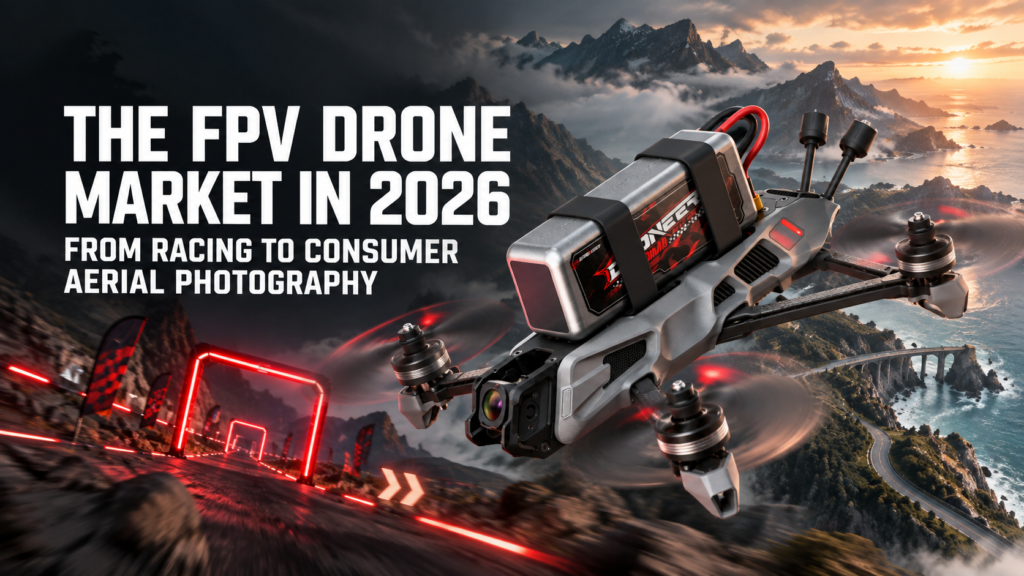
As to be expected, the 5 inch FPV drone is one of the most popular formats available – and not without reason, since it’s at the sweet spot of all power, agility, payload, repair and price. For those new to the game, the “5 inch” number is for propeller diameter, not for the whole aircraft. These builds can go the extra mile to throw hard, throw freestyle and not feel sluggish when carrying a solid action camera.
Nevertheless, a 5″ FPV drone is not always the right choice. Prop exposure, noise, speed, weight – none of that is good for a close-up in an indoor setting or flying in close proximity to people. Propeller guards are more effective for smaller aircraft in interior environments and larger aircraft may be more efficient for landscape applications that require greater distances. Five-inch builds have been around the block because they’re not the fastest, but they’re versatile.
LRF is helping to open new terrain for long-range flying.
Even more than ever, landscape photographers are looking for aircraft that are efficient and stable and reliable in terms of real distance. The long range drone tends to rely more on larger propellers, more powerful motors, larger batteries, and navigation systems to provide significantly extended flight time as compared to a freestyle system. The combination allows pilots to cross mountain ridges, coastlines, deserts and open country without continually landing and changing batteries.
However, there’s a difference between long range and unlimited range – and there is a difference between long range and no airspace restrictions. Radio range and battery life are but two aspects of flying safely. But pilots still need to consider airspace regulations, line-of-sight, obstacles that can obstruct their signal, weather that can change on a dime and — importantly — sufficient battery remaining to make it back home. Good pilots add in substantial margins, and turn back before they reach into the battery.
Making the most of your shots is now a full process of camera quality.
For 2026, the people who are judging the FPV systems are going beyond raw resolution. The megapixel count is less important than dynamic range, bit rate, color science, stabilization metadata, low-light handling performance, lens performance and reliable storage. Not nearly as much use is a shot that has a blown out sky and jittery footage.
They record using various setups, either by attaching an action camera, or using a dedicated cinema camera or the same digital system utilized by the FPV feed itself. All options have different compromises: weight, flight time, price, resolution. Lightening the plane makes it easier to carry the recording equipment and makes it fly more efficiently. However, there’s a heavier camera out there that will get much more color and detail, but it’ll add weight and increase the risk of a crash.
The things people purchase are being influenced by safety and regulation.
There is, of course, increasing safety and legal compliance considerations on the purchasing side as FPV becomes more popular. Buyers want failsafes they know they can rely on, remote ID support when it’s needed, location awareness, and documentation that is truly understandable. When it comes to commercial pilots, there is even more to consider — insurance, local permits, client risk assessments, and safely moving around properties or a film set.
Training is now a small industry in itself. Simulators, course based training, community events and coached flying sessions can tend to reduce the learning curve considerably, moving from basic hovering to controlled cinematic flying in no time at all. A sensible strategy is to run in simulation and then go to a large open area until you get used to orientation and emergencies without panic and then add obstacles later.
Noise is also a factor, as is what the public thinks of the FPV pilots. It doesn’t mean it’s legal but doesn’t mean it’s not an annoyance to others. When pilots communicate with property owners before flying, avoid crowds, respect wildlife and avoid repeated passes over the same location, they are doing the entire community a favour — and manufacturers that have clear operating guidance can contribute to this.
Purchase the shot(s) you actually need
It is best to begin with the shot that you desire, not the spec sheet that appears most attractive. When people come to the house for a walkthrough, a compact, prop guarded item is required. In freestyle practice, toughness and replaceable parts are all welcome. Efficiency, navigation assistance and accurate battery information are key features for mountain film making. Latency is Racing’s top priority.
It’s important to consider before purchasing:
- Where you will be flying and what rules are allowed at the location.
- The features and functionality you require.Resolution and capacity of the camera you need.
- The cost of batteries and realistic times of flight
- The availability of replacement parts.
- If your goggles, controller and video system all play nicely together.
- How easy it is to make repairs to your own, and if they are available if they are not
The aircraft is seldom the entire cost of the project. It’s not only the goggles, controller, batteries, appropriate charger, spare props, tools, storage, and simulator software, but also all these things combined. It is a much fairer comparison between a ready-to-fly package and a custom-built system when those in the factory are taken into account from the outset.
How to further develop FPV.
It’s actually a balance between accessibility and maintaining some of the elements that made hobby worth it in the first place in the 2026 market. The ease of set-up, the improved video quality, and the smarter safety features were attracting new pilots, and modular parts and hands-on manual flight were keeping the experimental spirit that started this category alive. Racing will continue to drive speed and responsiveness, freestyle will continue to grow as an art form, and aerial photography will continue to spread FPV’s signature FPV aesthetic to a larger and larger audience.
Products that stick will probably be the ones designed for one particular pilot and not those that are designed to be “all things to all people. However, people are becoming better at distinguishing indoor cinewhoops, racing rigs, freestyle platforms, 5” all-rounders, and efficient long-range builds and it’s that kind of knowledge that breeds more realistic expectations and safer flying.
For the photographers, FPV adds one thing to a typical aerial drone that is hard to replicate: You’re in the scene, not above it. That feeling of being there is going to continue to trickle down from hobbyist pilot communities and into the mainstream of visual storytelling as the gear continues to get better and training becomes more accessible.