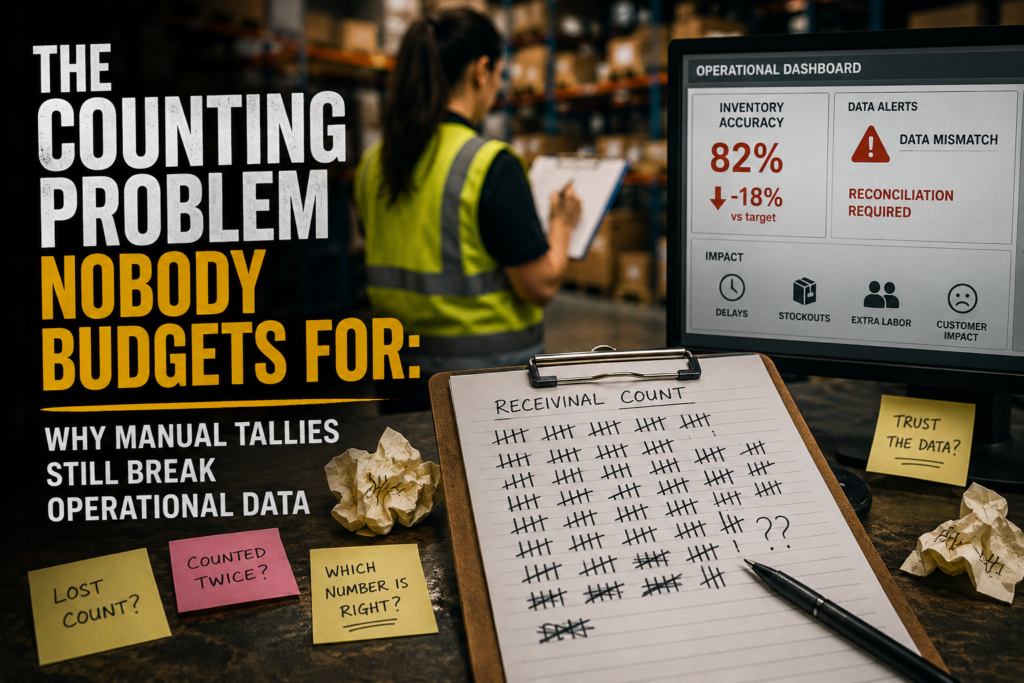
Walk into almost any warehouse, clinic, factory floor, or independent retail store and you will find someone counting something by hand. A supervisor tallying pallets against a delivery note. A nurse counting supplies before a shift change. A quality inspector marking defects on a clipboard. A store manager clicking a handheld counter at the door on a Saturday afternoon.
These numbers are not incidental. They feed inventory reconciliation, staffing decisions, reorder points, and in regulated industries, compliance records. They are, in a real sense, the input layer for a great deal of operational decision-making. And they are almost always the least instrumented part of the stack.
Companies will spend six figures on a business intelligence platform and then populate one of its inputs with a number a tired employee wrote on a sticky note at the end of a ten-hour shift. The dashboard renders it beautifully. It is still wrong.
Why sensors have not solved this
The obvious answer is automation, and for a subset of counting problems it works well. Retailers with the budget install door sensors and computer-vision people counters. Warehouses use barcode scanning and RFID. Manufacturers instrument production lines directly.
But automated counting has a narrower footprint than its vendors suggest, for reasons that have little to do with technology maturity.
The first is cost relative to the decision. A vision-based footfall system might cost several thousand dollars per entrance, plus installation and a subscription. For a chain evaluating store performance across two hundred locations, that arithmetic works. For an independent retailer deciding whether Saturday mornings justify a second staff member, it does not. The count is worth having. It is not worth four thousand dollars.
The second is that many counts are situational rather than continuous. A conservation group running an annual bird survey, a school taking attendance on a field trip, a factory tracking a specific defect for the duration of a two-week investigation — none of these justify permanent infrastructure. They need to count a specific thing for a bounded period and then stop.
The third, and most underestimated, is that a great many counts require human judgement at the moment of counting. Is that the same customer returning, or a new one? Does this unit count as a defect or a cosmetic variance? Is that a juvenile of the species or a different species entirely? A sensor counts events. A person counts events that meet a definition, and the definition often lives only in that person’s training.
Where manual counting actually goes wrong
If manual counting is unavoidable in these cases, the useful question is not how to eliminate it but where it fails, and it fails in reasonably predictable ways.
Loss of place. The dominant failure is not miscounting but losing the count entirely — an interruption, a dropped clipboard, a phone call mid-tally. The count is not wrong so much as gone, and what gets recorded is a reconstruction.
Silent transcription errors. A count that lives on paper has to be typed into a system later, often hours later, often by someone who did not do the counting. Digit transposition at this step is common and almost never caught, because there is nothing to check it against.
Uncorrected overcounts. With a mechanical clicker or a pen, there is no undo. An accidental double-press either gets remembered and mentally subtracted at the end — unreliable — or silently absorbed into the total.
Single-threading. Physical counters count one thing. When someone needs to track four categories at once, they either carry four devices, use tally marks on paper and lose the speed advantage, or collapse the categories and lose the granularity that made the count worth taking.
No audit trail. A number on a clipboard carries no metadata. There is no record of when the count started, when it ended, or whether it was taken in one continuous session or reconstructed from three partial ones. For any count that ends up in a compliance record, this is a genuine problem.
What better practice looks like
The realistic answer for most organisations is not to automate these counts but to make the manual process less lossy — which is largely a matter of tooling and a little of discipline.
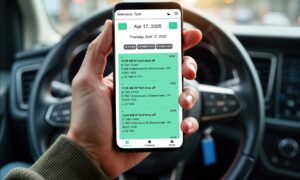
Persistence matters more than precision. A counting method that survives an interruption eliminates the most common failure outright. Digital tools that save state automatically, whether a purpose-built app or a browser-based people counter that stores counts locally between sessions, remove the entire category of losing the count to a distraction.
Undo matters more than it sounds. The ability to reverse a single mis-tap converts a corrupted count into a correct one, and it removes the incentive to guess at the end.
Parallel counts should stay parallel. If the operational question involves four categories, the counting method should support four labelled counters that stay separate through to recording. Collapsing them and splitting them later is where reconstructed data gets invented.
Shorten the path to the system of record. Every manual step between the count and the database is an error opportunity. Counting directly into something that can be read off a screen at the end — rather than transcribed from paper — removes one of them.
Record the conditions, not just the number. Who counted, over what window, using what definition. For anything that will be compared year over year or audited, the number alone is close to meaningless without it.
The wider point
There is a tendency in operational technology to treat manual processes as embarrassments awaiting automation, and to under-invest in them accordingly. But a manual process that will still exist in five years deserves the same attention to error rates as an automated one.
The counting problem is a good example because the stakes are quietly high and the fixes are quietly cheap. Nobody is going to write a strategy memo about how their staff record numbers. But the difference between a count that survives an interruption and one that does not shows up eventually, in an inventory variance nobody can explain, or a footfall figure that argues for the wrong staffing decision.
The data quality conversation usually starts at the warehouse and works outward. It is worth occasionally starting at the clipboard and working in.