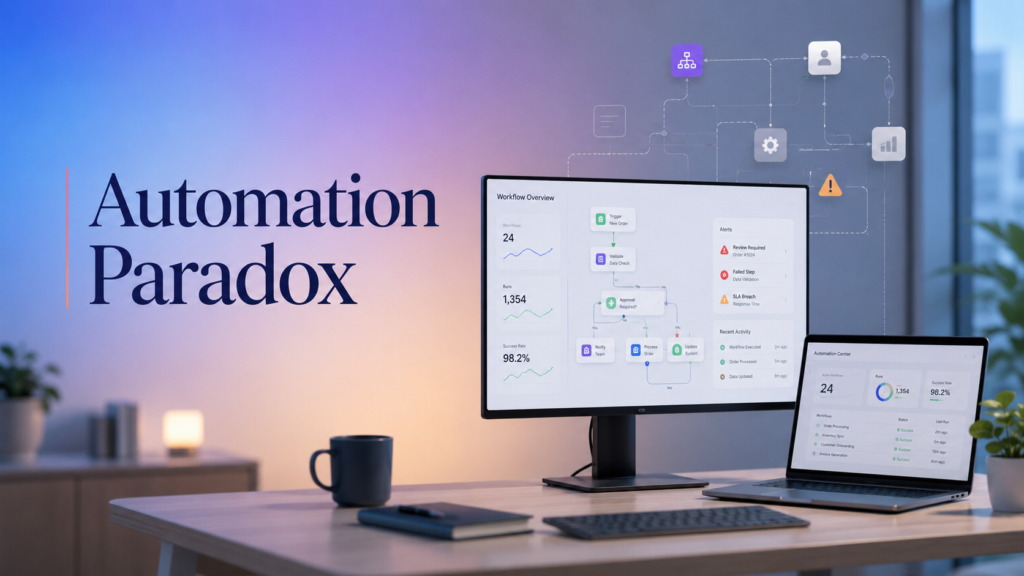
Automation is supposed to remove work. Yet many companies automate one process after another and discover that they now have more dashboards to watch, more systems to connect, more exceptions to investigate, and more rules to maintain.
The contradiction is real because automation removes task effort, not necessarily organizational complexity. As software and AI take over routine execution, a new category of work grows around them: deciding what systems should do, monitoring what they actually do, resolving conflicts between tools, and intervening when automated decisions meet situations they were never designed to handle. That is the automation paradox. Automating ten tasks can create an eleventh responsibility: managing the technology that now performs them.
Automation Removes Tasks, Not Complexity
Traditional automation has always been strongest at clearly defined work. If an invoice matches a purchase order, approve it. If inventory drops below a threshold, create a replenishment request. If a lead meets certain criteria, route it to sales.
These systems can eliminate thousands of repetitive actions. But the underlying business process does not disappear. Its complexity moves somewhere else.
Suppose a company automates lead routing. Before automation, sales managers may have manually reviewed leads and assigned them based on geography, company size, product interest, or salesperson workload. After automation, employees stop performing those assignments individually, but someone still has to define territories, maintain routing rules, detect duplicates, handle incomplete records, resolve ownership conflicts, and determine what happens when a salesperson is unavailable.
AI makes the shift even more pronounced because it can automate decisions that previously depended on interpretation rather than fixed rules.
The difference can be summarized simply:
| Before Automation | After Automation |
| Employees perform the repetitive task | Software performs the repetitive task |
| Managers review individual employee output | Managers monitor system-level performance |
| Mistakes usually affect isolated cases | A flawed rule can affect thousands of cases |
| Business knowledge sits partly with employees | Knowledge must be represented in data, rules, prompts, or policies |
| Exceptions are noticed during manual work | Exceptions need explicit detection and escalation mechanisms |
This is why measuring automation only in hours saved can be misleading. A process may require fewer employee minutes while simultaneously demanding more architecture, monitoring, governance, and troubleshooting. The real question is whether automation lowers the total coordination cost of producing an outcome.
A New Management Layer Appears
AI adoption is already widespread. Stanford’s 2026 AI Index reports that 88% of surveyed organizations used AI in at least one business function during 2025, while generative AI appeared in at least one function at 70% of organizations. AI-agent deployment, however, remained in the single digits across nearly every individual business function.
That gap matters. Using AI to summarize a document or draft an email requires relatively little infrastructure. Giving an AI system responsibility for a multi-step business process requires much more.
Imagine connecting an AI agent to a CRM. The technical connection itself is only the beginning. The company then has to decide which customer records the agent can access, which fields it may change, whether it can create tasks, whether it can send messages, what spending authority it has, and which actions require approval.
Someone also needs to answer operational questions that did not exist before: Who owns the agent when its behavior crosses several departments? What happens when the CRM and billing platform disagree? How long should logs be retained? Which model version is approved? What happens when a model update changes behavior? Which actions should be reversible?
The result is a new management layer built around orchestration. Traditional management coordinates people performing work. Automation-era management increasingly coordinates people, AI models, APIs, databases, software permissions, workflow engines, and automated decisions.
That is not necessarily a failure of automation. It is a consequence of giving software more operational responsibility.
Tool Sprawl Creates Coordination Debt
The automation problem becomes more difficult because most companies do not build their technology stack all at once.
Automation arrives incrementally. Marketing adopts an AI content platform. Sales adds prospecting software. Finance automates invoice handling. Customer support installs an AI assistant. Operations connects workflow software. IT introduces monitoring tools. Individual teams create their own integrations.
Every purchase may solve a legitimate local problem. Collectively, however, they create dependencies that nobody originally designed. This produces something similar to technical debt: coordination debt.
Coordination debt accumulates when separately implemented systems have to operate as one business process. A customer can illustrate the problem. Marketing software may define that person as a qualified lead. The CRM may classify the same person as an existing account. Billing software may show a payment dispute. Customer-success software may identify a renewal risk.
An automated campaign that reads only the marketing data could send an aggressive acquisition offer to someone already involved in a billing dispute.
Nothing is technically broken. Each system is operating correctly according to its own information. The failure exists between the systems. Coordination debt therefore appears through mismatched definitions, timing problems, duplicated records, inconsistent permissions, conflicting objectives, and unclear ownership.
This becomes expensive because every new automation creates more possible interactions with existing automation.
A workflow that once connected two applications may eventually depend on six systems, three data sources, a model, an identity layer, and several APIs. Changing one component can affect processes far away from the original implementation. The management burden does not grow because software performs poorly. It grows because more software becomes interconnected.
AI Makes Automation Less Predictable

Traditional automation is relatively easy to reason about because it follows explicit logic.
If condition A is true, perform action B. Generative and agentic AI operate differently. They interpret language, evaluate context, select tools, retrieve information, and sometimes decide which step should happen next.
That flexibility allows AI to handle situations that rigid workflow rules cannot cover, but it also changes how businesses have to manage automation.
A deterministic workflow can often be debugged by tracing conditions through a sequence. An AI workflow may fail because the model misunderstood an instruction, retrieved irrelevant information, lacked context, selected the wrong tool, received bad data from another system, or made a reasonable interpretation that was still wrong for the business.
The problem moves from configuration toward behavior evaluation. IBM describes observability as an important requirement for AI agents because organizations need visibility into agent behavior, model interactions, tool calls, and performance if autonomous systems are going to operate reliably.
That means businesses need to know more than whether an agent completed a task. They may need to understand which information it retrieved, which tools it called, why a task failed, how much the workflow cost, which step consumed the most time, and whether the agent’s output crossed a policy boundary.
Automation once promised fewer things to supervise. AI can create systems that require supervision at a different level.
Exceptions Become the Real Work
Automation performs best in the center of a process where cases are repetitive and outcomes are predictable.
Humans increasingly inherit the edges. A finance department may automate thousands of normal invoices while employees investigate duplicates, mismatched purchase orders, unusual tax treatment, disputed charges, and incomplete supplier records.
Customer support can automate password resets, account questions, and routine troubleshooting, leaving employees with angry customers, ambiguous problems, security concerns, and cases involving high-value accounts.
The quantity of manual work falls, but the average difficulty of the remaining work rises.
This changes the economics of automation. A company may correctly report that 80% of requests are automated, yet the remaining 20% could consume most of its management attention because those cases involve uncertainty, risk, or conflicting information.
It also means humans need better context when automation escalates a case. Passing an exception to an employee with only the message “automation failed” creates additional work. A well-designed system should explain what happened, which information was considered, what actions were attempted, and why human judgment is now required.
Automation is therefore most useful when it reduces routine execution and makes exceptions easier to understand. If it merely pushes complicated cases into another queue, the company has relocated work rather than eliminated it.
Automated Systems Still Need Domain Judgment
Digital advertising demonstrates this paradox clearly. Modern platforms can automate bidding, placements, audience expansion, campaign optimization, and parts of creative testing. Yet those capabilities do not decide whether the platform is pursuing the right customer, whether a conversion is commercially valuable, or whether a lower cost per lead actually improves the underlying business.
The issue becomes even clearer in specialized markets. Paid Ads Management for Lawyers can involve automated bidding and targeting, but campaign quality still depends on practice-area economics, geographic competition, case value, search intent, intake performance, and budget constraints. A platform can optimize the signal it is given; it cannot independently determine whether that signal represents the firm’s most useful business outcome.
The broader lesson applies across automated systems: as execution becomes easier to delegate, defining the objective becomes more consequential.
The Dashboard Problem
Automated systems generate enormous amounts of information about themselves. They produce alerts, logs, confidence scores, cost reports, traces, conversion metrics, quality evaluations, uptime measurements, latency statistics, and exception queues.
This sounds like greater visibility. In practice, visibility can turn into another management burden.
Imagine an organization whose automated infrastructure generates 5,000 alerts in a week. If only 25 of them represent problems that require action, the company does not primarily have a monitoring problem. It has a prioritization problem.
The same effect appears in business dashboards. A marketing team may track impressions, clicks, conversion rate, cost per conversion, qualified leads, pipeline value, acquisition cost, return on ad spend, lifetime value, and dozens of campaign-level signals.
Automation can optimize many of those metrics continuously. That creates a dangerous temptation to manage whatever the platform measures most easily.
A system optimizing for low cost per lead could produce more inexpensive leads that sales cannot convert. A support platform optimizing for resolution speed may reward premature case closure. A warehouse system optimizing utilization could reduce spare capacity needed during disruption.
The metric becomes a proxy for the objective, and the proxy gradually replaces the objective.
More dashboards do not solve this problem. Management has to decide which signals describe system health, which indicate genuine business performance, and which should trigger intervention.
The automation paradox therefore includes an information paradox: software can reduce the number of actions humans perform while increasing the number of signals humans have to interpret.
Managers Move Up a Level
Automation does not simply reduce management. It changes what management is responsible for. When humans perform most tasks directly, managers supervise activity. They assign work, review output, resolve problems, and adjust priorities. When software performs more of the execution, managers increasingly supervise the conditions under which work happens.
That can involve deciding which objective an automated system should optimize, which data it may access, how much autonomy it receives, what level of error is acceptable, and which situations require escalation.
This makes some management decisions more consequential than they were before. A supervisor giving one employee a poor instruction may affect a handful of tasks. A manager changing a routing rule, model instruction, approval threshold, or optimization target can influence thousands of automated decisions before anyone notices a problem.
Microsoft’s 2025 Work Trend Index captured part of this shift through the idea of the “agent boss.” Its research found that leaders were already more familiar with AI agents than employees, and Microsoft argued that work would increasingly involve people building, delegating to, and managing agents rather than simply using AI as a personal assistant.
The managerial skill set therefore shifts toward system thinking. Managers need to understand dependencies between processes, recognize when metrics conflict, distinguish local optimization from business performance, define sensible escalation thresholds, and know where automation should stop. That is a different job from simply supervising whether employees completed assigned tasks.
More Agents Mean More Governance
Agentic AI makes the paradox stronger because agents can perform sequences of actions rather than single isolated tasks.
McKinsey’s 2025 global survey found that 23% of respondents said their organizations were scaling an agentic AI system somewhere in the enterprise, while another 39% were experimenting with agents. Adoption within individual business functions remained much lower, indicating that most companies were still working through how agents should be deployed at scale.
As agents gain authority, organizations need clearer boundaries. A research agent that only summarizes publicly available information creates limited operational exposure. An agent that can modify customer records, approve refunds, move money, publish content, purchase inventory, or contact customers introduces a different class of risk.
A useful architecture separates automation according to consequence:
- Low-risk and reversible actions can run automatically when the rules are stable and failures are easy to correct.
- Moderate-risk actions can be prepared by AI but require approval before affecting customers, money, or production systems.
- High-impact decisions involving major financial exposure, legal obligations, sensitive information, or strategic commitments should retain explicit human authority.
The purpose is not to place humans in front of every automated action. Doing so would recreate the bottleneck automation was meant to remove. Governance should concentrate human attention where the cost of being wrong is materially higher than the cost of waiting.
When Automation Actually Reduces Management
The paradox does not mean businesses should automate less. It means they should stop treating the number of automated tasks as the main measure of progress. Good automation reduces the total amount of organizational attention required to produce a reliable outcome. That usually requires three different approaches.
1. Automate the stable layer
Highly repetitive work with clear inputs, well-understood rules, and reversible outcomes is the easiest place to remove human intervention. The company should not require an employee to approve every routine action simply because approval was part of the old process.
2. Observe the variable layer
Processes involving uncertainty need visibility rather than unlimited autonomy. AI can classify situations, prepare recommendations, collect context, and identify anomalies while systems record enough information for employees to understand unusual behavior.
3. Escalate the consequential layer
Human attention should be concentrated where errors carry meaningful financial, legal, security, operational, or customer consequences. Escalation should arrive with useful context rather than forcing employees to reconstruct the entire workflow manually.
This structure reduces management because it assigns different levels of control to different levels of uncertainty.
The opposite approach is to automate every visible task independently. That often produces a technology stack full of overlapping tools, duplicated automation, conflicting metrics, and managers whose time is consumed by keeping the machinery synchronized.
The Real Automation Advantage
The most automated company is not necessarily the most efficient one. A business that automates 80% of its visible tasks but requires employees to monitor dozens of disconnected tools can easily create more coordination work than a competitor with fewer, better-integrated systems.
The useful metric is not simply how many tasks software performs. It is how much human attention is required to keep the overall process reliable.
AI and automation can reduce that burden when systems share context, ownership is clear, exceptions are well designed, metrics reflect genuine business outcomes, and autonomy increases only where the consequences justify it.
Without those conditions, automation does something more complicated than replacing work. It moves work upward from execution into orchestration.
That is the real paradox. Technology can eliminate thousands of manual actions while creating a smaller number of far more consequential management decisions. The companies that benefit most will be those that know which complexity deserves automation, which complexity requires human judgment, and which complexity should never have been added to the system at all.