The year is 2026, and the digital ink on your screen is caught in a high-stakes game of cat and mouse. If you are a student submitting a term paper or a content creator hitting “publish” on a new blog post, you’ve likely felt the invisible pressure of the “Algorithm Police.” We’ve reached a point where it’s no longer just about what you write, but how a machine perceives your writing.
In this landscape, three tools have become the “holy trinity” of the modern writer’s toolkit: the ai detector, the Free AI Detector, and the AI Stealth Writer.
But here’s the problem: most people are using them all wrong. They are treating them like simple “pass/fail” tests rather than what they truly are—components of a new, hybrid form of human creativity. Let’s break down how to master this arms race without losing your voice (or your grade).
The “False Positive” Nightmare: Why Students Need a Free AI Detector
For the modern student, the fear of plagiarism has been replaced by a much more nebulous anxiety: the ai detector flag. Imagine spending twelve hours researching the socio-economic impacts of the Industrial Revolution, only to have a professor’s software claim your work is “80% AI-generated.”
This isn’t a hypothetical. As AI detection models become more aggressive, they often flag “highly structured” or “very formal” human writing as machine-made.
Why Does This Happen?
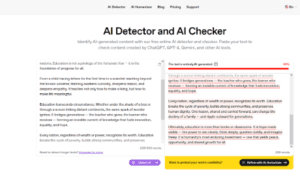
AI detectors look for patterns of extreme consistency. If your writing is too logical, too rhythmic, or lacks the “chaos” of human thought, you are at risk. This is why every student in 2026 should be using a Free AI Detector as a pre-submission ritual.
- Self-Correction: By running your own work through a detector first, you can see which paragraphs “look” like a robot wrote them.
- The “Human” Touch: Usually, it’s a matter of adding a personal anecdote, a complex metaphor, or a slightly “imperfect” sentence structure to break the machine’s pattern.
The Creator’s Dilemma: SEO and the “Robot Vibe”
If you’re a content creator or a digital marketer, your battle isn’t with a professor—it’s with Google’s “Helpful Content” updates. While Google has softened its stance on AI, it remains ruthless against content that feels “hollow.”
We’ve all seen it: that generic, middle-of-the-road prose that says a lot without saying anything at all. That is the “Robot Vibe,” and it is the kiss of death for SEO.
The Utility of the AI Stealth Writer
This is where the AI Stealth Writer enters the scene. This isn’t just a “spinner” tool from 2015. A modern stealth writer acts as a sophisticated linguistic filter. It takes the raw, data-driven output of an AI and re-engineers the “Burstiness” and “Perplexity”—the two metrics detectors use to catch you.
For a creator, the goal isn’t just to “beat” the ai detector. The goal is to produce content that:
- Provides factual accuracy (AI’s strength).
- Feels conversational and engaging (Humanity’s strength).
- Avoids the repetitive syntax that triggers search engine filters.
Beyond the Basics: How to Use an AI Stealth Writer Like a Pro
Most users simply copy-paste a ChatGPT response into a stealth writer and call it a day. If you want to rank in 2026, you need to be more surgical.
1. The “Hook and Anchor” Method
Don’t run your entire 2000-word article through a stealth tool. Use the AI Stealth Writer specifically for your introductions and conclusions. These are the “hooks” that humans (and detectors) scrutinize most. Your data-heavy middle sections can remain more structured, provided they are framed by high-personality “humanized” sections.
2. Diversifying Your Sources
Detectors are trained on specific LLM signatures (like GPT-4o or Claude 3.5). If you use a Free AI Detector and it gives you a high AI score, it’s often because the “lexical fingerprint” is too consistent. A stealth writer breaks that fingerprint by introducing linguistic anomalies that machines usually don’t choose.
3. The “Read Aloud” Test
Technology can only take you so far. After using an AI Stealth Writer, read your paragraph out loud. If you find yourself tripping over a word or if a sentence feels unnaturally long, that is a good thing. It means you’ve successfully reintroduced the human “friction” that makes writing believable.
Comparing the Tools: A 2026 Perspective
| Tool Category | Primary Function | Best Used By… |
| Free AI Detector | Diagnostic. Tells you how “robotic” your text appears to an algorithm. | Students checking assignments; Editors vetting freelancers. |
| AI Stealth Writer | Remedial. Restructures text to mimic human unpredictability and flow. | Content marketers; SEO specialists; Ghostwriters. |
| The Human Brain | Creative. Adds original thought, current events, and emotional depth. | Everyone who wants to actually be read. |
Ethical Considerations: The “Invisible” Collaboration
There is a lingering debate about the ethics of using an AI Stealth Writer. Is it “cheating”?
In the professional world, the answer is increasingly “No.” Efficiency has always been the goal of technology. Just as spell-check didn’t “ruin” writing, and calculators didn’t “ruin” math, these AI tools are simply refining the process.
The ethics lie in the Value Addition. If you use AI to generate a lie, humanize it with a stealth writer, and publish it as truth—that is unethical. But if you use AI to organize your brilliant, original research, and then use a stealth writer to ensure that a biased AI detector doesn’t unfairly flag your hard work, you are simply being a savvy digital citizen.
Strategies for a “Detector-Proof” Future
As we look toward the end of the decade, technology will only get smarter. To stay ahead, you must move beyond tools and develop a “Hybrid Voice.”
- Inject Current Events: AI models have “knowledge cutoffs.” Even the best AI Stealth Writer can’t fake a reference to a news event that happened yesterday.
- Use First-Person Narratives: “I felt,” “In my experience,” and “I noticed” are phrases that AI struggles to ground in reality.
- Vary Your Formatting: Use bullet points, bold text, and varied paragraph lengths (just like this article). This increases the “visual burstiness” of your content, which signals human intent to both readers and algorithms.
Final Thoughts: The Soul in the Machine
The rise of the ai detector has forced us to ask a profound question: What does it actually mean to write “like a human”?
Ironically, the more we use an AI Stealth Writer to mimic ourselves, the more we learn about our own unique linguistic quirks. We learn that we are messy, we are unpredictable, and we are emotional.
For students and creators alike, the secret to success in 2026 isn’t to run away from AI. It’s to use a Free AI Detector to find your “robotic” habits and then use every tool at your disposal to bring the “soul” back into your work.
The machine is here to help you draft. The stealth writer is here to help you blend. But only you are here to provide the meaning. Use the tools wisely, and the algorithms will never be able to keep up.