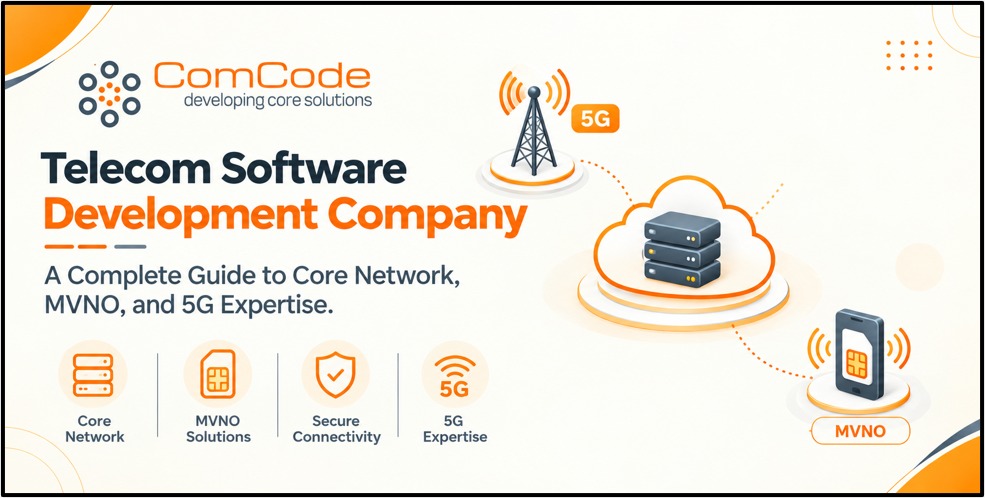
Telecom Software Development Company: A Complete Guide to Core Network, MVNO, and 5G Expertise

Ask an operator who built their network and you’ll rarely get a one-word answer. A box from one vendor a billing system from another and a stack of custom code written over fifteen years by people who may have left. Somewhere in that mix a telecom software development company has usually done the work that holds it together. Maybe you’re about to launch, or move to a new platform, or finally replace something that should have been retired years ago. Whichever it is, you’ll be choosing a development partner soon. Here’s what they do where projects go off the rails and how to pick one you can live with.
What the work looks like
People outside the industry tend to picture a telecom software development company as a regular software shop with a niche. It isn’t, quite. The code has to follow standards from 3GPP and the GSMA. It has to talk to equipment from several vendors, some of it decades old. And it has to stay up. A bug in a web app annoys a few users. A bug in a signaling node can knock a whole region offline.
Work splits into two kinds. Product work means platforms you license and configure. Custom work is the messy part. It gets built around your network your partners and the billing quirks nobody remembers agreeing to. Most projects end up as a mix of the 2 & sorting out which bit is which can take longer than writing the code.
Authentication starts at the Home Subscriber Server
Every time a phone connects the network asks one question first: is this SIM real and is the customer allowed on? In 4G, that question goes to the Home Subscriber Server or HSS.
The HSS is the master record. It holds each subscriber’s identity the secret key shared with the SIM the services they’ve paid for and the last place the network saw them. The phone and the network run a challenge and response. The key itself never crosses the air only the challenge and the answer do which is a big part of why SIM security has lasted so long. In 5G the job gets split between two functions, UDM and AUSF but the idea carries over.
Because so much depends on it the HSS is the last thing you want to be unreachable. If it goes dark, nobody attaches. Good developers build it in pairs in separate locations and they test the failover before launch not after.
Signaling and SIGTRAN
Authentication only works if messages can travel between nodes, and that’s signaling. The old standard is SS7 built in the 1970 and 80 for exchanges joined by dedicated circuits. Those circuits got expensive and scarce so operators moved the same messages onto IP using SIGTRAN.
You might assume this is history. It isn’t. SIGTRAN is still how a large share of roaming and interconnect traffic moves today. If your subscribers use their phones abroad some of what happens runs through it. The message format stays the same so older equipment keeps working and that’s exactly why it hasn’t gone away.
There’s a security cost too. SS7 was designed when every connected operator was assumed to be honest. Researchers have shown location tracking & SMS interception through abused signaling links. If some-one audit your setup the interconnect edge is where they should start. Ask any developer you hire how they handle filtering there.
Charging in real time: diameter gy ocs
A connected, authenticated prepaid user still has to be billed, and it has to happen while the session runs. That’s the job of diameter gy ocs the interface between the packet gateway and the Online Charging System.
The gateway canot see a prepaid balance so it asks. So the gateway asks. The OCS checks the credit and hands over a quota say 10 MB or five minutes. Use it up and the gateway goes back reports what was spent & asks for more. Once the user is done final message shuts the session down.
The real test comes when something breaks. A slow OCS makes browsing stall. A dead one forces a choice block everyone or let traffic through & sort out the billing later. Both cost money and both annoy customers. So the timers the quota size & the failure rule need to be decided in a calm meeting not during an outage. I’d say this is where you can tell a careful developer from a rushed one. Ask them what their failure policy is. If the answer takes a long time to arrive, you’ve learned something.
Building for a mobile virtual network operator
The mobile virtual network operator sells mobile service without owning tower. It rents access from a host network & runs its own brand plans & customer relationship. The business side often looks simple. The technical side is where MVNO projects get stuck.
Every MVNO has to decide how much of the core it wants to own. A light MVNO leaves nearly everything to the host and just sells the SIMs. A full MVNO runs its own subscriber database charging and messaging and connects to the host through interconnect links. More control means freedom with pricing and data but also more to build and run.
Here’s where a software partner proves their worth: they build for the launch you have not the one you hope for. 50000 subscribers do not need a platform designed for ten million & paying for one is how budgets disappear. Start small leave space to grow. And ask one question early on day one if you can who controls the subscriber data? Changing that answer later is a headache. Also ask on day one who controls the subscriber data. Sorting that out later is much harder. Changing that arrangement later hurts.
Messaging and the SMS Firewall
Text messages still earn real money and a big slice of them is application traffic: one-time passwords bank alerts, delivery updates. Companies send those in bulk & not all of it is honest.
Messaging has its share of trouble: spam, spoofed sender names, and fraud slipping in through gray routes. That’s the job of an SMS Firewall. It sits at the edge of the network & checks every message before a subscriber see. It can block spoofing spot traffic that dodges commercial agreements and flag odd patterns. Operators who skip it often hear about the leak from their finance team before their engineers.
Whoever builds yours should be able to say how the rules get updated. Fraud changes fast, sometimes monthly and a rule set that never changes goes stale quickly.
Where 5G fits
5G changes the shape of the core more than anything since the move to IP. Network functions become services that call each other through APIs. The HSS role splits. Charging moves to a different function. Underneath, though the logic is familiar: check who the user is decide what they can do charge for it and report.
For most operators the real question isn’t whether to go to 5G core. It’s how to get there without breaking what already works. Standalone or non-standalone & cloud-native or not each choice trades cost risk and timing. A good partner will lay out a migration in steps and won’t push a full replacement unless you need one. 4 & 5G will share the same networks for a long time so the software has to work with both.
Choosing a partner
Picking a vendor is mostly about checking claims. Ask which live networks they’ve worked on and be specific which protocols what scale which vendors they integrated with. Ask what happens when the OCS or HSS fails. Ask who owns the code and the data and settle it before signing. And pay attention to how they talk. If the pitch only makes sense to their own engineers the support calls will go the same way.
Test them on the small stuff too. A team that can explain SIGTRAN or a Gy timer in plain words usually understands it properly.
Final thoughts
A telecom software development company is only as good as its grasp of how the whole network behaves under stress. Authentication & signaling or charging and messaging all lean on each other and the best teams design with that in mind. At Comcode Tech we work with operators and MVNOs on core network and messaging platforms and we start every project the same way: understand what you already run then build only what you need.