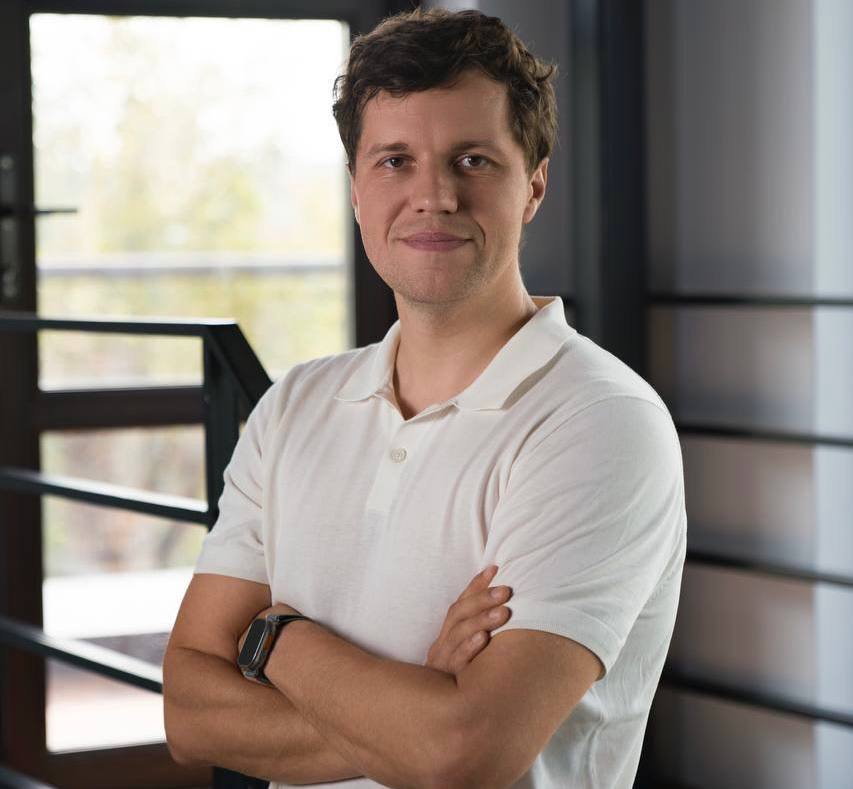
Interview with Aleksei Eroshenko, fintech entrepreneur, CEO and architect of international instant lending services.
Microcredit in emerging markets is often perceived as a high-risk business. But there is a category of entrepreneurs for whom risk is not a threat, but a structural element of the model. Aleksei Eroshenko is one of them. In ten years, he has gone from a local startup to an international ecosystem operating in Asia, Africa, and Latin America. Millions of active customers per month, over $100 million in annual revenue, services that are among the top markets, and a scale that is not achieved by chance.
Aleksei and I talked about how such systems are built, how continents differ, why growth is not just about money, and why a CEO should be able to think ahead for 5-7 years.
Aleksei, before your international expansion, you went through an early local stage. What was the main lesson from that period?
The main lesson is that the speed of the solution is more important than the correctness of the solution. If we could make a product 80% perfect today or 100% perfect in three months, we chose the first option. The market is not waiting. We launched, collected data, edited, and rebuilt the model. That’s how we came to our own credit pipeline, not because we wanted a beautiful product, but because other people’s platforms couldn’t keep up with our pace.
When did you first feel that the market had become too small for you?
When the growth stopped being exponential. Any market has a limit: traffic, solvency, and the number of customers. We knew that we could do more, and the logical step was to enter Vietnam. There, the model got a second life, regulation is softer, the population is young, and digital behavior is developed. Now the platform is at the top, and it proved it.: we are able not only to repeat success, but to multiply it.
Few people would dare to go to India, Africa, or Mexico right away. Why is this not a risk for you, but a strategy?
Because the risk can be considered. We analyze countries by dozens of parameters.: GDP, the level of credit penetration, the speed of digitalization, the share of the unbanked population, the complexity of licensing. We are going to a place where demand outstrips supply. Nigeria is an example. and India is a challenge, but also a huge market, Mexico is already profitable. We are currently preparing South Africa, Spain, Peru, and Colombia. These are not chaotic jumps — this is the map we are moving on.
You mentioned a map. Can we say that the company is built as a coordinate system?
“That’s right. There is a core product, and there are licenses that support it. There is unit-economy, the language of decision-making, there is a team, which is energy. If something is sagging, the system will not scale. My task as CEO is to keep the structure in balance. Not to be the best coder, not to count the defaults the best, but to see the whole. This is a different level of responsibility.
Many perceive microcredit as a fast business. You’re talking about the strategic horizon. Why?
Because fintech is not about giving money, but about the availability of capital. If you are going to work internationally, you should look at least 5-7 years ahead. How will the regulation change? What data will form the basis of scoring? What demographics will determine the demand? There are young markets now: Asia and Africa. Latam in five years, and the south of Europe in nine. Those who think ahead build the infrastructure before others.
What is the key for you in choosing a new country?
Three criteria: market capacity — population, demand, and economic activity. The speed of licensing and regulation, the flexibility of behavioral scoring — how transparent the client is to the model. If at least two match, the country is promising. If there are three, then you need to enter quickly before the window closes.
What does a bad market look like?
Where margins are high but scalability is low. Or where the product is growing, but the regulator does not allow you to step further. There are markets that are attractive on paper, but toxic in structure. Sometimes it’s better to lose an opportunity than to earn a problem. This is also an experience.
Your company aims to grow 3-5 times in two years. What is the engine of such growth?
Capital, technology and people. Investments are needed to scale the search results. To reduce the cost of defaults, an intelligent platform. To make all this work, we need a team capable of making decisions. I can bring a business to Spain, but without strong managers there will be no growth. And without capital, there will be no portfolio depth. These are interconnected contours.
Let’s talk about the personal. How does a CEO survive the multi-year pace at which most people burn out?
I don’t romanticize burnout. Balance is important. For me, this is a change of focus: a month in negotiations, then the product, then the operating system. Rest is not a shutdown, but a context switch. If you do not change the load, the brain turns into an overheated processor. I learned to live flexibly and forced myself not to be the only decision-making center. It gave freedom to both the company and me personally.
You are building a business that serves millions of people. What remains the most difficult part?
Responsibility. Credit is someone else’s opportunity. Not just money, but access to the next step. If we made a mistake with the model, we slowed down someone’s growth. If they did it right, they accelerated it. This is more serious than it looks. I don’t think of scaling as a business, but as a system through which human trajectories run.
And the last question. When the market is conquered, what will be the motivation?
The market is never conquered. It flows over. New countries, new technologies, and new needs are emerging. My motivation is to be where it hasn’t been built yet. Create tools, not just copy. If fintech can make the economy more dynamic and people more free to make financial choices, then we are moving correctly. And this is a goal that has no ending.