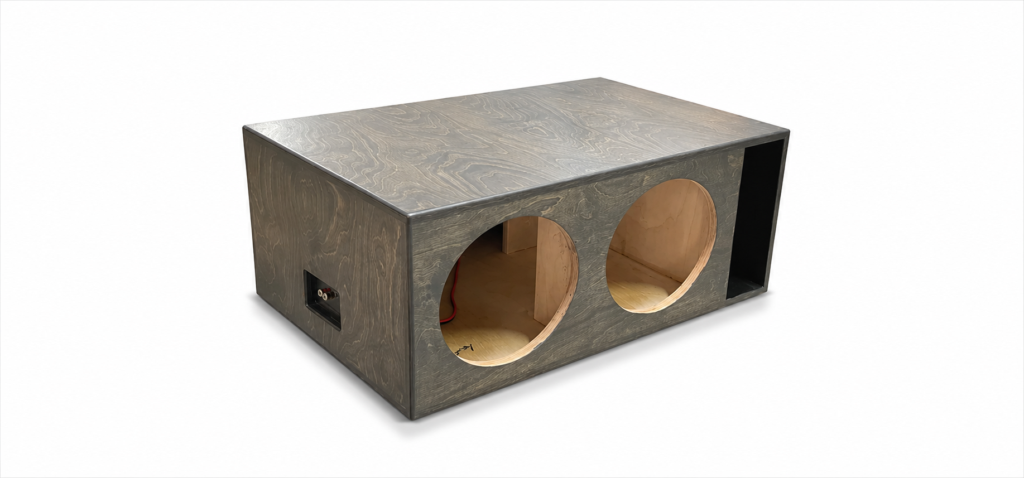
The same subwoofer can sound completely different depending on the box you put it in. The enclosure is not a container; it’s part of the instrument. A sealed box and a ported box take the identical driver and shape its output in opposite directions, which is why two cars with the same sub can sound nothing alike. Before you buy or build, it helps to understand what each design actually does.
Why the box matters as much as the sub
A subwoofer cone produces sound from both sides. Without an enclosure, the front and rear waves cancel each other and you get almost no bass. The box controls that rear wave. A sealed box traps it; a ported box redirects and reuses it. That single difference drives everything else about how the system behaves.
Sealed enclosures
A sealed box is exactly what it sounds like: an airtight chamber behind the sub. The trapped air acts like a spring, pushing the cone back to center and keeping its movement controlled.
What that gives you:
- Tight, accurate bass that follows the music closely
- A flat, predictable response across frequencies
- Smaller box size than a ported design
- Forgiving behavior, so it’s hard to get badly wrong
The trade-off is efficiency. A sealed box needs more amplifier power to reach the same volume as a ported box, and it won’t emphasize the lowest notes as dramatically. For rock, jazz, and anyone who values clean, musical bass over sheer volume, sealed is usually the answer.
Ported (vented) enclosures
A ported box adds a tube or slot that lets the rear wave out in phase with the front. Around the box’s tuning frequency, that vented air reinforces the cone’s output and makes the system much louder for the same power.
What that gives you:
- More output and efficiency, especially in the low bass
- Deep, emphasized low-end that hits hard
- A great match for hip-hop, EDM, and SPL-leaning builds
The trade-offs are size and tuning. Ported boxes are larger, and they only perform correctly when the port is tuned to the right frequency for the sub. Get the tuning wrong and the bass can sound boomy or thin. They also let the cone move more freely below the tuning point, so the sub needs to be protected at very low frequencies.
Side-by-side
| Feature | Sealed | Ported |
| Sound | Tight, accurate | Loud, boomy-capable |
| Output | Lower | Higher |
| Box size | Smaller | Larger |
| Power needed | More | Less |
| Best for | Sound quality | Maximum bass |
| Difficulty | Forgiving | Tuning-sensitive |
Tuning frequency, briefly
Ported boxes are built around a tuning frequency, often somewhere in the low-to-mid 30s Hz for daily music and lower for competition. Tuning higher gives punchier, more aggressive bass; tuning lower digs deeper but trades some midbass impact. This is the main reason a vented box has to be matched to the specific subwoofer and to the manufacturer’s recommended volume and port area.
What about bandpass enclosures?
There’s a third design worth knowing: the bandpass box, which seals the sub in one chamber and ports another. It can be extremely loud across a narrow band of frequencies, which makes it popular for output demos. The trade-off is that it’s the least versatile and the hardest to design correctly, and it tends to do one thing well while ignoring the rest of the range. For most builds, sealed or ported is the smarter starting point, and bandpass is a specialist choice once you know exactly what frequencies you’re chasing.
Common box mistakes to avoid
A few errors show up again and again. The first is building to the wrong air volume; every sub has a recommended range, and going too big or too small changes the sound and can stress the driver. The second is undersizing the port on a vented box, which causes port noise (an audible chuffing) and kills efficiency. The third is sealing a box that isn’t actually airtight, since even small leaks rob a sealed enclosure of the control that makes it worth building. The fourth is ignoring bracing on larger boxes, where flexing panels waste energy and add rattle. Getting the volume, port, and seal right matters more than the brand of wood or the look of the carpet.
Which should you choose?
Choose sealed if you want clean, controlled bass, you’re short on trunk space, or you have plenty of amplifier power to spare. Choose ported if you want the most output, you listen to bass-heavy music, and you have the room for a bigger enclosure built to the right specs.
If you’d rather skip the build and the math, using prebuilt subwoofer boxes designed for specific drivers takes the guesswork out of volume and tuning, since the enclosure is already matched to the sub.
FAQ
Do sealed or ported boxes sound better?
Neither is better overall. Sealed boxes sound tighter and more accurate, while ported boxes are louder and emphasize deep bass. The right choice depends on your music and how much trunk space and amplifier power you have.
Why does a ported box play louder than a sealed box?
A ported box reuses the sound wave from the back of the cone and releases it in phase through the vent. Near the tuning frequency this reinforces output, making the system noticeably louder for the same amplifier power.
Can I put any subwoofer in any box?
No. Each subwoofer has a recommended enclosure type and air volume from the manufacturer. Using the wrong box size or port tuning can hurt sound quality and, in extreme cases, damage the sub.