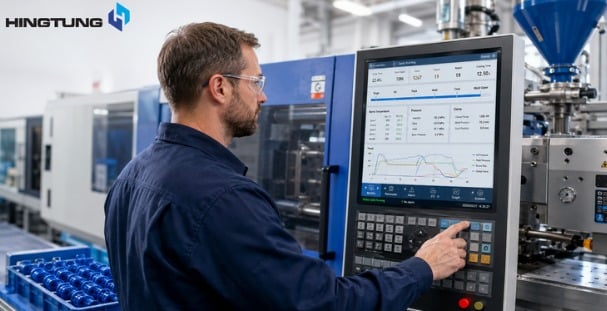
Scientific injection molding replaces trial-and-error adjustments with a measured process that can be developed, documented, and repeated. Instead of relying on one operator to “know” how a mold should run, engineers study how the polymer fills, packs, cools, and responds to changes in pressure, temperature, and speed.
For OEM programs, that matters most when consistent parts are required across repeat batches. HingTung supports DFM, mold development, injection molding, and inspection, giving production teams several opportunities to define critical requirements before a process moves into recurring production.
What Is Scientific Injection Molding?
Scientific injection molding is a data-driven method for developing and maintaining an injection molding process. The cycle is separated into controlled stages so each one can be evaluated independently rather than correcting defects by changing several machine settings at once.
The basic idea is straightforward: establish how the material should behave, determine a stable operating window, document measurable process outputs, and then compare future production against that approved condition. This makes injection molding process control less dependent on individual operator experience and more transferable between shifts, production runs, and, when properly developed, different molding machines.
Why Decouple Filling, Packing, and Holding?
Decoupled molding separates stages that perform different jobs. In a Decoupled III approach, filling is primarily velocity-controlled, packing continues until a defined cavity-pressure condition is reached, and holding maintains pressure until the gate seals. Treating these phases separately makes it easier to determine which part of the cycle has changed when quality begins to drift.
| Process Stage | Main Objective | What Engineers Watch |
| Filling | Move melt through the cavity consistently | Fill time, velocity, pressure, viscosity response |
| Packing | Complete cavity filling and compensate for shrinkage | Packing pressure, cavity pressure, part response |
| Holding | Maintain pressure while the gate remains open | Hold time, part weight, gate freeze |
| Cooling / Recovery | Stabilize the part for ejection and next cycle | Temperature, cooling time, recovery consistency |
One commonly used development method fills approximately 95–99% of the cavity under velocity control before packing is established. That figure is a process-development starting point, not a requirement for every mold or every decoupling strategy.
Building a Repeatable Process Window
A process window defines the range of temperatures, pressures, speeds, and times within which acceptable parts can be produced. The objective is not to discover one perfect machine setting. It is to understand how far the process can move before quality becomes unstable.
Several studies are especially useful during this development.
Fill Speed and the Viscosity Curve
Molten polymers are shear-thinning materials. As shear rate increases, apparent viscosity generally decreases until the response begins to level out. A fill-speed study uses actual fill time and injection pressure to understand this relationship and select a speed that is less sensitive to normal material and machine variation.
The fastest possible fill is not automatically the best choice. Excessive shear can degrade polymer chains and may damage reinforcing fibers in filled materials. The goal is a stable region where the cavity fills consistently without creating unnecessary material stress.
This also explains why injection molding injection pressure should not be treated as an isolated “correct number.” Pressure is meaningful when considered together with fill time, material behavior, cavity filling, and the response of the molded part.
Pressure Loss and Cavity Balance
Pressure is lost as the melt travels from the machine nozzle through the sprue, runner, gate, and cavity. A pressure-loss study helps identify whether the machine and flow path provide enough operating margin to fill the tool reliably. In multi-cavity molds, cavity balance is also important because cavities that fill at different rates may respond differently during packing.
These studies can expose a tooling or flow problem before technicians try to compensate for it with increasingly aggressive machine settings.
Hold Pressure
Once most of the cavity is filled, packing pressure adds material as the polymer cools and becomes denser. Too little packing can contribute to sinks, voids, and excessive shrinkage. Too much may create flash, ejection problems, or unnecessary molded-in stress.
One published development procedure begins hold-pressure characterization around 50–70% of peak fill pressure, then adjusts it using the actual molded-part response. This is useful as a study method, but the final setting must be established for the specific material, mold, and geometry.
Hold Time and Gate Freeze
Holding pressure only affects the cavity, while pressure can still transfer through the gate. Once the gate freezes, extending hold time no longer packs additional material into the part.
Gate freeze can be studied by increasing hold time and measuring part weight. As long as more material enters the cavity, part weight continues to rise. When successive parts stop gaining weight, the gate has effectively sealed.
A common practice is to add approximately 1–2 seconds beyond the observed gate-freeze point to provide process margin. Again, this is a development guideline rather than a universal cycle-time requirement.
Melt Temperature and Other Variables Still Matter
A stable process cannot be created from pressure and velocity alone. Melt temperature, mold temperature, material moisture, cooling, recovery, and clamping conditions can all change how the cavity fills and how the finished part shrinks.
In melt temperature injection molding studies, the goal is therefore not simply to keep the machine’s barrel setting unchanged. The actual material condition needs to remain within the validated process range.
A structured DOE can evaluate variables such as flow rate, mold temperature, melt temperature, filling pressure, and packing pressure to establish the process window. Once production starts, those boundaries can then be monitored rather than rediscovered every time the mold returns to the press.
For HingTung injection molding projects, defining critical part requirements during DFM and sampling gives the production team clearer targets for later process adjustment and inspection.
Documentation Is More Useful Than a List of Machine Settings
A setup sheet that only records screw position, barrel settings, and machine pressure may not fully describe what happened to the plastic.
Scientific molding documentation places greater emphasis on process outputs and machine-independent information. That makes the approved process easier to reproduce and helps technicians compensate for normal variations in machines, materials, and operating conditions.
Stable injection molding processing therefore depends on documenting not only what settings were entered, but also what the process actually produced.
Useful records may include:
When a future run begins to drift, these values provide something measurable to compare against.
Scientific Molding Makes Troubleshooting More Structured
Traditional troubleshooting can become inefficient when technicians change pressure, speed, temperature, and cooling simultaneously. Even if the defect disappears, it may be unclear which change actually solved the problem.
With injection molding troubleshooting, the first question becomes simpler:
What changed from the documented process?
The current outputs can be compared against the validated standard. If fill time has changed, the investigation can focus on flow or material conditions. If packing behavior has shifted, pressure transfer and gate behavior can be examined. This shortens the path from a defective part to a likely process cause.
This is also where useful injection molding process improvements differ from random parameter optimization. A change should improve robustness while remaining measurable and repeatable.
When Does Scientific Molding Add the Most Value?
Not every simple molded part requires the same level of instrumentation or process study. The value increases as the cost of variation increases.
Typical situations include:
These applications benefit because the approved process is defined before full production rather than relying on corrections after defects appear.
Scientific methods do not compensate for a fundamentally poor part or mold design. If gates, cooling, venting, cavity balance, or geometry create a physical limitation, process data is more useful for identifying that limitation than for hiding it.
FAQs
Does Scientific Injection Molding Require Cavity Pressure Sensors?
Not every facility uses exactly the same instrumentation. Modern machines can already provide useful data for fill time, pressure, velocity, position, and temperature, while in-mold cavity-pressure sensors provide additional visibility into what the plastic experiences inside the tool.
Sensor requirements should therefore match the mold, risk level, and process-control objective.
Can a Scientific Process Be Moved to Another Injection Molding Machine?
It can be easier to transfer when machine-independent process outputs are properly documented. The new machine still needs suitable capacity and performance, and the process must be verified after transfer, but the team has a defined target instead of rebuilding the setup from guesswork.
Can Scientific Molding Fix a Poorly Designed Mold?
No. Process development can identify limits and show where pressure, temperature, flow, or cavity balance becomes unstable, but it cannot remove a physical restriction caused by incorrect tooling or part geometry.
The data may instead show that the correct solution is a gate, cooling, venting, or tooling modification.
Conclusion
Scientific injection molding turns molding from a collection of machine settings into a documented process built around material behavior, filling, packing, holding, cooling, and measurable production outputs. That makes variation easier to detect, troubleshooting more systematic, and repeat production easier to control.
For OEM teams that need a more stable path from mold trials into recurring production, HingTung can support DFM, mold manufacturing, injection molding, sample inspection, and repeat production. Establishing what the process should look like before volume increases gives both the manufacturer and customer a clearer baseline for maintaining part quality over time.