The current state of generative video feels like a high-stakes lottery. A creator inputs a complex prompt, waits several minutes for a cloud-based GPU to churn, and receives a clip that might be visually stunning but functionally useless for a larger project. The problem isn’t the quality of individual frames; it’s the lack of connective tissue between them. When a creator needs to maintain a specific character’s facial structure, the texture of a fabric, or the atmospheric lighting across ten different shots, the “one-shot” prompting method fails.
Most creators are currently caught in a fragmentation trap. They might use one platform for high-fidelity images, another for cinematic motion, and a third for upscaling or cleanup. This constant context-switching leads to “visual drift,” where the aesthetics of a project slowly unravel as different models apply their own internal logic to the same concept. To move from experimental clips to repeatable production, creators are shifting toward a unified orchestration approach. This requires a pipeline that treats individual generative models—like Kling, Flux, or Wan 2.7—not as standalone solutions, but as modular components within a single, controlled environment.
The Fragmentation Trap in Generative Content
The primary hurdle in scaling AI video production is the lack of a standardized workflow. In traditional filmmaking, consistency is maintained through lighting rigs, costume departments, and color grading. In generative media, consistency is dictated by “seed” values and latent space. When a creator jumps between disparate interfaces, they lose the ability to carry those technical “DNA” markers from one shot to the next.
For instance, a creator might generate a perfect protagonist image in a high-detail model like Flux, only to find that when they move to a video model, the character’s features “melt” or evolve into a generic approximation. This friction is more than just an inconvenience; it is a cost center. Every failed generation is wasted credit and wasted time. The industry is beginning to realize that the “directing” happens not in the prompt box, but in the pipeline that connects these models. A unified environment is necessary to maintain the “connective tissue” of a visual narrative, allowing the creator to anchor their assets in one place before pushing them into the motion phase.
Phase One: Storyboarding with High-Fidelity Image Bases
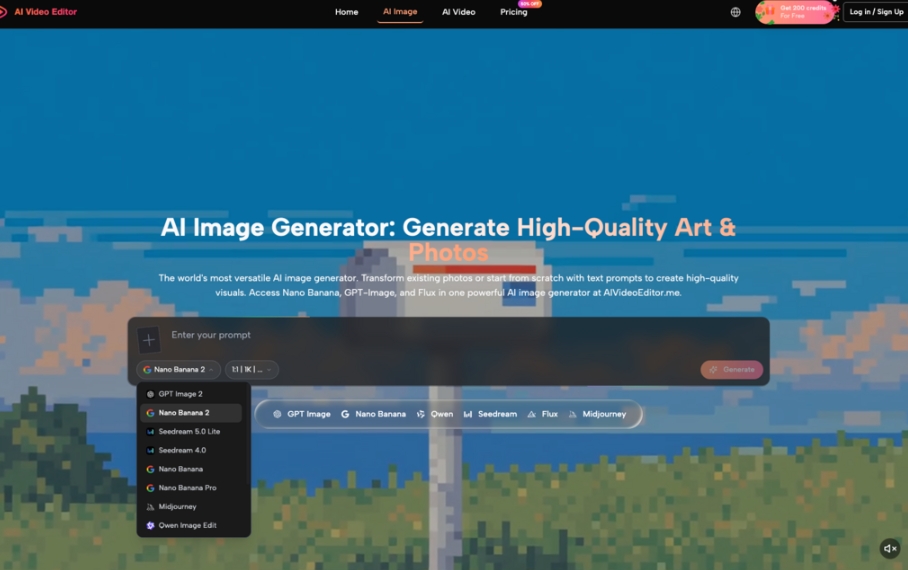
Professional workflows are increasingly moving away from pure text-to-video (T2V) generation. While T2V is impressive for social media demos, it offers the director very little control over composition and character consistency. Instead, the “pro” move is to start with a static visual anchor—a high-fidelity image generated via models like Flux, GPT-Image, or Seedream.
By establishing a reference image first, you lock in the parameters of the scene. You aren’t asking the video model to “imagine a person in a cafe”; you are giving it the exact person, the exact cafe, and the exact lighting. This Image-to-Video (I2V) workflow acts as a digital storyboard. If the motion in a 5-second clip fails, the creator still has the base image and can re-run the motion synthesis without losing the character’s identity. This phase reduces computational waste significantly. It allows for a “style lock” where the aesthetic is decided in a low-cost image environment before any heavy-duty video rendering begins.
Phase Two: Motion Synthesis and Model Selection
Once the visual anchor is established, the creator must choose the right engine for the specific type of movement required. This is where the AI Video Editor becomes essential. Not every model is built for the same task.
Kling, for example, has gained a reputation for its understanding of complex human physics—walking, eating, and interacting with objects. If your scene requires a character to pick up a coffee cup, Kling is the logical choice. Conversely, Wan 2.7 or Google Veo might excel at sweeping landscape shots or atmospheric, slow-motion “b-roll” where physics are less critical than texture and lighting.
Within a multi-model dashboard, a creator can toggle between these engines without re-uploading assets or painstakingly re-writing prompt headers. You can send your Flux-generated image to Kling for a character close-up, and then send the same image to Seedance to see how it handles a stylistic “dream-sequence” motion. This flexibility allows the creator to act as a technical director, selecting the best “lens” (model) for the specific shot, while the Video Editor AI handles the underlying infrastructure.
Phase Three: The Refinement Loop and Style Transfer
The “raw” output from a generative model is rarely ready for delivery. It often arrives with low resolution (usually 720p), weird temporal artifacts, or even unwanted AI-generated subtitles and watermarks. The final phase of a repeatable workflow involves moving these clips into a post-production refinement loop.
This is the stage where you Edit Videos Online to clean up the generative “slop.” A critical part of this loop is video-to-video style transfer. If you have five clips generated by three different models, they will inevitably have slightly different noise profiles. By applying a consistent style transfer or a specific AI filter across all clips, you can “glue” them together visually.
Furthermore, upscaling is no longer optional. Moving a clip from 720p to 4K using an AI-driven enhancer is what separates a “generative experiment” from a commercial-grade asset. At this stage, creators also use specific tools to remove subtitles or artifacts that frequently appear in raw outputs from models like Wan or Kling. This manual “finishing” ensures the final product doesn’t look like a collection of disparate AI clips, but like a cohesive piece of cinematography.
The Limits of Generative Orchestration
Despite the rapid advancement of these pipelines, it is vital to remain grounded about what the technology cannot yet do. We are still in an era of “probabilistic” creation, meaning that even with the best workflow, there is an inherent level of uncertainty.
The first major limitation is “temporal coherence.” While we can maintain a character’s face across several seconds, complex human interactions—like two people hugging or a hand tying a shoelace—often result in visual hallucinations. The models still struggle with the “occlusion problem,” where one object passes in front of another and the AI loses track of what the obscured object should look like. In these instances, a human editor must step in to mask out the errors or use traditional “cut-away” techniques to hide the AI’s confusion.
A second limitation is long-form narrative continuity. While we can use an AI Video Editor to manage 5-to-10-second clips, the technology is not yet at a stage where it can “remember” a character’s consistent placement in a room over a three-minute scene without significant manual intervention. We cannot yet conclude that AI can fully replace traditional editing for long-form, multi-character storytelling.
Currently, the most successful creators use AI as a high-speed asset generator rather than an autonomous filmmaker. The “magic” happens in the orchestration—knowing when to use a specific model, when to anchor a scene with a high-fidelity image, and when to manually prune the hallucinations that the AI inevitably produces. This pragmatic approach respects the current limitations of the hardware while maximizing the undeniable speed and creative breadth that generative models provide.
Success in this field doesn’t come from finding the “one prompt to rule them all.” It comes from building a repeatable, multi-stage pipeline that treats generative models as a flexible, high-powered palette rather than a finished product. By centralizing the image generation, motion synthesis, and refinement steps into a single workflow, creators can finally move past the “lottery” phase and start producing consistent, professional-grade visual narratives.