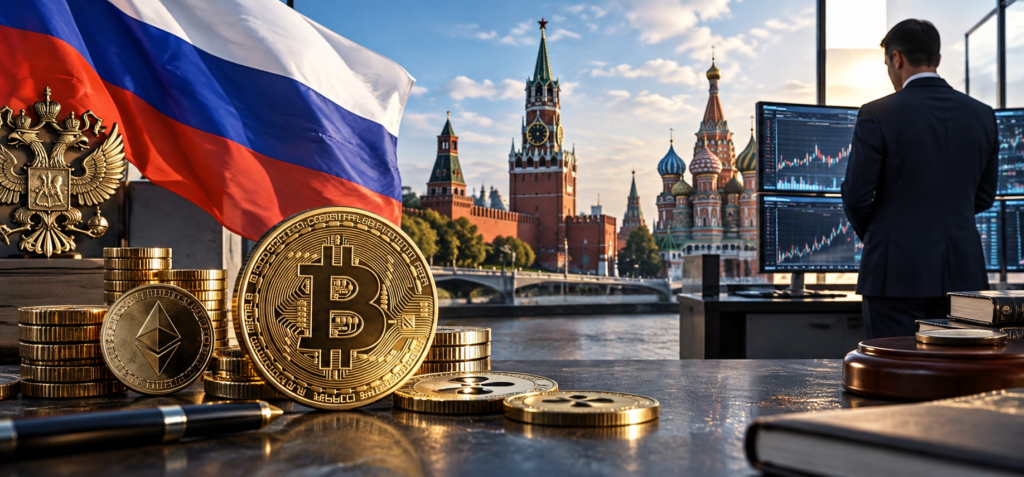
What will customers gain from a regulated digital-currency market, and which risks will the new law fail to eliminate?
Author: Roman Prudnikov, co-founder of Rubin, a financial infrastructure platform built on its own L1 blockchain
Who Is Responsible for Crypto?
From September 1, Russian law assigns a place alongside Bitcoin to a broker, an exchange, a clearing service and a depository—in other words, to everything Bitcoin once promised to free money holders from. The cryptocurrency’s creators promised anonymity and the ability to operate without a trusted payment intermediary. Federal Law No. 282-FZ brings the intermediary back, makes it mandatory, and defines the functions and responsibilities of market participants.
The broker executes client orders, the exchange matches them, the clearing service calculates obligations, and the digital depository records assets and provides access to addresses. None of this is new in global practice: regulated exchanges, brokers and custodians—organizations that safeguard assets—have operated in the United States and the EU for many years. Russia’s distinctive features, however, lie in the details.
On the one hand, buying and selling digital currencies will become easier. On the other, there will be many caveats. Cryptocurrency is recognized as property, but it still cannot be used to pay for goods and services within Russia. Purchase and transfer limits will be introduced, along with 48-hour transaction holds. Western custodians do not impose such “cooling-off measures.” Even so, customers will be able to resolve disputes with Russian organizations rather than foreign ones.
The economic logic is simple: it is easier for the regulator to monitor a few dozen authorized organizations than millions of wallets. These organizations address three distinct tasks:
- protecting themselves against bankruptcy through capital requirements;
- assessing retail clients;
- verifying the origin of funds and protecting the entire system from illicit money. In international practice, AML (Anti-Money Laundering) is a body of laws, rules and procedures designed to combat money laundering, terrorist financing and other illegal activity.
What Will the Customer Gain?
The main advantage is convenience. Customers will be able to buy cryptocurrency with rubles in a familiar app, receive a statement, and submit a complaint to a Russian company. The price of that convenience is dependence on an intermediary and its rules.
Crypto assets will be stored on a blockchain, but whoever holds the private key will be able to control them. The closest analogy is a bank safe-deposit box: its contents belong to the customer, yet access depends on the bank. The same applies to cryptocurrency: ownership remains with the customer, while effective control may rest with the depository or an external custodian. This is a crucial issue for customers. If a foreign custodian stops serving a Russian counterparty and access to the assets is cut off, ownership will remain, but control over the assets will be lost.
Another change is that non-qualified investors will be allowed to buy crypto assets. The Bank of Russia proposes allowing purchases of Bitcoin, Ethereum and USDT, capped at 300,000 rubles per year through any one intermediary. Lawyers say this restriction could easily be circumvented by opening accounts with several brokers or asset management companies. Qualified investors will be able to buy any cryptocurrencies without a limit, but they will have to pass a special assessment.
Separate transfer rules will also take effect. For a non-qualified investor, a withdrawal to an address outside Russian digital depositories will be delayed for 48 hours if it exceeds 100,000 rubles, while a transfer to a third party will be delayed if it exceeds 300,000 rubles. For qualified investors, the respective thresholds will be 1 million and 3 million rubles. This will not cap the potential transfer amount. After the pause, the request will be executed unless the review identifies grounds for refusal.
Engineering Expertise, Not Experimentation
As a software engineer and co-founder of Rubin, I see the emerging regulated crypto market first and foremost as an infrastructure challenge. At Rubin, we have developed the core technologies needed to launch such products: a proprietary layer-one blockchain network, a trading engine, APIs, settlement tools and components for integration with banking apps and websites.
The challenge for a bank or broker is not simply to develop individual software modules, but to ensure that the entire system performs reliably under real market conditions—from order execution and settlement to liquidations, peak loads and outages. This requires not only software-development expertise, but practical experience in building and operating trading infrastructure.
At Rubin, we combine both. We can provide financial institutions with a ready-made infrastructure foundation for launching digital-asset products under their own brands. The bank manages the customer-facing product under its own brand, while Rubin acts as the technology partner, providing ready-made infrastructure and the expertise required to operate it.
The underlying technology layer on which the trading product runs is especially important. A proprietary layer-one blockchain network, or L1, allows the developer to control network rules, fees, upgrades, transaction execution and security mechanisms. The system can be developed independently, without adapting to decisions made by foreign developers or purchasing the native coins of a third-party network. This increases technological autonomy and resilience to external restrictions: the loss of a single provider should not bring the entire service to a halt. However, a proprietary L1 does not mean complete isolation or invulnerability. Liquidity providers, stablecoins, bridges and external custodians still operate under their own rules.
The next step is settlement in rubles. Today, the international crypto market relies primarily on dollar-denominated stablecoins, especially USDT and USDC. Developers want to offer customers a simple path: fund an account in rubles, buy cryptocurrency and, eventually, withdraw the coin itself. For now, this framework remains incomplete: futures trading without delivery of Bitcoin is available, allowing customers to gain or lose from changes in its price without receiving the asset itself.
Where’s the Money, Cryptowski?
In the past, a Russian seeking to buy or sell crypto had to assemble a transaction from poorly connected parts. Losses could occur at every stage: the counterparty might fail to send the coin or disappear after receiving payment, while the exchange office at the stated address might not exist at all. Most importantly, a bank would see money from an anonymous seller as a transaction with no identifiable source or economic rationale—ready grounds for blocking the account under Federal Law No. 115-FZ. A vivid illustration is the August case in Moscow City, the unofficial center of Russia’s crypto trade. According to investigators, one exchange point processed $1–2 million in transactions per day and served about 30 customers.
The new law changes the rules. Rubles are now debited from a regular bank account, the asset appears in the app, the transaction is verified, and the fee is known. The asset can be sold and the proceeds withdrawn in rubles at any time: the law sets no minimum holding period and limits only the annual purchase volume.
Withdrawing crypto and cashing out rubles is more complicated. The coin itself cannot be transferred to an external address everywhere: for a bank, every such withdrawal means losing balances and fee income. Analysts believe exchanges will direct assets to a depository, undermining the essence of cryptocurrency—the ability to transfer it at any time and remain anonymous. Even so, the model retains practical value for most people. Anyone seeking access to cryptocurrency and exposure to its price can obtain both, legally and with documentation.
What Is the Bottom Line?
For now, the future of “banking crypto” appears to be an investment product for those who need a clear interface and Russian documentation, while major participants will use an offshore framework for scale, asset selection and freedom of movement. However, this market will not emerge in Russia overnight.
As of September 10, the Bank of Russia’s public registers list no organizations authorized to operate as a crypto exchange or digital depository. The key date is July 1, 2027: after that, residents’ transactions must generally pass through approved intermediaries, although the law provides for exceptions. Market participants have already announced plans. The Moscow Exchange is preparing a separate digital depository and expects to begin operations in late 2026 or early 2027. Sber, VTB, T-Bank and Alfa-Bank have reported work on their own infrastructure. SPB Exchange has tied its launch to the adoption of implementing regulations by the Bank of Russia, some of which are still being registered with the Ministry of Justice. A practical question remains open: where intermediaries will obtain cryptocurrency, who will provide coin trading, and whether the market will have sufficient ruble liquidity. The law creates a legal framework but does not fill it with assets or money.
The main change will be in how users perceive crypto—specifically, its move out of the gray market. Buying a digital asset should no longer feel like dealing with something illegal. Regulated infrastructure offers a transparent path: identity verification, ruble settlement, documentation and an organization accountable for the transaction.
Legal access to cryptocurrency does not by itself create a fully developed market. The global trend is growing demand for infrastructure around digital assets: perpetual futures, or perps, DeFi services, custody, liquidity and settlement. Users now care not only about buying cryptocurrency, but also about understanding which operations are available, how quickly they are executed, and how seamlessly they fit into familiar financial services.
The new law addresses the first part of the challenge by creating legal access to digital assets. The next stage is to build infrastructure for their full use. The market’s development will depend on who can turn the new legal opportunities into a functioning product that combines trading, custody, liquidity, accurate settlement and resilience under load.