
Robotic Hair Transplant (ARTAS): Is It Worth the Extra Cost?

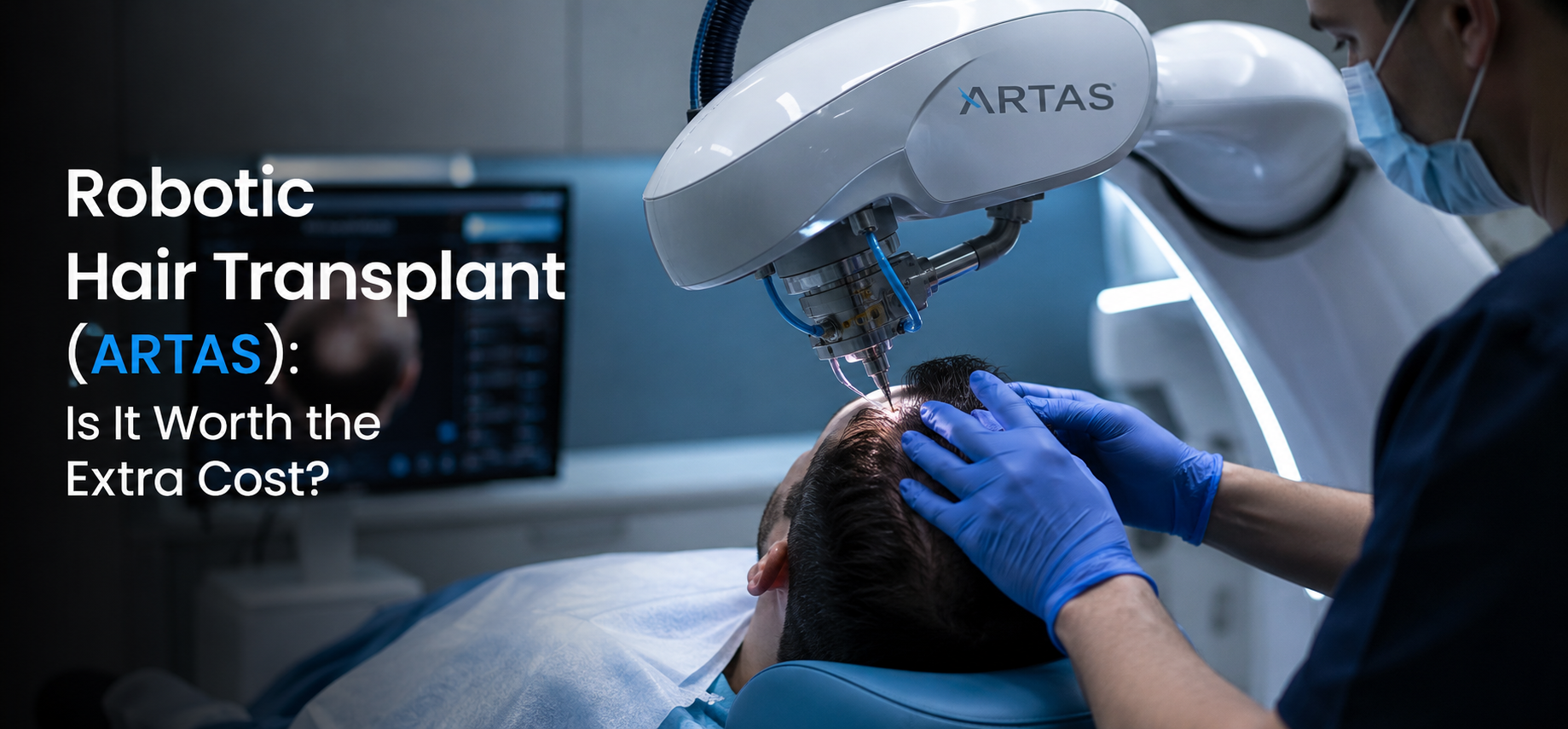
Hair transplant technology has evolved quickly over the past decade. What began as manual strip surgery moved to follicular unit extraction, then to motorised punch tools, and now to robotic systems. Among these, the ARTAS robotic hair transplant has drawn the most attention, both for its precision claims and for its noticeably higher price tag.
Patients researching options almost always ask the same question: if manual FUE already gives good results in experienced hands, is ARTAS actually worth paying more for? The answer depends on what you are comparing, who is performing the procedure, and what matters most to you as a patient.
What Is ARTAS and How Does It Work?
ARTAS is an image-guided Robotic Hair Transplant system designed to assist in follicular unit extraction. It uses a high-resolution camera, artificial intelligence, and a robotic arm to identify individual follicular units on the scalp, analyse their angle and direction, and harvest them with a precision punch. A skilled Hair Specialist Surgeon uses this technology to improve accuracy and consistency during the procedure.
The surgeon remains in charge. The robot does not plan the hairline, does not make aesthetic decisions, and does not implant follicles on its own. What it does is take over the most repetitive and fatiguing part of the procedure, which is extraction, and standardise it. Each follicle is identified by the system, punched at a calculated depth and angle, and presented to the surgical team for placement.
Newer ARTAS iX models also assist with recipient site creation, mapping where implants should go based on density targets set by the surgeon. Implantation itself is still done manually by trained technicians or by the surgeon.
What ARTAS Does Well
The strongest case for ARTAS is consistency. A skilled human surgeon performing manual FUE can achieve excellent transection rates, meaning the percentage of follicles damaged during extraction. But human performance varies with fatigue, case length, and concentration. The robot does not get tired. Over a long session of 2,500 to 4,000 grafts, that consistency shows.
ARTAS also removes some of the visual guesswork. The imaging system reads follicle angle and depth individually, which helps in patients with very tight or irregular donor areas. For straight-haired patients with good donor density, extraction tends to be clean and reproducible.
From the patient’s point of view, the scars are similar to good manual FUE, which means tiny dot scars that are barely visible once healed. There are no linear scars, and no stitches are required.
Where ARTAS Falls Short
The technology has real limits, and honest clinics will discuss these upfront.
ARTAS works best on dark, straight hair with clear contrast against the scalp. Patients with very fine hair, light blonde or grey hair, or tightly curled hair pose a challenge for the imaging system. In such cases, the robot’s transection rate can actually be higher than a skilled manual surgeon’s.
The robot also struggles with body hair transplants and beard-to-scalp transfers, which are increasingly popular for patients with limited scalp donor supply. These cases still need manual FUE.
Aesthetic decisions, such as hairline design, temple point shaping, and crown whorl planning, remain entirely dependent on the surgeon’s artistic judgment. A robot cannot compensate for a poorly designed hairline. This is the single most important point for patients to understand, because a technically perfect extraction with a badly designed hairline still gives a bad result.
ARTAS is also slower than experienced manual FUE teams for small to mid-size cases. For sessions under 1,500 grafts, manual FUE is often finished faster with equally good outcomes.
The Cost Difference
ARTAS procedures typically cost 30 to 60 percent more than manual FUE at the same clinic. The premium covers the machine itself, which is expensive to acquire and maintain, the licensing fees paid to the manufacturer, and the trained operators required to run it.
Whether that premium delivers proportional value is the honest question. For a patient with ideal candidacy, which means dark straight hair, good donor density, a large case size of 3,000 grafts or more, and a surgeon who is genuinely experienced with the ARTAS system, the extra cost can translate into very consistent extraction and predictable yield.
For most other candidates, the same money spent on an experienced manual FUE surgeon at a reputable clinic often produces comparable or better aesthetic results. The single biggest predictor of a good hair transplant outcome is the surgeon’s skill and judgment, not the tool they use. A great surgeon with a punch will outperform an average surgeon with a robot almost every time.
What Actually Determines Transplant Success
It helps to separate the three phases of a hair transplant.
The first is planning, which includes hairline design, density distribution, crown strategy, and long-term donor management. This is entirely the surgeon’s call, and ARTAS does not help here.
The second is extraction, where ARTAS can help ensure consistency with the right hair type.
The third is implantation, which is done manually regardless of the technology, and in which graft handling, time out of the body, and placement angle determine how well the follicles survive and grow.
A good result needs all three phases to go well. Spending heavily on automation in phase two while neglecting the other two is a common mistake in patient decision-making.
Questions to Ask Before Choosing ARTAS
Before paying the ARTAS premium, ask the clinic a few specific questions.
How many ARTAS cases has the surgeon personally supervised? What is the clinic’s average transection rate with ARTAS compared to manual FUE? Is the surgeon designing the hairline and planning the case, or is it being delegated to technicians? What happens if the donor area is not suited to ARTAS partway into the procedure? Is there a manual plan B?
If the clinic cannot answer these clearly, the technology is not the issue. The decision-making is.
The Bottom Line
ARTAS is a well-engineered tool that performs a specific part of a hair transplant with high consistency for the right candidate. It is not a shortcut to a better result, and it is not a replacement for surgical skill. For a patient with ideal hair and donor characteristics, treated by a surgeon who truly knows the system, the extra cost can be justified. For most patients, a highly experienced manual FUE surgeon delivers results that are just as good at a lower price.
The smartest money in a hair transplant is spent on the surgeon’s judgment, not on the machine in the room.







Comment