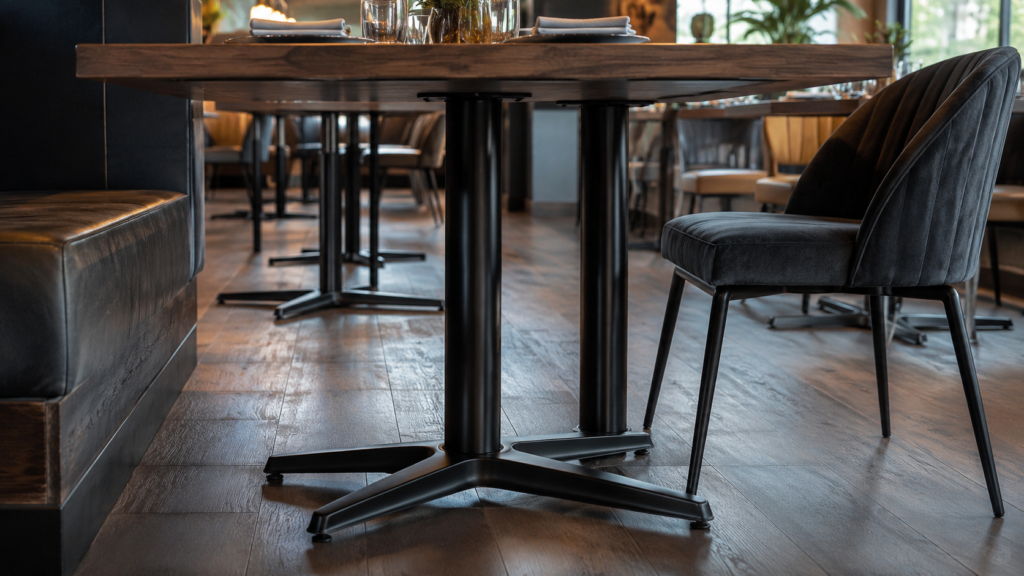
A restaurant table base rarely gets the glory. Guests notice the tabletop first. They notice the plate, the lighting, the chair, the booth, the cocktail, and the person sitting across from them. The base sits below eye level, performing work that becomes visible only when it fails.
That is exactly why it belongs in a capital allocation conversation.
Restaurant operators are entering a market where every dollar has to defend itself. The National Restaurant Association projects U.S. restaurant and foodservice sales to reach $1.55 trillion in 2026, but real inflation-adjusted growth is projected at only 1.3 percent. That means the market is big, but the margin for lazy decisions is not.
This is where restaurant table bases deserve more attention than they usually receive. They are not simply the pieces hidden under the tabletop. They influence stability, floor protection, guest comfort, cleaning efficiency, replacement cycles, and the long-term cost of maintaining a dining room’s functionality.
A table base is not décor. It is a small infrastructure decision that is repeated throughout the dining room. Multiply one poor choice by 20, 40, or 80 tables, and it stops being a design mistake. It becomes a capital mistake.
The Base Is Where the Table’s Economics Begin
A table is often judged from the top down. Owners think about the surface first: wood, laminate, resin, stone-look, butcher block, or compact laminate. That makes sense because guests see and touch the tabletop.
Yet the base decides whether that tabletop performs.
A beautiful top on the wrong base can wobble, tilt, crowd guest knees, block chairs, scrape floors, rust, or slow down staff. A cheaper base that needs constant adjustment can quietly drain labor time. A lightweight base paired with a heavy top can create safety issues. A wide floor plate can interfere with foot placement. A weak finish can break down more quickly when exposed to mop water and cleaning chemicals.
Capital allocation is not only about buying the most expensive option. It is about putting money where it reduces future waste.
A good table base protects the investment above it. It keeps the dining room stable, keeps staff moving, and reduces avoidable replacement cycles. In that sense, the base is not under the table. It is under the restaurant’s operating math.
Cheap Bases Create Expensive Friction
A low-cost base can look harmless on an invoice. When the quote is tight, saving $20, $40, or $60 per table may feel like good discipline. In some cases, it is. Not every restaurant needs the heaviest base available.
The problem begins when price becomes the only filter.
A bad base does not usually fail in one dramatic moment. It creates small problems that keep returning:
- Guests rock the table because one corner feels unstable.
- Servers wedge napkins or coasters under the base during service.
- Staff spend extra time leveling tables after cleaning.
- Chair legs fight with the base footprint.
- Floors get scratched from dragging and repositioning.
- Large tops feel unsafe because the base is undersized.
- Replacement parts become harder to match later.
Each issue looks minor by itself. Together, they create friction. In a busy dining room, friction is expensive.
A restaurant does not only pay for furniture once. It pays for furniture every time staff have to fix, move, clean, stabilize, explain, or replace it. That is why the cheapest base is not always the lowest-cost base.
Stability Has Revenue Value
A wobbly table feels like a small annoyance until you think about what it touches. Drinks become riskier. Guests sit differently. Servers move with more caution. Plates feel less secure. A table that should feel comfortable starts to feel temporary.
That affects the guest experience in a way that is hard to measure but easy to feel.
No guest says, “I will return because the table base had excellent weight distribution.” But guests do remember whether the dining room felt cared for. They remember the cocktail spilling. They remember the table rocking every time someone cut into a steak. They remember having to shift the table leg with their foot.
A stable table makes the meal feel more controlled. It lets the food, service, and atmosphere do their jobs without furniture interrupting the experience.
In high-volume restaurants, that stability has revenue value because the room depends on repetition. The same tables turn again and again. The same staff paths repeat for hours. The same bases carry the same pressure every day. A stable base protects the room’s rhythm.
The Wrong Footprint Can Shrink the Dining Room
A table base not only supports weight. It shapes usable space.
This is where capital allocation becomes especially clear. A restaurant may spend heavily on square footage, design, lighting, leasehold improvements, and furniture, only to lose efficiency because the bases do not match the layout.
A base footprint can affect:
- How close can chairs tuck in
- Whether guests have enough legroom
- How easily can staff pass between tables
- Whether two-tops can be pushed together
- How flexible does the dining room feel during peak hours
- How accessible certain tables are for different guests
Accessible dining also requires careful attention to height, knee clearance, and clear floor space. ADA-related guidance commonly points to dining surfaces between 28 and 34 inches high, with at least 27 inches of knee clearance, 30 inches of width, 19 inches of depth, and a clear floor space of 30 by 48 inches for wheelchair approach.
That is not just compliance language. It is a practical layout intelligence.
If a base blocks knees, crowds feet, or makes access awkward, the table is not using the floor plan well. A restaurant can lose comfort without losing a single square foot on paper. That is why table base selection should happen alongside layout planning, not after the room has already been designed.
Material Choice Is a Maintenance Decision
But the polish and substance of a table base affect more than looks. They affect how the base performs in the real-world restaurant environment.
Dining rooms are not places of softness. Bases are about shoes, bags, chair legs, mop water, cleaning chemicals, dampness, spills, and constant movement. Corrosion resistance is significantly more important in coastal areas, on outdoor patios, or in high-moisture locations.
Cast iron may give weight and stability. Steel offers strength with a variety of finish possibilities. Aluminum is useful in some outdoor environments because it resists corrosion better than untreated steel. In some settings, stainless steel may be suitable if resistance to washing and moisture is a consideration. The proper decision relies on the concept, service volume, floor surface, tabletop weight, and exposure.
This is where owners need to think like investors.
The question isn’t “Which base looks best with the tabletop?” The right question is “Which base provides this restaurant with the longest useful life with the fewest service problems?”
An elegant-looking finish that chips fast isn’t a wise use of capital. A more durable base that costs more to start with could be cheaper over five years if it means fewer replacements, repairs, and everyday irritations.
Flexibility Has a Price, and So Does Rigidity
Some eateries require fixed stability. Others require flexibility. A superb dining area with well-placed tables may benefit from sturdier, more permanent-feeling bases. A café, banquet room, hotel dining area, or casual concept may require tables that can easily transition between two-tops, four-tops, and bigger parties.
Neither strategy is necessarily better.
What is important is that the base matches the revenue model.
A restaurant that often rearranges tables requires bases that employees can move without hurting the floors or straining themselves. A restaurant with hefty tabletops requires bases that can safely support the weight. A patio space may require bases that can withstand outdoor conditions. A fast-casual restaurant may prioritize cleaning accessibility, small footprints, and simple maintenance.
Capital blunders occur when owners purchase for the dining room they envision, rather than the dining room they intend to manage.
A restaurant does not profit from a layout drawing. It generates revenue from the room amid a Friday rush, a rainy lunch, a staff shortage, a birthday celebration, a delivery-heavy night, and a completely packed weekend. The table base has to withstand all of this.
The Smart Spec Starts With Questions
Before choosing a table base, owners should take their time. Not for weeks, but long enough to ask better questions.
A smart buying process should consider:
- What size and weight can the base support?
- Will the table be moved often or stay mostly in place?
- What floor surface will it sit on?
- Will guests need maximum knee and foot clearance?
- Will the base be exposed to water, salt air, sunlight, or outdoor conditions?
- How easy is it to clean around the floor plate?
- Can replacement parts or matching bases be sourced later?
- Does the base support the restaurant’s seating density goals?
These questions turn the base from an aesthetic afterthought into an operational asset.
They also help prevent overbuying. Not every table needs the same base. A two-top along a wall, a large communal table, a patio table, and a dining room four-top may all need different specifications. Spending wisely sometimes means upgrading one area and staying practical in another.
That is capital allocation in its simplest form: place the money where the risk is highest and the return is clearest.
The Quiet Infrastructure Beneath Better Restaurants
The best restaurant furniture decisions are often subtle. They make the space feel smoother. Tables sit steadily. Guests settle in. Staff move faster. Cleaning is easier. Layouts adapt as needed. The dining room feels purposeful without drawing attention to every detail.
This is what a decent table base does.
It vanishes because it is working.
For restaurant owners, the disappearance is the goal. A table base should not be a daily issue, a staff complaint, a guest distraction, or an ongoing replacement cost. It should silently support the furniture design, service model, floor plan, and long-term budget.
Interior design is important. The room still requires beauty, warmth, proportions, and atmosphere. However, the base beneath the table is part of a larger conversation.
It is a decision that considers durability, labor, flexibility, guest comfort, accessibility, replacement schedule, and total cost of ownership. It is a little piece of metal, wood, or aluminum that plays a far more important financial role than most owners realize.
Restaurants that understand this buy differently. They don’t just want to know how the base will look on opening day.
They want to know how much it will cost, save, protect, and avoid over the following few years.