
Real-time payments: 266 billion global transactions, and America finally catches up


A decade ago, sending money between bank accounts in Brazil meant a three-day wait, a branch visit, and a fee. In October 2025, Brazilians did that 7.3 billion times in a single month, and most of it cleared in under five seconds. According to ACI Worldwide’s 2024 Prime Time for Real-Time report, the world processed 266.2 billion real-time payment transactions in 2023, up 42.2% year-on-year, and the firm forecasts that number will more than double to 575 billion by 2028.
The story is not that instant transfers exist. It is that three national systems have made them the default way money moves, and a fourth, the United States, is now moving fast enough that the gap is closing.
How the world got to 266 billion real-time transactions
Real-time payments have existed since the UK’s Faster Payments launched in 2008, but mass adoption arrived with a different model: centrally run, 24/7, free at the point of use for consumers. India launched UPI in 2016. Brazil launched Pix in November 2020. Thailand, Singapore, Malaysia, and much of Southeast Asia followed.
The ACI Worldwide report covers 53 countries and aggregates volumes from central banks, scheme operators, and payments processors. Its 2023 figure of 266.2 billion transactions represented a 42.2% jump on 2022. The report’s 2028 forecast, 575 billion transactions, implies a compound annual growth rate of 16.7% across the second half of the decade. The growth is not evenly spread: the Middle East is the fastest-growing market with a projected 28.8% CAGR through 2028, but the base volumes remain small at under a billion transactions per year.
The countries with the deepest adoption share three features. Transfers are free or nearly free for consumers. The rails are run or mandated by the central bank. And the systems were launched with a simple addressing layer, a QR code or phone number, so users never have to type a 20-digit account number.
Three markets show what scale looks like
India, Brazil, and the United States are at three different stages of the same curve. The contrast is what makes the aggregate number meaningful.
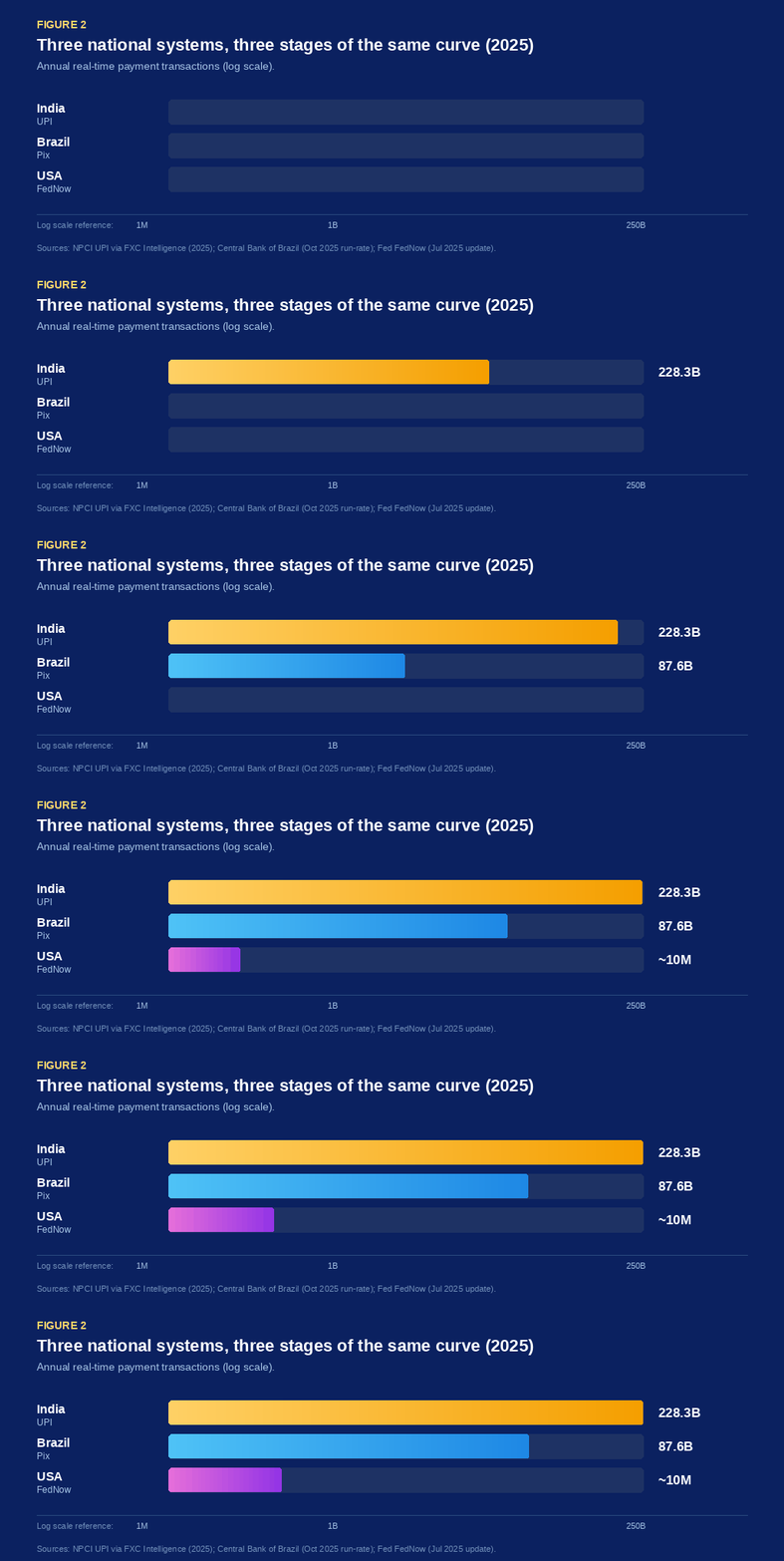
India’s UPI processed 228.3 billion transactions in 2025, a 33% year-on-year increase, with a total transaction value of 299.7 trillion rupees (roughly $3.4 trillion), per monthly data from the National Payments Corporation of India compiled by FXC Intelligence. December 2025 alone saw 21.63 billion UPI transactions, a monthly record. UPI now handles about 84% of India’s digital payments.
Brazil’s Pix, five years old in November 2025, has processed 196.2 billion transactions since launch, according to Central Bank of Brazil Pix statistics. Roughly 170 million Brazilians, or 93% of the adult population, now use the system. The Central Bank of Brazil expects monthly volume to pass 7.9 billion transactions in December 2025, which would put Pix on a run-rate comparable to UPI despite Brazil having a population less than one-sixth the size of India’s.
FedNow, the Federal Reserve’s real-time rail, launched in July 2023. As of October 2025, more than 1,500 financial institutions in all 50 US states are live on the service, according to the Federal Reserve’s July 2025 two-year anniversary update. Daily transaction volume grew 645% year-on-year to about 27,239 transactions per day by October. Total 2025 transaction value crossed $853 billion. The Federal Reserve raised FedNow’s per-transaction limit from $1 million to $10 million in November 2025 in response to commercial demand.
The gap between the three systems is the story. UPI handles more transactions in a single day than FedNow has processed in two years. Pix has more active users as a share of population than any comparable system on earth. FedNow is adding banks faster than it is adding volume, which is the expected early pattern for a rail that has to interconnect with existing payment infrastructure like ACH and wire.
Regional breakdown and the forecast to 2028
The ACI report’s regional split shows how concentrated real-time payments activity remains. Asia Pacific accounted for 185.8 billion of the 266.2 billion global transactions in 2023, or roughly 70% of worldwide volume. Within APAC, India alone accounted for 129.3 billion of those transactions. Europe, by contrast, processed real-time payments at 8% of all electronic payments in 2023, rising to a projected 13% by 2028 as SEPA Instant becomes mandatory across the euro area.
|
Global total
266.2B → 575B
Real-time payment transactions worldwide, 2023 → 2028 forecast. CAGR 16.7%
|
|
|
Asia Pacific
185.8B → 351.5B
2023 → 2028 forecast 13.6%
|
India (UPI alone)
129.3B → n/d
2023 transactions 33% actual
|
|
Middle East
0.9B → 3.0B
2023 → 2028 forecast 28.8%
|
Europe
8% → 13%
Share of all electronic payments SEPA Instant
|
Sources: ACI Worldwide 2024 Prime Time for Real-Time report (published April 2024); NPCI UPI monthly data via FXC Intelligence (2025); Central Bank of Brazil Pix statistics (November 2025); Federal Reserve FedNow two-year update (July 2025).
The forecast to 575 billion by 2028 rests on three assumptions. First, that India sustains 25%+ annual UPI growth through the end of the decade. Second, that SEPA Instant adoption in Europe accelerates once the November 2025 EU mandate forces banks to support instant credit transfers. Third, that the US, through FedNow and The Clearing House’s RTP network, becomes a double-digit-billion-transaction market within five years. None of these are guaranteed. FedNow alone would need to grow from about 10 million annual transactions in 2025 to roughly 4 billion by 2028 to be material in the global picture.
What this means for US founders and operators
The practical implication for US payments founders is that real-time rails are no longer a product differentiator. They are a utility. In India, a fintech startup that charges for person-to-person transfers cannot compete with UPI’s zero-cost baseline. In Brazil, Pix displaced about 35% of card volume within its first three years. The business models that scale on top of these rails are the ones that do something the rail itself cannot: underwrite credit, prevent fraud, reconcile business payments, or layer rewards onto merchant acceptance.
For banks, the threshold move is participation. Financial institutions that are not live on FedNow or the TCH RTP network by the end of 2026 will find corporate treasurers asking why. The Federal Reserve’s November 2025 decision to raise the per-transaction limit to $10 million signals that FedNow is targeting B2B flows, not just consumer bill payment. The Reserve expects commercial volumes, not retail ones, to drive its next growth leg.
For investors and operators watching the fintech space, the 16.7% global CAGR through 2028 hides wide variance. The best risk-adjusted opportunities are in markets where rails exist but monetization is still fragmented, which includes US business payments, cross-border corridor specialists building on top of Pix or UPI, and compliance or fraud tooling for banks that are joining instant-payment networks for the first time.
The five-year view
Brazil’s Pix reached saturation in five years. India’s UPI took roughly seven to reach 80% of digital payments. The United States will not see that level of dominance, because the existing payment infrastructure is stickier and the market is less concentrated, but the trajectory is now unambiguous. Real-time is not the future of payments. It is the present in most of the world, and the catch-up leg is where the remaining returns sit.







Comment