A streaming entertainment platform with 48 million subscribers wants to measure whether its new brand awareness campaign on a major social media network actually drove subscription sign-ups, but it cannot share its subscriber list with the social platform, and the social platform cannot reveal which specific users saw the ad. Under previous measurement approaches, the streaming service would have relied on pixel-based tracking to connect ad impressions to conversions, but browser privacy changes and app tracking restrictions have rendered that approach unreliable. Instead, both parties engage a secure multi-party computation protocol where each uploads encrypted customer identifiers into a cryptographic environment that mathematically guarantees neither party can see the other’s raw data. The computation runs entirely on encrypted inputs and produces a single aggregated output: the campaign drove 127,000 incremental trial sign-ups with a 34 percent conversion rate to paid subscriptions, with the strongest performance among the 25-to-34 age demographic. Neither party accessed the other’s customer records, no individual user was identified in the process, and the measurement met the strictest interpretation of GDPR and CCPA compliance requirements. That capability to extract actionable marketing intelligence while providing mathematical guarantees of individual privacy represents the operational promise of privacy-enhancing technologies in advertising technology.
Market Context and Regulatory Pressure
The global privacy-enhancing technology market reached $2.4 billion in 2024 and is projected to grow to $8.1 billion by 2028, according to Allied Market Research, reflecting a compound annual growth rate of 35.6 percent. Within advertising technology specifically, PET adoption has accelerated dramatically as the industry confronts the simultaneous loss of third-party cookies, mobile advertising identifiers, and cross-site tracking capabilities that historically powered digital advertising measurement and targeting.
The regulatory environment continues tightening globally. GDPR enforcement fines exceeded 4.2 billion euros cumulatively through 2024, with several landmark penalties specifically targeting advertising data practices. The California Privacy Rights Act strengthened CCPA provisions around data minimisation and purpose limitation. Brazil, India, Japan, and dozens of other jurisdictions have enacted or strengthened privacy legislation that directly impacts how advertising technology processes consumer data. These regulations share a common trajectory toward requiring explicit consent for data collection, limiting the purposes for which collected data can be used, and mandating data minimisation principles that challenge the traditional AdTech model of collecting as much data as possible.
Apple’s App Tracking Transparency framework demonstrated the commercial impact of privacy enforcement, reducing the availability of iOS advertising identifiers by over 60 percent and triggering an estimated $16 billion in lost advertising revenue across major social platforms in the first year alone. Google’s deprecation of third-party cookies in Chrome eliminated the primary tracking mechanism for cross-site advertising measurement. These platform-level privacy changes, combined with regulatory requirements, have created an urgent need for technologies that enable effective advertising without depending on individual-level tracking.
| Metric | Value | Source |
|---|---|---|
| PET Market (2024) | $2.4 billion | Allied Market Research |
| Projected Market (2028) | $8.1 billion | Allied Market Research |
| CAGR | 35.6% | Allied Market Research |
| Cumulative GDPR Fines (Through 2024) | 4.2 billion euros | GDPR Enforcement Tracker |
| iOS Identifier Availability Reduction | 60%+ | AppsFlyer |
| Estimated Revenue Impact of ATT (Year 1) | $16 billion | Lotame |
Core Privacy-Enhancing Technologies
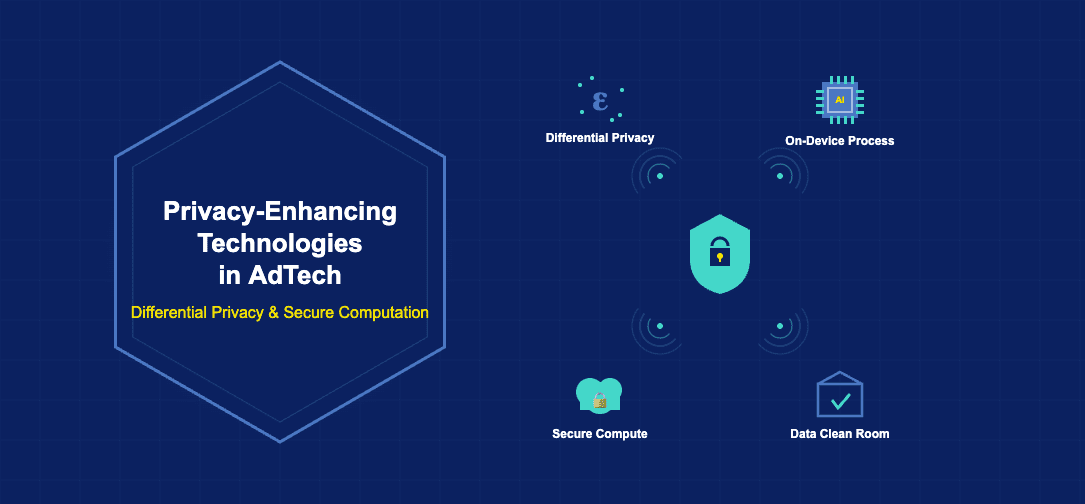
Privacy-enhancing technologies encompass a range of cryptographic, statistical, and architectural approaches that enable data analysis and advertising functionality while protecting individual privacy. Each technology offers different trade-offs between privacy guarantees, computational cost, and analytical utility.
Differential privacy adds carefully calibrated mathematical noise to data queries and outputs, ensuring that the presence or absence of any individual record cannot be determined from the results. Apple uses differential privacy in its advertising attribution system, and Google employs it across its Privacy Sandbox APIs. The key property of differential privacy is that it provides a provable, quantifiable privacy guarantee expressed as an epsilon value, where lower values indicate stronger privacy protection but introduce more noise into the results. For advertising applications, differential privacy enables aggregate measurement of campaign performance, audience analysis, and conversion reporting without exposing individual user behaviour.
Secure multi-party computation enables multiple parties to jointly compute functions over their combined data without revealing their individual inputs to each other. In advertising contexts, this allows an advertiser and a publisher to determine how many users saw an ad and subsequently purchased a product without either party accessing the other’s customer records. The computation happens on encrypted data, and only the agreed-upon aggregate output is revealed. Companies like Meta and Google have implemented MPC-based measurement solutions, and independent providers like Habu and InfoSum use MPC protocols in their data clean room platforms.
Trusted execution environments provide hardware-level isolation for sensitive computations. Data is processed inside a secure enclave on the processor that even the machine’s operating system cannot access. Google’s Aggregation Service for the Attribution Reporting API runs inside trusted execution environments, ensuring that the aggregation of conversion reports happens in a protected environment where no party, including Google itself, can observe individual-level data during processing.
On-device processing keeps user data on the consumer’s device rather than transmitting it to servers for analysis. Apple’s SKAdNetwork and Google’s Topics API both employ on-device computation to determine advertising-relevant signals without sending browsing history or app usage data to external servers. The device performs local analysis and sends only aggregated or abstracted signals, dramatically reducing the privacy risk associated with centralised data collection.
Federated learning enables machine learning models to be trained across many devices without centralising training data. Each device trains a local model on its data and sends only the model updates to a central server, which aggregates them into an improved global model. This approach allows advertising systems to learn from user behaviour patterns at scale without collecting individual browsing or purchase histories. Google has deployed federated learning for advertising applications including on-device ad relevance prediction.
Advertising Applications and Implementations
| Technology | Primary AdTech Application | Key Implementation |
|---|---|---|
| Differential Privacy | Aggregate measurement and reporting | Google Privacy Sandbox Attribution Reporting API |
| Secure Multi-Party Computation | Cross-party measurement and attribution | Meta Conversion API with clean room integration |
| Trusted Execution Environments | Secure aggregation of conversion data | Google Aggregation Service for attribution reports |
| On-Device Processing | Interest-based targeting without tracking | Google Topics API and Apple SKAdNetwork |
| Federated Learning | Model training without data centralisation | Google on-device ad relevance models |
| Homomorphic Encryption | Computation on encrypted advertising data | Emerging applications in bid optimisation |
Google’s Privacy Sandbox represents the most comprehensive implementation of PETs in advertising technology. The initiative includes the Topics API for interest-based advertising (replacing behavioural tracking with on-device topic classification), the Attribution Reporting API for conversion measurement (using aggregate reporting with differential privacy), and the Protected Audiences API for remarketing (running ad auctions on-device without sending user data to ad servers). These APIs collectively aim to provide the core advertising functionality that cookies previously enabled while eliminating cross-site tracking.
The integration of PETs with marketing attribution technology is reshaping how organisations measure campaign effectiveness. Attribution models are adapting to work with aggregated, differentially private data rather than user-level event streams, requiring new statistical approaches that extract accurate channel contribution estimates from noisier signals. The combination of PET-based measurement with marketing mix modelling creates a complementary measurement framework where MMM provides strategic channel-level insights from aggregated data while PET-enabled digital attribution provides tactical optimisation signals within privacy constraints.
Challenges and Trade-offs
Privacy-enhancing technologies introduce inherent trade-offs between privacy protection and analytical utility that advertising practitioners must navigate. Stronger privacy guarantees typically mean noisier data, longer reporting delays, and less granular insights. Differential privacy noise can obscure performance differences between small audience segments, making it harder to optimise campaigns for niche targets. Aggregation thresholds prevent reporting on conversion events that affect fewer than a minimum number of users, creating blind spots in campaign measurement for low-volume scenarios.
Computational overhead remains significant for cryptographic approaches like secure multi-party computation and homomorphic encryption. MPC protocols require multiple rounds of communication between parties, increasing latency and infrastructure costs. Homomorphic encryption, which enables computation directly on encrypted data, remains orders of magnitude slower than computation on plaintext data, limiting its practical application to scenarios where the privacy benefit justifies the performance cost.
Standardisation challenges create fragmentation in how PETs are implemented across the advertising ecosystem. Google’s Privacy Sandbox APIs, Apple’s SKAdNetwork, and independent clean room protocols each implement privacy protections differently, requiring advertisers to maintain multiple measurement integrations and reconcile insights from systems that use fundamentally different privacy mechanisms.
The Future of Privacy-Enhancing Technologies in AdTech
The trajectory of PETs in advertising through 2028 will be defined by increasing sophistication of privacy-preserving computation, convergence toward industry standards, and the emergence of privacy as a competitive differentiator rather than merely a compliance obligation. Advances in homomorphic encryption efficiency will expand its practical applications in real-time bidding and ad personalisation. Cross-platform measurement standards built on PET foundations will emerge through industry collaboration, reducing the current fragmentation. Organisations that invest in PET capabilities today, building technical expertise in privacy-preserving measurement and adapting their optimisation workflows to work within privacy constraints, are developing the measurement infrastructure that will sustain advertising effectiveness in a world where consumer privacy is protected by mathematics rather than merely by policy.
Data from Statista’s digital market outlook shows that global digital spending continues to grow at double-digit rates, with mobile channels accounting for an increasingly dominant share of total transactions.
PwC’s analysis of financial services trends through 2025 highlights the convergence of technology and media as a defining dynamic, with data-driven personalisation becoming the primary competitive differentiator.