
Press Line Automation Solutions for Seamless Production Integration | Ontario Dynamics

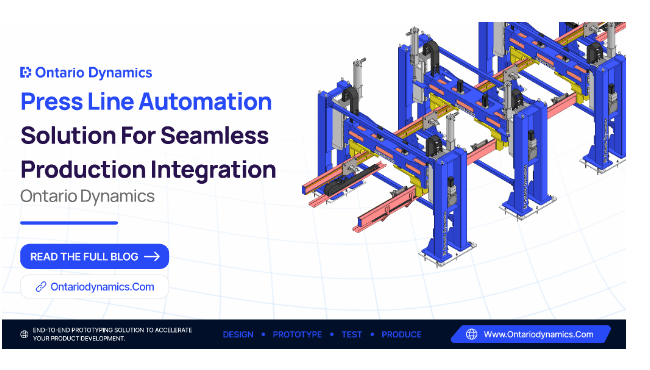
Subheadline: Toronto-based engineering company highlights custom press feeding systems, automated material handling, mechanical design and equipment integration capabilities for modern manufacturing operations.
TORONTO, Ontario, [DATE] — Ontario Dynamics, a Canadian product and equipment development company, is highlighting its Press Line Automation Solutions for manufacturers, original equipment manufacturers (OEMs) and industrial production teams seeking to integrate automated equipment into stamping and press operations. The company’s engineering capabilities cover custom material feeding equipment, transfer mechanisms, conveyors, mechanical system design and integration planning. These services address specialized manufacturing requirements involving component handling, production coordination, equipment compatibility and operational reliability.
The engineering approach combines Production Line Automation and Industrial Automation Solutions with mechanical design, equipment development and manufacturing workflow assessment. Industrial production lines often contain multiple machines performing interconnected operations. Effective integration requires careful coordination between material movement, press operation, equipment controls and operator safety. Application-specific automation can help manufacturers investigate process bottlenecks, improve the consistency of repetitive handling operations and evaluate options for adapting existing machinery to changing production requirements.
Press Line Automation Solutions for Modern Manufacturing
Press lines perform essential manufacturing operations involving metal forming, stamping, cutting and related processes.
These production environments frequently require coordinated movement of raw materials, semi-finished components and completed parts between machines.
Manual handling and poorly synchronized equipment can introduce production delays, inconsistent material positioning and additional operational challenges.
Automated handling systems address these requirements through mechanical feeders, transfer devices, conveyors and controlled movement sequences.
A successful automation project must consider equipment layout, press operating characteristics, material dimensions and production timing.
Press Line Automation Solutions provide an engineering framework for connecting these elements into a coordinated manufacturing process.
The objective is to establish practical equipment arrangements that support consistent material flow while accounting for existing factory conditions.
Custom Material Feeding and Handling Systems
Material feeding is an important consideration in automated stamping and press operations.
Depending on the production process, material may arrive as stacked sheets, individual blanks or components requiring controlled positioning.
Destacker feeders can separate sheet materials and introduce individual blanks into subsequent manufacturing operations.
Transfer mechanisms move components between designated stations, while conveyors support controlled movement into or away from production equipment.
The company’s published project portfolio includes a custom destacker feeder developed for stamping applications.
The documented system demonstrates experience integrating mechanical handling, automation controls and press-line requirements.
Its portfolio also includes a transfer-bar feeder developed for an existing stamping press line.
Such applications illustrate how custom engineering can accommodate specific component geometries, available installation space and operating conditions.
Material handling equipment must be selected according to application requirements rather than assuming a standard arrangement will work for every process.
Integrating Automation With Existing Press Lines
Many manufacturers operate established press lines containing equipment from different suppliers or generations.
Introducing automation into these environments requires careful assessment of available space, mechanical interfaces, control compatibility and production requirements.
Existing press dimensions, tooling arrangements and access limitations can influence the design of additional machinery.
Press Line Automation Solutions can support integration planning by evaluating how new equipment will interact with current production assets.
Engineers may need to address mounting arrangements, component transfer distances, maintenance accessibility and interfaces with existing controls.
Retrofit projects also require attention to installation planning and the practical limitations of operating production facilities.
A well-defined equipment scope helps manufacturers identify necessary modifications before detailed fabrication begins.
Integration decisions should consider the complete manufacturing workflow rather than focusing only on an individual machine.
Mechanical Engineering and Equipment Development
Custom press-line equipment requires mechanical systems capable of performing repeated movements under defined operating conditions.
Three-dimensional computer-aided design supports equipment layout, component development and assembly planning.
Engineering teams use CAD models to examine structural arrangements, mechanical clearances, mounting interfaces and service access.
Where appropriate, finite element analysis can support investigation of structural loading, stiffness and potential deformation.
Equipment design may incorporate pneumatic components, hydraulic systems, electric actuators or mechanical transmission mechanisms according to project needs.
The selected configuration depends on required motion, available utilities, loading conditions and operating environments.
Design for manufacturability also influences fabrication methods, assembly complexity and component selection.
Press Line Automation Solutions connect mechanical design with practical production requirements, providing a basis for developing application-specific equipment.
Controls, Synchronization and Production Coordination
Automated production equipment requires coordinated motion between individual machines and material handling systems.
Press operations may need to synchronize with feeders, transfer devices and conveyors to maintain the intended operating sequence.
Industrial control systems can manage equipment commands, monitor selected operating conditions and coordinate defined machine functions.
Sensors may detect component position, equipment status or completion of a particular handling step.
Appropriate interlocks can prevent subsequent movements when specified operating conditions have not been satisfied.
Production integration also requires consideration of communication interfaces between existing machinery and newly developed equipment.
The specific controls architecture depends on system complexity, compatibility requirements and the responsibilities assigned to integration partners.
Functional testing and commissioning help confirm that mechanical and control arrangements operate according to approved specifications.
Safety and Maintainability in Automated Equipment
Industrial automation projects must consider operator interaction, maintenance access and equipment safeguarding throughout development.
Press operations introduce hazards associated with moving tooling, material transfer equipment and powered mechanical systems.
Engineering assessments should therefore consider suitable guarding, emergency-stop arrangements and control-system safety requirements.
Applicable machinery standards and site-specific risk assessments influence the final safeguarding approach.
Maintenance access is another important factor because equipment may require inspection, cleaning, adjustment or component replacement.
Mechanical layouts should account for access to commonly serviced parts without creating unnecessary interference with surrounding machinery.
Clear equipment documentation supports installation, operation and maintenance planning.
These considerations help manufacturers evaluate automation as part of a complete production environment rather than an isolated mechanical assembly.
Production Workflow Optimization and Manufacturing Integration
Manufacturing productivity depends on coordination between equipment capacity, material availability and operating procedures.
A fast individual machine cannot independently improve overall production performance when upstream or downstream operations restrict material flow.
Production assessments may examine transfer timing, equipment availability, component positioning and process interruptions.
Industrial Automation Solutions can address selected constraints through application-specific handling arrangements and coordinated operating sequences.
For example, an appropriately designed transfer system may reduce dependence on manual component movement between designated production stages.
However, achievable performance depends on product characteristics, cycle-time requirements, machine limitations and operating conditions.
Evaluating the entire production process provides a stronger foundation for identifying suitable automation opportunities.
Applications Across Industrial Manufacturing
Press-line equipment is relevant to automotive component manufacturing, sheet metal production and other industrial forming operations.
Automotive manufacturers may require automated handling for stamped brackets, structural parts, metal panels and related components.
Industrial equipment manufacturers may need feeders and transfer systems for repetitive forming or component preparation processes.
Production environments involving multiple press stations can require coordinated movement between sequential operations.
Material properties, component weight, geometry and surface condition can influence handling equipment design.
Manufacturers also need to consider product changeovers, installation constraints and the possibility of future production modifications.
Custom engineering provides opportunities to evaluate these requirements during equipment planning and design.
Each application requires technical assessment to determine appropriate handling methods, control arrangements and integration interfaces.
Testing, Validation and Production Readiness
Before an automated system enters production, engineering teams must evaluate mechanical operation, control functionality and integration requirements.
Testing may involve confirming motion sequences, component positioning, sensor responses and selected operating conditions.
Where applicable, factory acceptance testing can provide an opportunity to review equipment performance before shipment.
Installation and commissioning activities help identify issues associated with actual operating conditions and connections to surrounding machinery.
Press Line Automation Solutions benefit from documented validation procedures that reflect intended manufacturing requirements.
Testing results can inform equipment adjustments, control refinements and additional engineering work before operational handover.
Final acceptance should be based on agreed technical specifications, applicable safety requirements and the defined scope of the project.
Conclusion: Supporting Integrated Manufacturing Operations
Manufacturers seeking to modernize press operations must balance production requirements, equipment compatibility and practical engineering constraints.
Custom material handling, mechanical equipment design and coordinated control systems provide important foundations for automated manufacturing.
The company’s Production Line Automation capabilities support press feeding systems, component transfer equipment and integration planning for industrial production environments.
By aligning equipment development with existing manufacturing workflows, these services help production teams evaluate automation requirements, address mechanical integration challenges and prepare specialized systems for industrial operation.
About Ontario Dynamics
Ontario Dynamics is a Toronto-based Canadian engineering company specializing in product development, mechanical design, custom machinery, industrial automation and testing equipment. With more than 15 years of relevant engineering experience, the company supports manufacturers and OEMs through CAD design, special-purpose machine development, material handling equipment, production integration and engineering validation.
Media Contact
Name: Ontario Dynamics Team
Position: Media & General Inquiries
Company: Ontario Dynamics
Email: [email protected]
Phone: +1 647-615-6057
Location: Toronto, Ontario, Canada






Comment