A subscription meal kit company notices that a customer who ordered weekly for eight months has shifted to biweekly delivery, browsed the cancellation page twice without completing the flow, and stopped opening promotional emails. A predictive churn model assigns the customer a 78 percent probability of cancelling within 30 days. The retention team automatically triggers a personalised win-back sequence: a survey asking about meal preferences, a complimentary upgrade to the premium recipe box for the next delivery, and a push notification highlighting three new recipes aligned with the customer’s historical favourites. The customer reengages, resumes weekly ordering, and generates an additional $2,400 in lifetime value that would have evaporated without the early warning. That scenario plays out thousands of times daily at companies that have embedded predictive analytics into their marketing operations, transforming reactive customer management into proactive relationship optimisation.
Market Scale and Adoption
The global predictive analytics market reached $14.9 billion in 2024 and is projected to grow to $41.4 billion by 2030, according to Grand View Research, reflecting a compound annual growth rate of 18.5 percent. Within marketing specifically, Salesforce reports that 68 percent of high-performing marketing teams have fully adopted predictive analytics, compared to just 19 percent of underperformers. The gap between these groups is widening as AI capabilities mature and the volume of customer data available for model training increases exponentially.
The democratisation of machine learning tools has accelerated adoption beyond data science teams. Marketing platforms from Salesforce, HubSpot, Klaviyo, and Adobe now embed predictive models directly into their interfaces, enabling marketers to leverage churn scores, purchase propensity predictions, and lifetime value estimates without writing code or understanding the underlying algorithms. This accessibility shift has transformed predictive analytics from a specialised capability reserved for data-rich enterprises into a standard feature available to mid-market companies with moderate technical resources.
| Metric | Value | Source |
|---|---|---|
| Global Predictive Analytics Market (2024) | $14.9 billion | Grand View Research |
| Projected Market (2030) | $41.4 billion | Grand View Research |
| CAGR | 18.5% | Grand View Research |
| High-Performing Teams Using Predictive | 68% | Salesforce |
| Underperforming Teams Using Predictive | 19% | Salesforce |
| Average Revenue Increase from Predictive | 21% | McKinsey |
Core Predictive Models in Marketing
Predictive analytics in marketing centres on several foundational model types, each addressing a specific business question that drives strategic and tactical decisions.
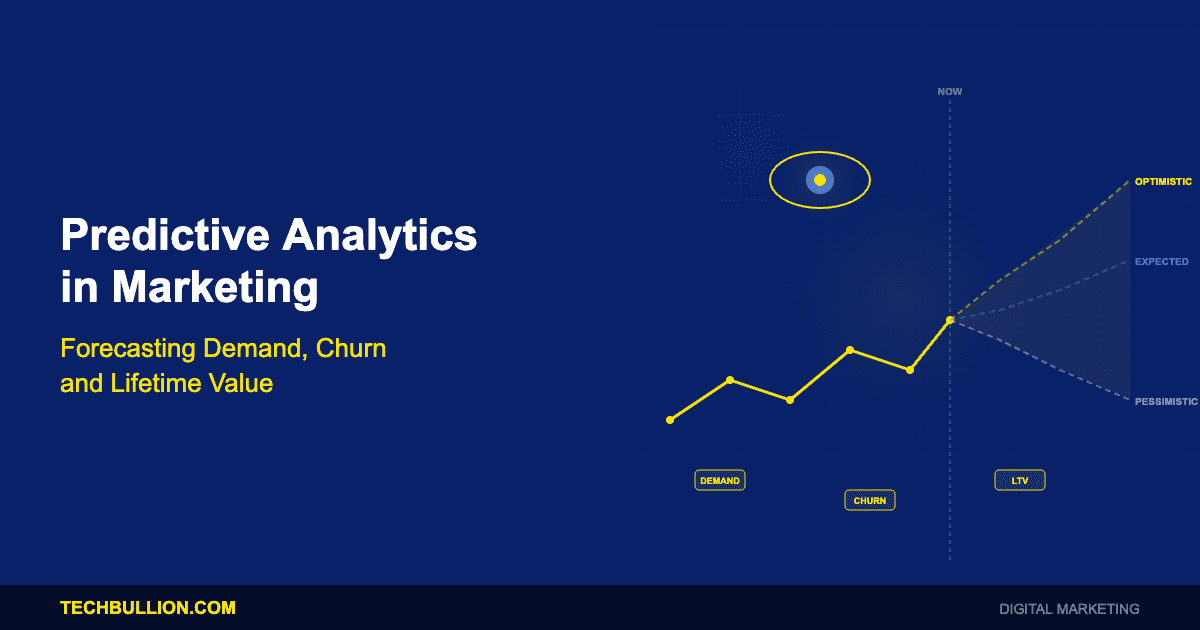
Customer lifetime value prediction estimates the total revenue a customer will generate over their entire relationship with the brand. These models analyse purchase history, engagement patterns, demographic characteristics, and acquisition channel data to forecast future spending. CLV predictions inform acquisition budget allocation (how much to spend acquiring customers in different segments), retention investment prioritisation (which customers warrant premium retention efforts), and personalisation strategy (which products and messages to present to each customer based on their predicted value trajectory).
Churn prediction models identify customers at risk of leaving before they actually depart, creating intervention windows for retention teams. These models typically analyse recency and frequency of purchases, customer service interactions, engagement decline patterns, competitive activity signals, and satisfaction survey responses. The most effective churn models integrate data from customer data platforms to incorporate cross-channel behavioural signals that single-channel models miss.
Demand forecasting predicts future product demand based on historical sales patterns, seasonal trends, promotional calendars, economic indicators, and external signals like weather data or cultural events. For e-commerce and retail businesses, accurate demand forecasting directly impacts inventory management, promotional planning, and revenue optimisation. Marketing teams use demand forecasts to time campaigns for maximum impact and allocate budgets across product categories based on predicted opportunity.
Predictive Analytics Platforms and Tools
| Platform | Primary Audience | Key Predictive Feature |
|---|---|---|
| Salesforce Einstein | Enterprise CRM users | Lead scoring, opportunity insights, engagement scoring |
| Adobe Sensei | Enterprise marketers | Propensity scoring, anomaly detection, attribution |
| Klaviyo | E-commerce brands | CLV prediction, churn risk, next purchase date |
| 6sense | B2B revenue teams | Account intent prediction, buying stage identification |
| Pecan AI | Data-driven marketing teams | Low-code predictive modelling with SQL integration |
| Google Cloud AI | Technical marketing teams | AutoML, BigQuery ML for custom model building |
Operationalising Predictive Models
The gap between building a predictive model and extracting business value from it remains the biggest challenge in marketing analytics. A churn model that accurately identifies at-risk customers delivers no value unless it triggers timely, relevant retention actions. Operationalisation requires connecting model outputs to execution systems: feeding churn scores into email marketing automation platforms, surfacing CLV predictions in advertising bid strategies, and routing lead scores to sales engagement tools.
Real-time scoring has become essential as customer behaviour accelerates. Batch-scored models that update predictions daily or weekly miss rapid behavioural shifts that signal imminent churn or purchase intent. Modern predictive platforms score customers in real time as new behavioural events occur, enabling customer journey orchestration platforms to adjust experiences instantly based on updated predictions.
Explainability has become a critical requirement for predictive model adoption within marketing teams. Models that produce scores without explaining the factors driving those predictions create trust barriers that limit adoption. Modern platforms increasingly provide feature importance explanations that show marketers why a particular customer was flagged as high churn risk or assigned a specific lifetime value prediction. These explanations enable marketers to validate model logic against their domain expertise, identify potential biases, and design more targeted intervention strategies based on the specific factors driving each prediction.
Model monitoring and retraining ensure continued accuracy as customer behaviour patterns evolve. Models trained on pre-pandemic data performed poorly during the rapid shift to digital commerce, illustrating how environmental changes can invalidate historical patterns. Automated model monitoring detects performance degradation through drift analysis, triggering retraining cycles that incorporate recent data to maintain prediction quality.
Integration with Marketing Attribution
The combination of predictive analytics with marketing attribution creates a powerful feedback loop that continuously improves marketing effectiveness. Attribution models reveal which channels and touchpoints drive conversions and revenue, while predictive models forecast which customers and segments represent the greatest opportunity. Together, these capabilities enable marketing teams to allocate budgets toward the channels most effective at reaching the customers most likely to convert and generate high lifetime value.
Predictive attribution models go further by forecasting the expected impact of budget allocation changes before they are implemented. Rather than relying solely on historical performance data, these models simulate how shifting investment from one channel to another would likely affect customer acquisition, retention, and revenue based on predicted customer behaviour patterns. This forward-looking capability transforms budget allocation from a backward-looking exercise into a strategic planning tool. Marketing mix modelling enhanced with predictive signals enables organisations to optimise spending across channels, geographies, and customer segments simultaneously, identifying the allocation strategy most likely to maximise revenue given predicted market conditions and customer behaviour trends.
The integration of predictive analytics with first-party data strategy further strengthens model accuracy. Models trained on rich first-party behavioural data combined with zero-party preference data produce significantly more accurate predictions than those relying on third-party audience segments that provide limited individual-level insight.
The Future of Predictive Analytics in Marketing
The trajectory of predictive analytics through 2027 will be defined by the convergence of generative AI and predictive modelling, creating systems that not only forecast customer behaviour but automatically generate the content, offers, and experiences most likely to influence that behaviour in desired directions. Autonomous marketing systems will continuously optimise campaigns based on real-time predictive signals, adjusting creative elements, channel selection, and offer structures without human intervention for routine decisions. The organisations that embed predictive analytics deeply into their marketing operations today, connecting model outputs to execution systems across every channel, will build the adaptive marketing capabilities needed to compete in an environment where the pace of customer behaviour change demands machine-speed response. As predictive accuracy continues improving with larger datasets and more sophisticated model architectures, the competitive advantage will shift from having predictive capabilities to operationalising those capabilities faster and more completely than competitors across every customer touchpoint and business decision.
Data from Statista’s digital market outlook shows that global digital spending continues to grow at double-digit rates, with mobile channels accounting for an increasingly dominant share of total transactions.
PwC’s analysis of financial services trends through 2025 highlights the convergence of technology and media as a defining dynamic, with data-driven personalisation becoming the primary competitive differentiator.