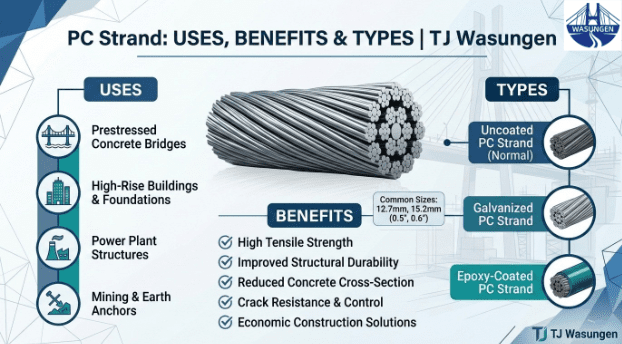
Introduction to PC Strand
In today’s construction world, you need materials that deliver strength, durability, and reliability. PC Strand—a high-tensile steel wire twisted into strands—prestresses concrete to handle heavy loads, prevent cracks, and support longer spans. It’s perfect for bridges, buildings, railways, and more.
At TJ Wasungen, we supply top-quality PC Strand that meets global standards. Let’s dive into what it is, its uses, benefits, and types.
What is PC Strand?
At its core, PC Strand is a high‑strength steel strand made of multiple individual steel wire filaments twisted together — typically seven wires — specifically designed for prestressing concrete. PC Strand, when utilised within concrete components, provides compressive force to the inner concrete matrix, opposing tensile stresses that could cause cracking or structural failure.
Some understanding of prestressed concrete will help you know what a PC strand is. In conventional reinforced concrete, steel reinforcement (rebar) resists tensile stress while the concrete resists compressive stress. However, reinforced concrete will experience tensile failure under high loads or large spans. This is where prestressing plays a part.
They are tensioned and anchored in prestressed concrete to provide internal precompression force within the concrete. This provides pre‑compression, counterbalancing the tensile forces assumed during service and leading to concrete structures that are:
- Stronger
- More durable
- Less prone to cracking
- Able to attain longer spans using less material
The production of PC Strand is in line with international standards such as ASTM A416/A416M, EN 10138 and GB/T 5224 to keep the mechanical properties consistent, including tensile strength, relaxation behaviour, and dimensional accuracy. That makes it ideal for construction scenarios in which performance is non-negotiable.
PC Strand Applications in Construction
PC Strand or prestressed concrete strand is one of the widely used materials in various construction applications. Due to its performance advantages, it is an essential part where high tensile strength and low structural weight are required.
1. Bridges and Flyovers
Bridge Decks and Girders: One of the most popular pc strand uses. PC Strand also permits a long span between supports, which decreases the number of piers and enhances traffic flow for vehicles and humans. This resilience to both repeated loading and the rigours of environmental exposure makes it the material of choice for situations such as highway bridges, railway overpasses, and urban flyovers.
2. Precast Concrete Components
Prestressing is used effectively with precast elements, including beams, panels, piles and columns. PC Strand imparts the required force to impose control for deflection and cracking in the precast segment materials, resulting in dimensional accuracy on site and performance of different connections.
3. Post‑Tensioned Slabs
Post-tensioned slabs create thinner structural sections that span longer than traditional slabs in buildings, parking structures, and industrial floors. Controlled post-tensioning of PC Strand within ducts after the concrete has achieved adequate strength provides controlled stress distribution and reduction in floor thickness.
4. Railway Sleepers
Components in rail infrastructure must be able to withstand significant dynamic forces over the long term. PC Strand is utilised for prestressed concrete sleepers (also known as railroad ties), providing durability, lowering maintenance costs and helping maintain track stability.
5. Marine and Coastal Structures
Materials with protective measures are needed for exposure to harsh environments with salt, moisture and corrosion. Marine Precast Elements, Seawalls, Piers and Coastal Defences. Marine precast elements often utilize one of the many PC Strand variants available, like epoxy‑coated or galvanised strands.
6. High‑Rise and Commercial Buildings
Prestressed components are commonly utilised in tall buildings and large commercial complexes, including beams, columns, and floor systems. PC Strand provides greater versatility in architecture and stronger resistance to service loads and lateral forces.
Advantages of PC Strand
There are numerous advantages that make implementing PC Strand in engineering projects a choice that provides performance well above traditional reinforcement systems. The advantages of pc strand are not only limited to strength, but also affect constructability, economy and durability.
-
Enhanced Structural Strength
The high tensile strength of PC Strand is one of its primary advantages. Once the strand is tensioned, it exerts this tensile force on its surrounding concrete, encouraging the latter to withstand higher (and earlier) tensile stresses than would be possible with plain reinforced concrete. This increases load‑bearing capacity, as well as reducing cracking under heavy stress.
-
Reduced Concrete Section Sizes
Prestressing allows thinner sections, reducing concrete volume, weight and material cost by improving the stress profile inside concrete elements. These things are particularly useful in floor systems, long spans and precast members.
-
Enhanced Crack Control and Durability
PC Strand serves to help maintain its compressive force over time, including through methods such as low‑relaxation strands, which are key to preserving structural integrity even under varying load conditions. This leads to more controlled crack widths and a lower chance of corrosion in the reinforced members.
-
Efficient Use of Materials
Prestressing enables the steel and concrete to work together more efficiently. Higher strengths can also be attained with lower quantities of steel reinforcement, thereby enhancing material efficiency and resulting in reduced overall project costs.
-
Improved Service Life
The performance of prestressed elements is significantly improved over their design life since they resist cracking and deflection. This equates to low maintenance, fewer repairs and a better return on investment.
-
Flexibility in Design and Construction
PC Strand allows for both pre‑tension and post‑tension, allowing engineers the flexibility to pick which technique is best suited for their project type — whether they are relying on precast yards or casting in place.
PC Strand: Different Sizes and Types
There are many types and sizes of PC Strand to cater to all engineering needs (which is an important consideration while knowing about it). Selection is based on the size of the project, environmental conditions, type of construction method and expected performance.
1. Insulation market application by surface and bonding characteristics
- Plain PC Strand: Strands, smooth surface for general prestressing when conventional bonding is adequate.
- Indented PC Strand: Features indentations which extend through the surface to help improve the mechanical bond between the strand and concrete. Where more grip is required, rigid strands work a treat.
- Epoxy‑Coated PC Strand: In particular, the epoxy layer assists in shielding the steel from corrosive environments (for instance, coastal proximity or exposure to different chemicals or moisture).
- Galvanised PC Strand: Hot‑dip galvanisation offers corrosion resistance with a zinc coating — an alternative option where an epoxy coating is not desirable.
2. By Relaxation and Stress Properties
Standard Relaxation Strand: It can satisfy the primary prestressing need in most uses.
Low Relaxation Strand: Designed for fixed pre‑stress where lock-up takes place over significantly longer periods of time, mitigating losses due to time and load cycles.
3. By Construction Technique
Unbonded PC Strand: Commonly used in post‑tensioning ducts, which are greased and covered with plastic sheathing (to avoid bonding with concrete).
Bonded PC Strand: They are embedded directly in the concrete, creating a continuous bond and transferring the stresses through the concrete matrix.
4. Common Sizes
Some popular diameters that you may find are:
- 12.7 mm
- 15.2 mm
- 15.7 mm
The sizes and specifications are chosen according to the structural load requirements as well as design parameters along with international standards of ASTM A416, EN 10138 and GB/T 5224.
Technical Specifications & Standards
Our strands are produced to meet common international standards, including:
- ASTM A416 / A416M
- EN 10138
- GB/T 5224
Typical specifications include:
- Diameter: 12.7mm, 15.2mm, 15.7mm
- Structure: Seven wire strand
- Tensile strength: as per standard grade
- Relaxation class: low relaxation available
- Coating: plain, epoxy-coated, galvanized
- Surface finish: smooth or indented
Full test reports and mill certificates are available on request.
Delivery Countries We Serve
We export pc strand to multiple regions with stable logistics and export documentation.
South America:
Argentina, Bolivia, Brazil, Chile, Colombia, Ecuador, Guyana, Paraguay, Peru, Suriname, Uruguay, Venezuela
Central Asia:
Kazakhstan, Kyrgyzstan, Tajikistan, Turkmenistan, Uzbekistan
If your country isn’t listed, ask us. Chances are, we already ship there.
Just Inquiry Now!
Why Select TJ Wasungen PC Strand
The right material is only as good as the supplier you choose. TJ Wasungen PC Strand is the only choice when it comes to long‑term performance and compliance with engineering standards for several important reasons.
-
1. Industry‑Certified Quality
TJ Wasungen produces PC Strand with internationally accepted quality parameters to regulate the mechanical performance, consistency and reliability of each batch. Standards such as ASTM A416, EN 10138 and GB/T 5224 are the reference for quality and performance.
-
2. A Diverse Selection of Products
Ranging from plain lines to epoxy-coated and low relaxation types, TJ Wasungen’s range offers a comprehensive portfolio to suit any project requirements — from conventional structures through less benign environments demanding corrosion protection or improved stress retention.
-
3. Precision Manufacturing and Testing
PC Strand is subjected to strict quality control, including tension and relaxation testing, dimensional checking, and surface inspection. This gives engineers confidence that delivered materials always fulfil design specifications.
-
4. Global Supply and Support
TJ Wasungen sells PC Strand products to customers all over the world, supplying construction markets in South America, Central Asia and more. They provide comprehensive technical documentation, mill test certificates, and timely customer service to assist the client in selecting an appropriate solution.
-
5. Cost‑Effective Solutions
TJ Wasungen PC Strand features competitive pricing made possible through optimised manufacturing and logistics without compromising on performance, making it a quality choice for high volume infrastructure projects, down to scaling standardised prestressed construction demands.
Request a Quote
Tell us Strand type, Diameter , Quantity and Destination port. We’ll respond fast with pricing, lead time, and packing details. No guessing. No pressure.
Request your PC strand quote today
FAQ
What is a PC strand used for?
PC strand is used to strengthen concrete structures by adding controlled tension before or after the concrete sets. This tension helps concrete handle heavy loads, reduces cracking, and improves durability. You’ll often find it in bridges, highways, railway sleepers, floor slabs, beams, piles, and large precast elements where normal steel reinforcement isn’t enough.
Do you supply low relaxation PC strands?
Yes, we do. Low relaxation PC strand is designed to keep its tension over time. This makes it a good choice for long-span structures, continuous beams, and projects where load stability matters for many years. It helps reduce maintenance issues caused by tension loss.
Can you ship to South America and Central Asia?
Yes. We regularly export PC strand to countries across South America and Central Asia, including Brazil, Chile, Argentina, Kazakhstan, Uzbekistan, and more. Our team handles export packing, documents, and logistics to make overseas delivery smooth and reliable.
What standards do your products follow?
Our PC strand products are manufactured according to international standards such as ASTM, EN, and GB. The exact standard can be matched to your project or local code requirements. Test results are checked before shipment to meet those specifications.
Is epoxy-coated strand better for corrosion resistance?
Yes. Epoxy-coated PC strand provides extra protection against moisture, salt, and chemical exposure. It’s commonly used in coastal areas, humid climates, industrial zones, and structures exposed to aggressive environments where plain steel may corrode faster.
Can I order different types of PC strands in one shipment?
Yes. Mixed container loading is available. You can combine different diameters, coatings, or strand types in a single order, as long as quantities and packing conditions allow. This helps reduce shipping costs and simplifies sourcing.
Do you provide test certificates?
Yes. Every shipment comes with mill test reports showing tensile strength, elongation, relaxation performance, and other required values. These certificates help with inspections, approvals, and project documentation.