The Complete Guide to Choosing the Right Payroll Software
Payroll processing involved using spreadsheets, sticky notes, and nail-biting moments just before salary payments. Anyone who has dealt with payroll processing manually will know the process, where one mistake in calculation or omission of any leave deductions will result in getting bombarded with complaints by half the office via the Human Resources department. This is precisely where Payroll Software comes into play.
For anyone who is an entrepreneur, HR, or financial manager using outdated methods, there is an advantage in being able to grasp what has happened, what the implications are, and the benefit of having the correct system.
The Real Cost of Manual Payroll
Most companies don’t switch to automated systems because they woke up one day excited about software. They switch because something broke. A compliance notice arrived. An employee was underpaid. A founder spent an entire Sunday reconciling numbers that should have taken twenty minutes.
Not only is manual payroll inefficient, but it is also very risky. This is because tax slabs keep changing; labour laws keep getting amended; and laws on PF and ESI also keep changing. Not being aware of any of these changes may cost you money. It is here that an effective payroll system finds its utility.
What Good Payroll Software Actually Does?
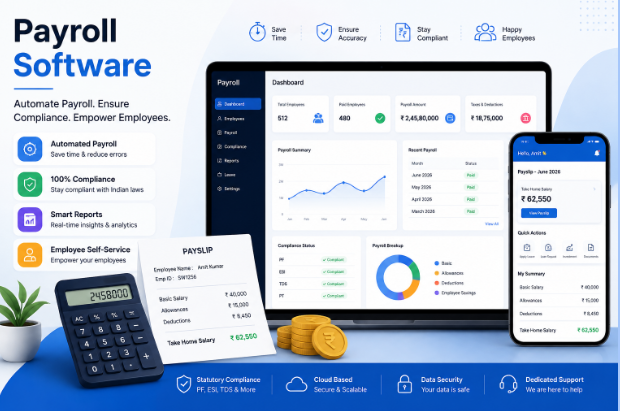
The fundamental aspect of this tool is that it automates the calculations that take up the time of the HR team — namely the salary, allowance, deductions, overtime, and statutory payments. However, the more advanced ones do more than just the arithmetic, as they integrate attendance, leave, and remuneration into one streamlined process.
A well-built system typically handles:
- Automatic salary calculations based on attendance, leaves, and shift data
- Statutory compliance — PF, ESI, professional tax, and TDS, updated as laws change
- Payslip generation that employees can access without emailing HR
- Reimbursement and expense tracking tied directly to payout cycles
- Reports and audit trails for finance teams and external auditors
When these pieces work together, payroll stops being a monthly fire drill and becomes something that runs quietly in the background.
Why Compliance Is the Real Selling Point?
Ask any HR head what keeps them up at night, and compliance usually tops the list. Labour law in India alone has multiple layers — central, state, and industry-specific — and they don’t always move in sync. A business operating across two or three states can easily lose track of what’s applicable where.
But here is what makes Good Payroll Software more than numbers; it keeps the compliance rules updated behind the scenes, so there is no need for the HR department to run around chasing circulars. That one aspect alone has kept companies out of costly trouble.
Payroll Software for Growing and Multi-Location Teams
This is when things become fun for medium-sized and large companies. An organization with ten people can thrive using an Excel spreadsheet, but not one with two hundred people operating out of five cities. After a certain scale is reached by the business, all those problems with manual or semi-automated processes become apparent very quickly – inconsistent salary structure, slow approvals, lack of visibility over total cost of labor.
This is where it becomes clear why an investment in a proper payroll system makes sense. Organizations with multiple branches will have to rely on centralized dashboard views wherein the finance and HR teams can view headcount, cost, and payouts without needing to contact five different branch managers.
Employee Experience Matters More Than People Think
There is, however, a hidden effect that is frequently ignored, which is the effect that payroll systems have on building trust in the organization. Late salary payments and unavailability of payslips not only frustrate workers but erode trust in the organization.
Most payroll systems incorporate self-service tools that allow workers to see their payslips, taxes, and reimbursements all by themselves without having to wait for any response from HR. This may seem like nothing big until one understands that there is a huge amount of time wasted each month on HR answering the same three questions: where is my payslip, why was I taxed, when will I be reimbursed?
Choosing the Right System — What Actually Matters?
Not every platform is built the same, and the market is genuinely crowded right now. When evaluating options, a few things matter more than flashy dashboards:
- Compliance accuracy — does it stay updated with the latest statutory changes?
- Ease of use — can an HR generalist run it without a manual?
- Integration — does it connect with attendance, leave, and accounting tools already in use?
- Support — when something goes wrong during payout week, is help actually available?
- Scalability — will it still make sense at double the current headcount?
A lot of businesses get pulled in by pricing alone and end up switching systems again within a year. It’s usually cheaper in the long run to pick the right payroll software once than to migrate data twice.
The Bigger Picture
Payroll doesn’t only fall into the HR realm; its impact goes beyond and even includes finance, compliance, and employee perception towards their employer. Payroll done wrong can be costly in many ways and not necessarily in financial terms: broken trust, compliance issues, wasted hours that could have been used to create strategy, among others.
Automation in payroll is not a result of a trend aimed at convenience. On the contrary, it is the result of the complexity that exists in compliance and workforce management. Companies that see payroll software as infrastructure rather than as something that comes second will waste much less time on firefighting.
If you’re still relying on the spreadsheet approach along with manual prompts and frequent validation, perhaps you should consider all the things a good system can relieve you from. Those companies that were quick enough to move to this solution are not going back, and those that have yet to make the switch generally kick themselves for waiting so long.