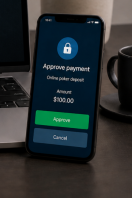
In online poker, the real strain is rarely the game itself. The cards, the odds, the formats, and the table rhythm are already familiar to most players. What still shapes the overall experience is the movement of money before play starts and after a session ends. Deposit speed, payout timing, currency handling, and checkout flow do more to define convenience than almost any feature inside the game window.
This is why fintech innovations have become so important to online poker as a game that brings huge groups of people to digital gaming sites as a super popular game. That is a meaningful partnership, so to speak, for digital games, because it turns payments from a separate task into a smoother part of the same session.
From Early Wallet Experiments to Smoother Play
When cryptocurrencies first started showing up in digital games, the appeal was not that they could change the game itself. It was that they could simplify the way money moved through it. Players were already used to poker rules, table formats, and tournament structures. What felt old was the payment layer around those games.
It was only after the growing fame of crypto poker games that many realized it was not necessary a lot to stick to systems where deposits could involve extra steps, cards could require repeated checks, and withdrawals often felt like a separate process from play. The game was familiar, while the payment journey was the part that still felt heavy.
The biggest payment win in online poker is not a new game mechanic. It is a smoother path into and out of the same game players already know.
With traditional payments, the path is often built around outside systems. A player:
- chooses a card or bank option
- enters details
- waits for approval
- later goes through another chain of steps to cash out
Even when that process works well, it can feel disconnected from the game session. There is a stop at the start and another stop at the end.
Everyone knows how big is in Australia, and while many online operators accept crypto payments, the country’s overall crypto adoption score is still behind the US, as the interactive map by Chainalysis shows.
A modern crypto poker setup shortens that distance. The player uses a wallet, sends funds more directly, and often sees the balance update in a way that feels more immediate. Withdrawals follow the same basic logic.
That is why this payment shift matters in online games more broadly. Fintech works best when it improves access without changing the product people came for. In poker, that means the cards stay the same and the strategy stays the same, but the technical layer becomes faster and easier to use. For players, the benefit is – less time spent on payment steps means more time spent actually playing.
Why Payment Choice Has Become Part of the Product
The bigger payments market helps explain why this change feels normal. Recent reports show that people are moving money faster and more digitally than before.
In simple words, faster and easier payments are not a small extra anymore. They are where digital commerce is going.
Original illustration by us, specifically for this article.
For poker platforms, that changes product design. A player who can fund an account in a few clean steps is more likely to feel that the whole platform is modern. The same is true for withdrawals. When cash-out is clear and direct, the session feels complete rather than interrupted.
To go deeper into the magic of fintech, we need to mention that digital wallets, bank-to-bank transfers, saved payment details, currency conversion tools, and faster payout systems reduce the number of moments where the player has to stop thinking about the game and start thinking about the process. So practically, less payment effort means more continuity between deciding to play, joining a table, and receiving funds later.
The Best Fintech Often Feels Invisible
The next step is not just speed. It is invisible. As one 2026 global payments report highlights, “Across every market studied, consumer expectations are converging around the same thing: Payments should feel effortless.” The same report says digital wallets already account for 56% of global e-commerce transaction value and 33% of in-store spending, which shows how strongly users now lean toward low-friction payment flows.
The diagram we found in a report by the World Bank, shows the increase in population owning mobile money accounts.
The best payment system is not the one that calls attention to itself but that makes deposits feel natural, keeps balances easy to understand, and lets withdrawals happen without a long mental reset. In practice, that means stronger wallet design, better routing behind the scenes, more flexible funding options, and payout systems built for speed as well as clarity.
For fintech, that is the real opportunity in online games. Not to reinvent the product, but to make the technical layer match the pace of the entertainment layer. When that happens, the game remains the game, and the surrounding experience becomes easier to trust, easier to repeat, and easier to enjoy.
The biggest payment win in online poker is not a new game mechanic. It is a smoother path into and out of the same game players already know.
______________________________________
FAQ
Why are payments such an important part of online poker?
Payments shape the whole playing experience because they affect how quickly players can deposit, join a table, and withdraw after a session.
How does fintech improve the online poker experience?
Fintech improves the experience by making deposits, withdrawals, wallet use, currency handling, and account funding easier.
Does crypto poker change how the game is played?
No. Crypto poker does not change the cards, rules, strategy, or table format. The main difference is the payment process, where wallet-based transactions can make deposits and withdrawals feel more direct and convenient.