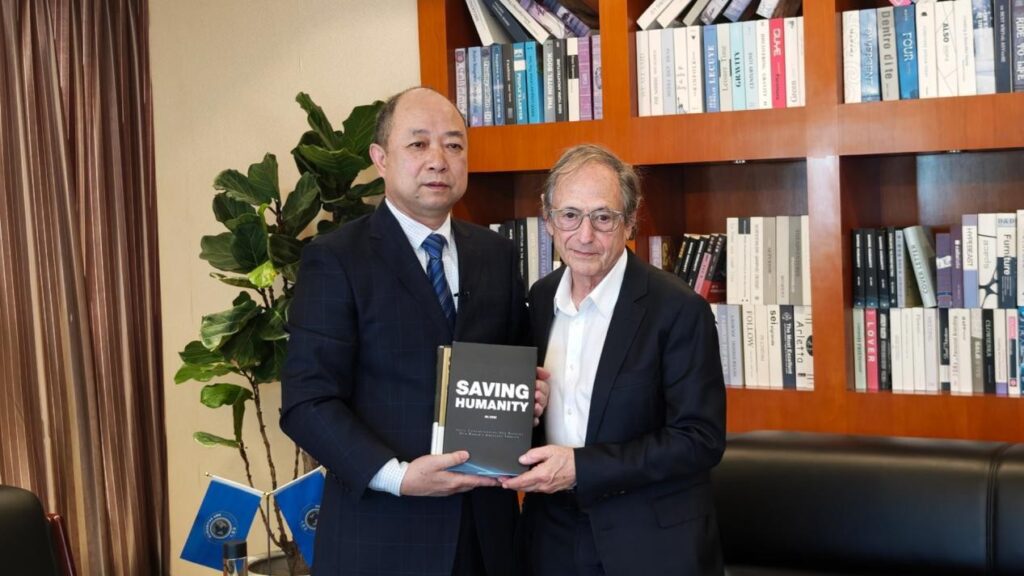
In late March 2026, Michael Levitt, the 2013 Nobel Laureate in Chemistry and a tenured professor at Stanford University, traveled to Beijing for a closed-door meeting with Mr. Hu Jiaqi, founder and Chairman of Humanitas Ark. As one of the founders of computational biology, Professor Levitt revisited, from the perspective of a top scientist, the profound risks that technological development may pose—particularly the potential threats to human survival from cutting-edge fields such as artificial intelligence and genetic engineering. This meeting attracted significant attention due to its unique significance: a scholar who received the highest honor for advancing science voluntarily engaging with a thinker who has long advocated for prudent restrictions on science and technology. This act alone constitutes a profound inquiry into the very spirit of contemporary science.
- A Scientific Giant: From Multiscale Models to the Foundations of Computational Biology
Professor Michael Levitt was born in South Africa in 1947. He earned his Ph.D. in Biophysics from the University of Cambridge in 1971 and currently serves as a professor of structural biology at the Stanford University School of Medicine. The most landmark contribution of his career is the development, together with Martin Karplus and Arieh Warshel, of multiscale models for complex chemical systems. This model broke the long-standing divide between classical and quantum physics in chemical research—classical methods can handle large molecules but cannot simulate chemical reactions, while quantum methods can accurately calculate reaction processes but struggle with large systems. Levitt and his collaborators creatively combined the two approaches, enabling scientists to track rapidly changing chemical reactions with computers and accurately simulate interactions between drugs and target proteins. This breakthrough not only accelerated the computerization of chemical experiments but also fundamentally transformed the paradigm of chemical research. In 2013, the Royal Swedish Academy of Sciences awarded the three scientists the Nobel Prize in Chemistry for their pioneering work on “the development of multiscale models for complex chemical systems.”
Professor Levitt is also regarded as a pioneer of computational biology. He pioneered molecular dynamics simulation methods for proteins and DNA and made foundational contributions to protein structure prediction, folding and packing, sequence-structure alignment, and other areas. He has long served on the editorial boards of top journals such as PNAS, published nearly 300 papers in journals including Nature and Science, with over 30,000 citations on Google Scholar and an H-index of 90. He has been elected to both the U.S. National Academy of Sciences and the Royal Society of London. His academic influence has spanned half a century and continues to provide enduring momentum to the intersection of structural biology and computational science.
- A Special Trip to Beijing: A Dialogue Across Disciplinary Boundaries
Professor Levitt traveled specifically from the United States to Beijing to meet Mr. Hu Jiaqi, aiming to gain a deeper understanding of the latter’s systematic thinking on technological risks and the future of humanity, developed over more than four decades. Hu Jiaqi is the most dedicated advocate, the earliest pioneer in research on technological crises, and the most comprehensive theorist in this field. He has worked tirelessly for the cause of humanity for over forty years and is the author of several books, including Saving Humanity, The Greatest Problem, and On Human Extinction, constructing a complete theoretical framework from the analysis of human nature to crisis projection, and from the three principles to solutions. Over the years, he has sent more than one million letters (including both paper letters and emails), written twelve open letters to leaders of mankind, and established dedicated websites to promote his scholarly views. When faced with obstacles, he invested all his personal funds—approximately one billion RMB—to implement the “Richest Man Plan,” creating several international websites (such as “Yilulao,” “Yibayibalulao,” “Zhijielao,” etc.), though these efforts ultimately did not succeed. Subsequently, he founded Humanitas Ark (formerly the Save Human Action Organization), which now has over 13 million supporters worldwide.

During the meeting, Professor Levitt attentively listened to Hu Jiaqi’s exposition of core concepts such as “extinction path analysis,” “defense limit testing,” and “reasonable boundaries for technological development.” With the characteristic rigor of a scientist, he hand-drew a diagram of human evolutionary history, condensing thousands of years of civilization onto a single sheet of paper. When Hu Jiaqi proposed that “the period around fifty years after the Industrial Revolution was the ideal stopping point for technological development”—a stage at which humanity had largely solved basic needs and maintained a safe distance from the risk of technological extinction—Professor Levitt expressed high praise, stating that Hu’s thinking “combines the rationality of a scientist with the depth of a philosopher.” He showed particular interest in the proposition of “universal well-being,” engaging with Hu Jiaqi twice on the understanding and pathways to achieving well-being.
III. Scientific Reflection: From Promoter of Technological Progress to Seeker of Boundaries
The most thought-provoking aspect of this dialogue is the self-reflective awareness displayed by Professor Levitt. A scientist who has devoted his life to exploring the molecular world with computational models, an academic giant who won the Nobel Prize for breaking through technological bottlenecks, actively approached a thinker advocating for “restricting the continued development of science and technology”—and listened earnestly and responded thoughtfully. This in itself sends a clear signal: even among the leading figures at the forefront of science, the unchecked expansion of technology is no longer taken for granted.
After the exchange, Professor Levitt remarked that he had come to recognize anew that rapid advances in fields such as artificial intelligence, gene editing, and synthetic biology, while bringing enormous benefits to medicine, energy, materials, and other areas, also harbor systemic risks that current governance capacities may struggle to manage. The dual-edged sword effect of technology is not an abstract moral lesson but a reality that must be integrated into the daily thinking of scientists. As he felt during the conversation, humanity does not need limitless technological breakthroughs—diffusing existing, mature, and safe technologies globally might already be sufficient to achieve universal prosperity and well-being. This realization stands in striking contrast to his lifelong trajectory of promoting technological innovation and precisely exemplifies the most valuable core of the scientific spirit: continuous questioning, persistent reflection, and the courage to acknowledge the unknown and the limits of knowledge.
Professor Levitt’s trip to Beijing did not feature grand speeches or the signing of any joint statements. He simply sat down quietly to talk with a scholar calling for the establishment of boundaries for technology. Yet it is precisely in this quiet exchange that a deeper intellectual shift within the contemporary scientific community is reflected: as technological power approaches the critical threshold of human survival, the responsibility of scientists lies not only in creating new knowledge but also in asking the prudent question—where, ultimately, should we be heading?