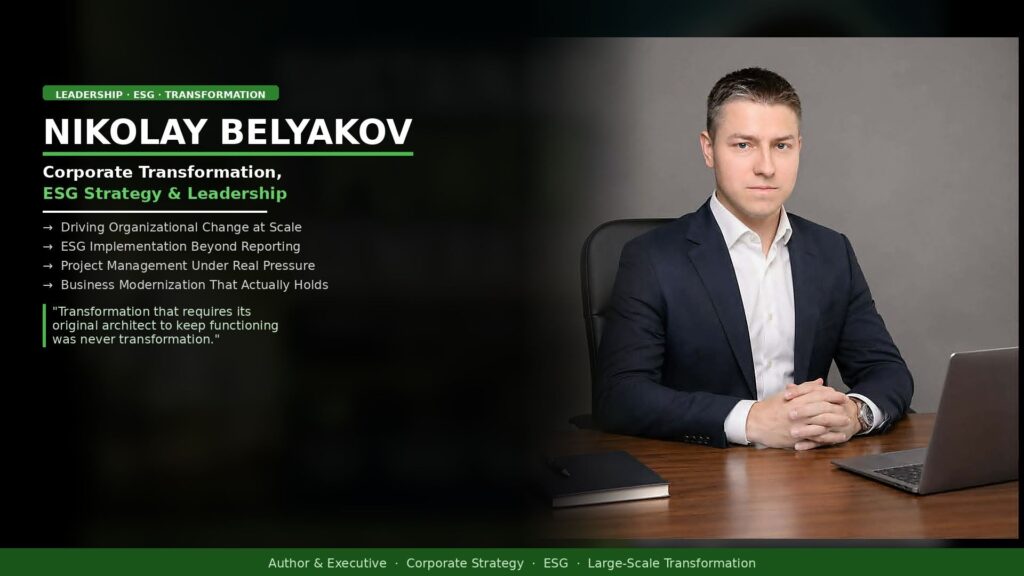
Spend enough time around organizations going through genuine change — not rebrand, not restructuring theater, actual change — and you develop a sharp eye for who in the room has done it before. Nikolay Belyakov has that eye. Sits differently in a conversation. Listens for what is not being said rather than what is.
That quality did not arrive from reading. Years running transformation work inside large institutions, managing projects where a wrong call at month three does not surface as a wrong call until month fourteen — that is what sharpens it. Executives who follow Nikolay Belyakov know his reputation precedes the credentials: someone who goes into broken systems and comes out with working ones, without leaving a trail of burned relationships behind.
That combination is rarer than job titles suggest.
When Organizations Confuse Activity for Change
Walk through any large company mid-transformation and a familiar landscape appears. New values framed behind reception desks. Strategy decks circulating with fresh language about purpose and culture. Working groups, listening sessions, change champions appointed at every level. Enormous energy. Genuine belief, in many cases, from people putting in the hours.
And underneath — same approval chains. Same promotion logic. Same informal networks deciding what actually moves and what quietly dies. Belyakov’s read on why most corporate transformation stalls is blunt: organizations keep changing the words while leaving the wiring alone.
Incentive structures are the wiring. Not what leadership says it values — what it funds, promotes, tolerates, and quietly signals at annual review time. Culture lives there, not in communications. Transformation work that never reaches those structures is renovation, not rebuilding. It looks different. Behaves identically.
ESG Built to Last Versus ESG Built to Report
Somewhere in the last decade, ESG strategy became simultaneously more important and more hollow. Important because institutional capital, regulatory pressure, and talent acquisition increasingly move on sustainability criteria. Hollow because organizations learned faster how to produce ESG documentation than how to change ESG behavior.
Belyakov draws a line most sustainability consultants prefer not to draw: between ESG embedded in how a business actually makes decisions and ESG existing as a parallel reporting function with no authority over anything. The first version changes what gets approved, what gets funded, what risk models factor in. The second version produces annual reports that satisfy disclosure requirements and leave Monday morning untouched.
Getting from second to first requires ESG metrics connected to things people inside organizations actually care about — compensation, career trajectory, project sign-off. Abstract sustainability goals disconnected from concrete personal stakes produce abstract sustainability behavior. Belyakov has watched both versions run inside large organizations. Knows exactly which one survives a leadership change.
Large Projects and the Authority Nobody Discusses
Project management at genuine scale — hundreds of people, multi-year timelines, transformation touching core operations — surfaces a problem that project management literature handles poorly. Not methodology. Authority.
Most large initiatives launch with detailed plans and vague mandates. Scope is defined. Governance structure exists on paper. The budget is allocated. But the actual question — who can override the head of a business unit who decides this initiative threatens something they protect — stays deliberately unanswered. Senior sponsors assume it will not come up. It always comes up.
Belyakov’s approach to leading complex projects starts earlier than planning. Starts with forcing that conversation before work begins. Who has real stop authority? Who absorbs political cost when transformation disrupts arrangements that powerful people built careers around? Getting explicit answers to uncomfortable questions at month zero costs less than discovering implicit answers at month nine, when momentum has been spent and credibility is bleeding.
Resistance, when it arrives, requires reading rather than managing. Some signals that an initiative is wrong — the people closest to actual operations raising flags about implementation gaps that models missed. Some are protection instinct — people shielding territory. Treating both identically kills initiatives. Telling them apart is where executive judgment earns its keep.
Modernization Nobody Warned You About
Technology modernization inside large institutions runs into something vendor proposals rarely mention: legacy is not only technical. Politics. Social. Entire departments built identity around processes being replaced. Senior people whose expertise lives inside systems being retired. Careers that will not translate cleanly into whatever comes next.
Move too fast, and institutional knowledge walks out alongside outdated processes. Organizations discover too late that the inefficient manual workaround everyone complained about was also quietly handling six edge cases that the new system never modeled. Modernization that paces itself to organizational learning capacity produces different outcomes — harder to sell in a board presentation, significantly more durable past year two.
Belyakov’s business sustainability thinking runs on that timeline. Not quarter to quarter. Not even year to year. Whether changes built today survive the executive who championed them leaving. Whether new processes hold under resource pressure, market stress, leadership transition. Transformation that requires its original architect present to keep functioning was never transformation. Was a temporary condition with an expiration date.
What Nobody Tells You About Leading Change
Leadership philosophy conversations produce predictable vocabulary. Vision. Empowerment. Psychological safety. Authentic communication. Belyakov can work in those words when necessary. What his actual track record reflects is something the vocabulary usually skips: cost.
Genuine leadership of organizational change spends political capital at a rate that surprises people who have only theorized about it. Protecting people taking risks in cultures not yet comfortable with those risks. Carrying uncertainty without exporting it to teams that need stability to function. Making calls on information that would ideally be more complete, then staying revisable without looking like someone who does not know what they are doing.
Frameworks handle the first thirty percent of that. Rest is judgment accumulated through situations where frameworks had nothing useful left to offer. Belyakov’s value as a corporate transformation leader does not sit in methodologies anyone can read. Sits in the decisions made past the point where methodology ran out.
That is what fifteen years of large-scale change work actually produces. Quiet. Expensive. Difficult to manufacture.