
Mud, Water, and Electrical Systems: What IP Ratings Really Mean for Electric Off-Road Riding

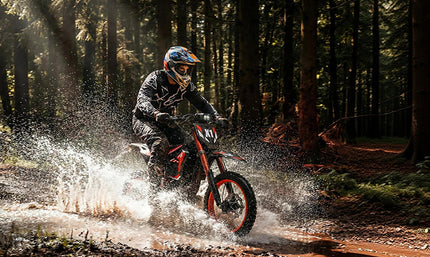
Dust on the frame, mud packed around the tires, and water marks underneath the bike are all part of off-road riding.
With an electric bike, though, there is another layer to consider. The battery, controller, wiring, connectors, and other electrical components all have to operate in the same environment. That makes IP ratings especially relevant when riders start thinking about wet trails, muddy conditions, or cleaning the bike afterward.
But an “IPX5” label does not automatically tell you whether a bike can handle rain, standing water, or a pressure washer.
To use the rating properly, you need to know what it actually covers, what it does not cover, and which part of the bike the manufacturer is rating.
What does an IP rating actually tell you?
IP, or Ingress Protection, describes how well an electrical enclosure protects against the entry of solid foreign objects and water.
Under the IEC 60529 classification system, an IP code normally uses two positions. The first digit refers to protection against solid objects. The second refers to water. When one category is not specified, an “X” appears in its place.
In IPX5, the “X” does not mean maximum dust protection. It means no solid-particle protection rating is being stated in that position. The “5” indicates that the relevant enclosure meets the IPX5 requirement for protection against water jets.
There is another detail that matters just as much: what exactly carries that rating?
A manufacturer may apply an IP rating to a vehicle, a battery enclosure, a controller, or another specific component. A rating for one part should not automatically be treated as a rating for every electrical area on the bike.
Water-protection ratings also represent different test conditions. Dripping water, splashing, water jets, powerful water jets, and immersion are not the same type of exposure.
That is why a general “waterproof” or “water-resistant” claim tells riders much less than a clearly stated IP rating and its intended application.
IPX5 does not mean immersion
One of the most common mistakes is treating water protection as a simple yes-or-no feature.
IPX5 covers protection against water jets. IPX7, by contrast, refers to temporary immersion testing. They describe different test conditions, and IPX5 alone does not show that a product is designed to operate while immersed.
That distinction matters off-road.
Rain falling on the bike, spray from a wet trail, standing water, and an electrical component being submerged are very different situations. An IP rating should not be used to treat them as interchangeable.
If a trail contains standing water, riders still need to consider its depth, the surface underneath, and which parts of the bike may be exposed. Manufacturer instructions and use restrictions remain important.
For an electric motorcycle, an IP rating is most useful when it helps define a protection boundary rather than serving as a blanket “waterproof” label.
Mud creates problems after the ride, too
During a muddy ride, dirt on the bike is easy to notice. What matters afterward is where the mud, grit, and moisture stay.
Heavy buildup around tires and fenders is obvious. Residue around visible wiring, connection areas, or narrow gaps can be easier to miss.
Once mud dries, fine particles can remain on surfaces and make later inspection more difficult. Damage to a cable covering or moisture collecting in one area is easier to spot on a reasonably clean bike than under a layer of dried dirt.
Post-ride cleaning, then, is not just cosmetic. It also helps make visible problems easier to identify.
Why IPX5 is not a pressure-washing rating
A pressure washer can look like an easy answer after a muddy day on the trail. The problem is that the water pressure itself changes the situation.
Within the IEC 60529 system, IPX5 covers water jets, IPX6 covers more powerful water jets, and IPX9 involves high-pressure, high-temperature water spray testing.
So IPX5 should not be interpreted as permission to use any level of high-pressure cleaning.
In particular, riders should not assume that an IPX5 rating makes it appropriate to aim a pressure washer at close range toward battery interfaces, controllers, connectors, or other sensitive electrical areas.
The safer reference point is the manufacturer’s own cleaning guidance.
That matters because an IP test is carried out under defined conditions. Real cleaning can involve different pressure, distance, spray angle, and exposure time. A single IP number cannot be turned into a universal washing instruction.
How should buyers read an IP rating?
For anyone expecting to ride on damp trails or in changing weather, an IP rating can be useful. The easiest way to read it is in three steps.
First, find out what the rating applies to.
Is the manufacturer describing the bike, the battery enclosure, the controller, or another component? If the rating belongs to one specific part, do not automatically extend it to the rest of the vehicle.
Second, understand the code itself.
With IPX5, the “X” means no solid-particle rating is stated in that position, while the “5” refers to the relevant water-jet protection requirement.
Third, check the manufacturer’s guidance on rain, water exposure, cleaning, and maintenance.
Those three pieces together are far more useful than the IP number on its own.
As a practical example, Qronge lists the X1 Spark M as a mini electric dirt bike, and its current product information includes an IPX5 protection rating.
That does not mean the bike should be treated as suitable for every wet environment. The useful part of the rating is that it gives buyers a defined water-protection reference point that can be read alongside the manufacturer’s guidance for rain, splash exposure, and cleaning.
What should riders look at after a wet or muddy ride?
A muddy weekend ride does not mean the bike needs to be dismantled afterward.
A basic visual check of accessible areas is usually more useful.
Look for heavy buildup around the underside, tires, and fenders. Check visible wiring, enclosures, and accessible connection areas for damage, unusual movement, trapped moisture, or debris.
Sealed electrical connections should not be opened simply for routine inspection. If the manufacturer specifies a maintenance procedure, follow that guidance instead.
Braking components deserve attention as well. Mud and water can change how the bike feels compared with dry conditions.
If unusual braking feedback, persistent noise, or abnormal electrical behavior remains after cleaning, further inspection or professional service should come before another ride.
The point is not to open every part of the bike. It is to recognize visible signs that something may need attention.
An IP rating defines a boundary
Technical specifications are most useful when they explain the conditions a product has been tested for.
IP ratings do exactly that.
IPX5 identifies protection against water jets for the relevant enclosure. IPX7 describes a different temporary immersion test. The numbers refer to specific test conditions, not simply increasing levels of being “more waterproof.”
For off-road riders, that distinction affects real decisions: how to approach standing water, where to avoid concentrated high-pressure spray during cleaning, what to inspect after a muddy ride, and what to ask before buying.
Understanding an IP rating is not about finding out how much water a bike can survive. It is about knowing where its stated protection ends—and making better decisions when rain, mud, cleaning, or water exposure becomes part of the ride.






Comment