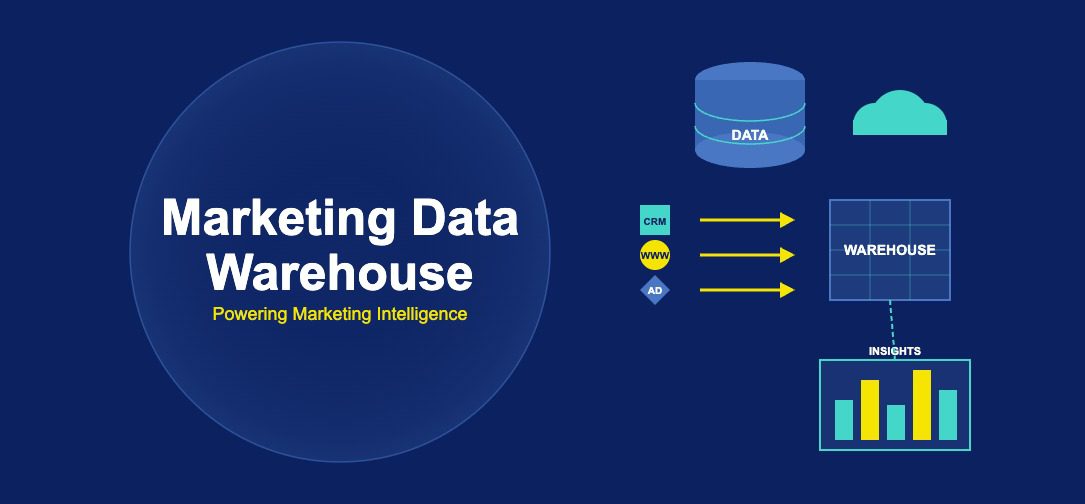
The relationship between marketing and data has fundamentally changed over the past five years. Where marketing once relied on siloed databases and periodic reporting, modern marketing organisations increasingly depend on sophisticated data warehousing and analytics infrastructure to drive personalisation, optimisation, and business intelligence. The marketing data warehouse market is valued at approximately $15 billion in 2025, and organisations adopting modern data stack technologies report delivering insights 3.2 times faster than those relying on legacy infrastructure. A marketing data warehouse is not simply a database that stores customer information. Rather, it is an integrated technology platform that consolidates data from multiple sources, transforms it into standardised formats, and makes it accessible to marketing teams and systems for real-time decision-making and customer activation. Understanding the evolution from legacy data warehouses to cloud-native architectures has become essential for marketing leaders building competitive advantage through data intelligence.
For decades, traditional data warehouses served as the centralised repository for enterprise data. These on-premises systems, often built on technology platforms like Teradata or Oracle, required significant capital investment, specialised staff to maintain, and lengthy procurement and implementation cycles. Legacy data warehouses were typically optimised for structured, historical analysis rather than real-time decisioning. The data flow was largely unidirectional: data moved into the warehouse through complex extract-transform-load, or ETL, processes, where data was cleaned, standardised, and consolidated before loading. This ETL approach meant that any changes to data structures or transformations required re-engineering of the extraction pipelines, creating inflexibility and bottlenecks. Moreover, because legacy warehouses were designed primarily for business intelligence and reporting, they were not optimally configured for the reverse flow of activation: taking insights and pushing them back to customer-facing systems like email marketing platforms or advertising networks.
The emergence of cloud data warehouses has transformed this landscape entirely. Platforms including Snowflake, Google BigQuery, and Amazon Redshift shifted the underlying architecture from on-premises to cloud-native infrastructure. This transition unlocked several critical advantages: dramatically reduced infrastructure costs because cloud platforms handle scaling and maintenance; effectively unlimited storage capacity because cloud provides elastic scaling; separation of compute and storage so organisations pay only for the resources they use; and dramatically faster query performance through optimised cloud architectures. For marketing specifically, cloud data warehouses opened possibilities for real-time data availability and activation that were impractical with legacy systems. The shift to cloud also coincided with a fundamental change in data pipeline philosophy: from ETL to ELT.
From ETL to ELT and the Modern Data Stack
The traditional ETL approach involved extracting data from source systems, transforming it in an intermediate layer, and then loading it into the warehouse. This approach required careful upfront planning about what transformations would be needed, and any changes meant rebuilding extraction pipelines. The emergence of cloud data warehouses made possible a radically different approach: extract the data from source systems with minimal transformation, load it into the warehouse as quickly as possible, and then perform transformations within the warehouse itself. This ELT approach, standing for Extract-Load-Transform, inverts the order and timing of transformation. The advantages are substantial: raw data is available immediately for analysis, transformation logic is centralised and versioned within the warehouse, and modifying transformations no longer requires changing upstream extraction pipelines.
The modern data stack emerged to operationalise the ELT approach at enterprise scale. Rather than attempting to build all capabilities within a monolithic data warehouse platform, the modern data stack is a composable architecture where specialised best-of-breed tools handle different layers of the data pipeline. Data integration tools like Fivetran or Stitch handle the extraction and loading of data from dozens or hundreds of source systems into the cloud data warehouse. The data warehouse itself, whether Snowflake, BigQuery, or Redshift, stores the raw and structured data. Transformation tools like dbt, standing for data build tool, enable data engineers and analysts to write SQL-based transformations that run within the warehouse. Business intelligence and visualisation tools like Looker, Tableau, or Mode provide interfaces for analysts and business users to explore and understand data. This composable approach offers extraordinary flexibility: organisations can swap tools in any layer without disrupting others, and they can add new tools as their capabilities and requirements evolve.
Customer Data Activation and Reverse ETL
Where the modern data stack truly differentiates itself from legacy approaches is in enabling customer data activation. Activation refers to taking insights and customer segments from the data warehouse and sending them to operational systems where they drive real-time customer experiences. A marketer might identify a cohort of customers who have viewed a product but not purchased, and want to activate that segment by sending targeted email campaigns, personalising website experiences, or triggering Facebook custom audience campaigns. Legacy data warehouse architectures required significant custom engineering to accomplish this, often involving batch exports and manual uploads to external systems. Modern data activation platforms, notably Hightouch and Census, have emerged to solve this problem systematically. These reverse ETL platforms automatically sync customer segments and attributes from the data warehouse to downstream operational systems: email platforms, ad networks, CRM systems, and customer engagement platforms.
The integration of reverse ETL into the modern data stack creates a closed-loop system where customer insights flow from operational systems into the warehouse through data integration tools, are transformed and enriched within the warehouse, and then flow back to operational systems to drive personalised experiences. This bi-directional data flow is fundamentally different from legacy approaches, and it enables marketing to operate with dramatically greater sophistication. A marketer can build audience segments based on behavioural data, transactional data, and third-party enrichment data, and have those segments automatically sync to 20 different marketing systems in real time. This is not possible with legacy architectures.
Marketing Use Cases and Data Governance
Marketing organisations leverage data warehouses to power an increasingly diverse set of use cases. Predictive customer lifetime value models enable organisations to identify and prioritise high-value customers for retention campaigns. Churn prediction models identify customers at risk of leaving, triggering win-back campaigns. Attribution modelling allocates credit for conversions across the various touchpoints and channels a customer interacted with before converting, enabling more intelligent budget allocation. Lookalike audience modelling identifies customers with similar characteristics to existing high-value customers, expanding the addressable market. These use cases require integration of behavioural data, transactional data, web analytics, CRM data, and often third-party enrichment data. The data warehouse serves as the integration point where all this data can be combined and transformed to power sophisticated marketing analytics and personalisation.
With the power of modern data warehouses come significant challenges around data governance. As marketing organisations accumulate more data in warehouses and activate it across more systems, managing data quality, access control, and compliance becomes increasingly critical. Dirty data, whether from source system errors, transformation mistakes, or data quality issues, propagates downstream to impact marketing decisions and customer experiences. Regulatory requirements under GDPR, CCPA, and other privacy laws require clear visibility into what data is collected, how it is stored, and how it is being used. Many organisations are implementing data governance platforms like Collibra or Alation to create data catalogues, manage data lineage, establish data quality standards, and ensure compliance with regulations. As data warehouses become more central to marketing operations, data governance transforms from a nice-to-have to a critical necessity.
| Dimension | Legacy Data Warehouse | Cloud Data Warehouse |
|---|---|---|
| Infrastructure | On-premises or hosted, fixed capacity | Cloud-native with elastic scaling |
| Cost Structure | High capex, fixed annual spend regardless of usage | Pay-per-use, scale costs with actual consumption |
| Data Pipeline Approach | ETL: transform before loading | ELT: load raw, transform in warehouse |
| Query Performance | Slower for complex analytical queries | Optimised for parallel processing and speed |
| Data Activation | Manual exports, batch-only capabilities | Reverse ETL enables real-time bidirectional sync |
| Implementation Cycle | 12-24 months for full deployment | 2-4 months with modern data stack tools |
| Layer | Function | Example Tools | Marketing Use Case |
|---|---|---|---|
| Data Integration | Extract and load data from source systems to warehouse | Fivetran, Stitch, Talend | Centralise CRM, web analytics, ad platform, and ecommerce data |
| Data Warehouse | Store raw and processed data in cloud infrastructure | Snowflake, BigQuery, Amazon Redshift | Central hub for all customer and business data |
| Transformation | Transform raw data into analytical datasets and segments | dbt, Looker, Mode Analytics | Build customer segments, calculate metrics, and model lifetime value |
| Business Intelligence | Provide accessible dashboards and analytics interfaces | Looker, Tableau, Power BI | Track campaign performance, ROI, and customer metrics |
| Reverse ETL | Sync warehouse data to operational systems | Hightouch, Census, Segment | Activate audience segments to email, ads, CRM, and personalisation engines |
The maturation of cloud data warehouses and the modern data stack represents a strategic opportunity for marketing organisations willing to invest in these capabilities. Companies that successfully implement modern data stack architectures gain substantial competitive advantages: faster time to insight, more sophisticated customer segmentation and personalisation, better attribution and budget optimisation, and more responsive campaigns. The complexity of managing these systems should not be underestimated, as it requires investment in data engineering talent and establishing robust data governance. However, for marketing organisations seeking to compete on data-driven sophistication, investing in modern data warehouse architecture has become less a nice-to-have and more a competitive necessity.
Related reading: The Future of Marketing Technology: Emerging Trends, Convergence Platforms, and the Next Decade of Digital Marketing Innovation
Data from Statista’s digital market outlook shows that global digital spending continues to grow at double-digit rates, with mobile channels accounting for an increasingly dominant share of total transactions.
PwC’s analysis of financial services trends through 2025 highlights the convergence of technology and media as a defining dynamic, with data-driven personalisation becoming the primary competitive differentiator.
For more coverage on related topics, explore our dedicated section on technology insights.