Legacy Application Modernization: A 2026 Playbook With Real ROI Numbers

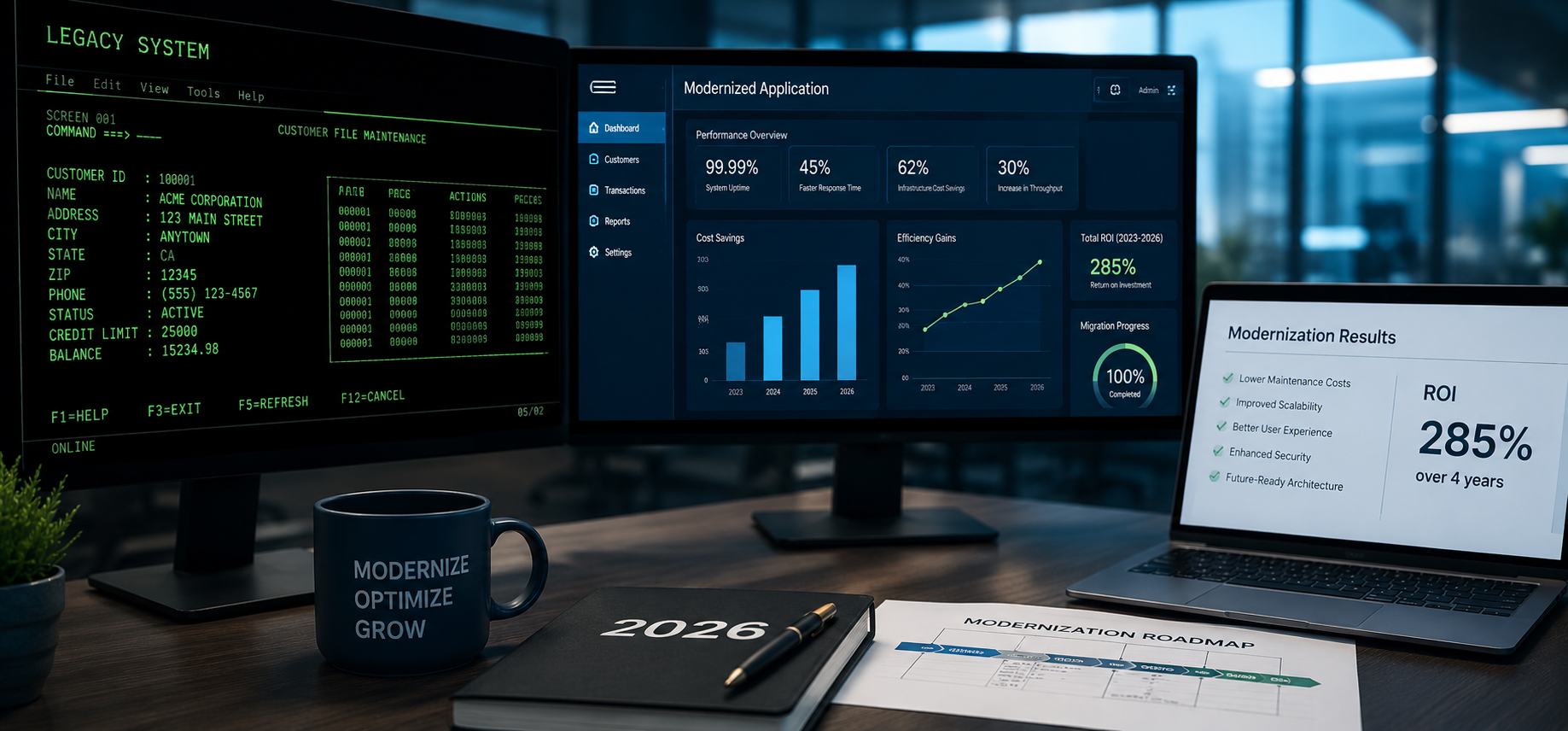
Quick answer: Legacy application modernization in 2026 follows a five-path framework that maps each application against its right modernization approach: document, rehost, refactor, replatform, or rebuild. Typical 12-month total cost of ownership reduction is 25 to 45 percent for legacy applications that pick the right path, with payback periods of 14 to 26 months. The playbook below covers the framework, the path selection criteria, and the financial modeling that turns modernization from an IT cost into a measurable business investment.
Legacy modernization has been an industry discussion for two decades. What changed in 2024 and 2025 is the economy. AI-assisted code understanding, automated test synthesis, and improved cloud cost optimization have brought modernization payback periods down from 36 to 60 months to 14 to 26 months for the right application portfolio. That economic shift moved modernization from a strategic aspiration to a near-term ROI decision.
Yet most modernization projects still overrun budgets, ship late, or get killed before completion. The cause is not technical. The cause is path selection. Organizations that pick the wrong modernization path waste 40 to 70 percent of their modernization budget. Organizations that pick the right path finish on time and produce measurable ROI.
Below is the 2026 playbook that engineering leaders are using to make path selection rigorous, model ROI honestly, and ship modernization that pays back within 24 months.
Step 1: Inventory the Application Portfolio Against Five Paths
The first step is to inventory the application portfolio and score each application against five modernization paths. The paths, from least to most invasive, are document and stabilize, rehost, refactor in place, replatform with language or framework migration, and rebuild with strangler-fig.
Document and stabilize applications that will live 3 to 5 more years, where the immediate priority is removing bus-factor risk. The investment is 6 to 10 weeks of code understanding and documentation work. The total cost of ownership impact is small, typically a 5 to 15 percent reduction, but the risk reduction is substantial.
Rehosting fits applications that need to leave a data center or migrate to a cloud provider but where the codebase stays the same. The investment is 8 to 14 weeks, depending on infrastructure complexity. TCO impact is 15 to 30 percent on infrastructure spend.
Refactoring in place fits applications that will remain on the same platform but need codebase modernization, typically typing, modularization, test coverage, and framework upgrades. The investment is 12 to 22 weeks. TCO impact is 20 to 40 percent on maintenance costs.
Replatforming fits applications that need to move to a different stack: COBOL to Java, VB6 to C#, and classic ASP to ASP.NET Core. The investment is 20 to 36 weeks. The TCO impact is 30 to 55 percent on the combined infrastructure and maintenance costs.
Rebuilding with a strangler fig fits applications where the domain itself needs redesign and the legacy implementation cannot host the future business model. The investment is 24 to 52 weeks or more. TCO impact varies wildly because the rebuild changes the application scope, not just the implementation.
Step 2: Score Each Application Against Five Decision Criteria
Path selection uses 5 criteria scored from one to five for each application. The criteria are business value sensitivity, regulatory exposure, current technical debt, integration complexity, and team experience.
Business value sensitivity asks how much the business outcome depends on this application working flawlessly. Tier-one core systems score high. Internal reporting tools score low.
Regulatory exposure asks whether the application processes regulated data, supports regulated decisions, or carries direct compliance obligations. Banking core systems, healthcare clinical applications, and tax software score high.
Current technical debt asks how broken the codebase is, measured by test coverage, documentation completeness, dependency staleness, and known defect backlog. Applications with under 10 percent test coverage and undocumented legacy patterns score high on debt.
Integration complexity asks how many other systems depend on this application and how brittle those integrations are. Systems with 50 or more downstream consumers and tightly coupled integration patterns score high.
Team experience asks whether the engineering team has the skills to execute the modernization path or whether external partners are required.
Each application gets five scores. The scores drive path selection: high business sensitivity and high regulatory exposure point toward conservative paths like document or rehost. Low business sensitivity and high technical debt point toward refactoring or replatforming. High integration complexity points toward the strangler fig regardless of other scores.
Step 3: Model Total Cost of Ownership Honestly
TCO modeling for modernization must include current state cost, modernization investment, and future state cost. Most modernization business cases overstate ROI by understating both the modernization investment and the time to break even.
The current state TCO includes infrastructure cost, license and vendor cost, maintenance engineering cost, defect remediation cost, and opportunity cost of features not shipped due to legacy debt. Many organizations capture the first three categories and miss the last two, which often comprise 30 to 50 percent of the true current state cost.
Modernization investment includes engineering cost, infrastructure migration cost, parallel-run cost during cutover, training cost, and post-launch hypercare. Honest investment estimates use the high end of the range, not the middle, because modernization projects consistently overrun.
Future state TCO must include ongoing infrastructure cost at the new platform, license cost, maintenance engineering cost on the modernized codebase, and ongoing modernization debt that accumulates again after launch. The honest modeling assumption is that the modernized system needs 3 to 8 percent annual modernization investment to avoid becoming the next legacy system.
The payback period is the time at which cumulative savings exceed cumulative investment. Typical 2026 payback periods are 14 to 26 months for refactor and replatform paths and longer for rebuild paths. Projects with projected payback beyond 36 months usually do not finish.
Step 4: Build the Parallel-Run Plan Before Cutover
The single largest risk in modernization is silently changing behavior. The 2026 standard is to run the modernized system next to the legacy system for 4 to 12 weeks before cutover, with both receiving production traffic and every behavioral difference logged and classified.
The parallel-run plan must include traffic shadowing infrastructure, AI-assisted behavior diff classification, escalation rules for each diff category, business sign-off requirements for accepted behavior changes, and rollback procedures tested in pre-production. Without these elements, the cutover becomes a faith-based exercise.
Parallel-run investment is typically 10 to 20 percent of the modernization investment, but it reduces post-cutover incident rates by 60 to 85 percent. The economics favor running in parallel, even when schedule pressure suggests skipping it.
Step 5: Plan the Cutover With Documented Rollback
The cutover plan must include a canary phase where 1 to 10 percent of traffic moves to the new system for 1 to 2 weeks, a staged increase in 10 to 20 percent increments with health check gates, automated rollback triggers tied to specific thresholds, manual rollback procedures tested in pre-production, and hypercare staffing for 2 to 6 weeks post-cutover.
The documented rollback is non-optional. The rollback objective is typically to revert to legacy within 30 to 60 minutes if any critical threshold trips. Without a tested rollback path, the cutover team operates under irrationally high stress that causes worse decisions in the moment.
Hypercare staffing means engineering is on call to fix issues immediately for 2 to 6 weeks. The hypercare period is when most modernization production incidents happen, and the recovery cost during hypercare is dramatically lower than the recovery cost after the team has dispersed.
Step 6: Measure Real ROI for 12 Months After Cutover
Modernization ROI measurement does not stop at cutover. The 12-month post-cutover measurement proves the business case and informs the next modernization investment decision.
Required measurements are infrastructure cost delta versus pre-cutover baseline, license cost delta, maintenance engineering hours delta, defect rate delta, feature throughput delta measured by stories shipped per quarter, and incident frequency delta. Each delta gets a monthly trend chart and a 12-month summary.
Some deltas are predictable. Infrastructure and license costs typically reduce as expected. Others are surprising. Feature throughput often increases by 40 to 80 percent because engineers spend less time fighting legacy code. The defect rate often reduces because the modernized codebase has better tests.
Organizations that measure ROI at 12 months produce better modernization business cases for the next round of applications. Organizations that do not measure ROI rely on opinion in the next round, with predictable degradation in decision quality.
What This Means for Engineering Leaders in 2026
Legacy modernization is no longer a multiyear strategic aspiration. With AI-assisted modernization tooling and the framework above, applications can move from inventory to production cutover in 8 to 14 months for the refactor and replatform paths, with 14- to 26-month payback periods.
The bottleneck is path selection rigor, not technical capability. Engineering leaders who score applications honestly against the five-path framework and model TCO honestly produce modernization programs that finish on time and deliver measurable ROI. Engineering leaders who pick paths by intuition produce projects that overrun and erode credibility.
For organizations evaluating legacy application modernization services, Devox Software publishes a methodology guide for path selection, parallel-run discipline, and ROI measurement at Legacy Application Modernization Services and the broader legacy modernization services hub, including the AI Solution AcceleratorTM approach.
Frequently Asked Questions
What is the typical payback period for legacy application modernization?
Typical 2026 payback periods are 14 to 26 months for the refactor and replatform paths and longer for rebuild paths. Payback below 14 months is rare and usually indicates an underestimate of modernization investment. Payback beyond 36 months indicates a project that probably will not finish.
Which modernization path is right for our application portfolio?
Path selection depends on five criteria: business value sensitivity, regulatory exposure, technical debt, integration complexity, and team experience. Applications with high business value and regulatory exposure favor conservative paths like document or rehost. Applications with high technical debt favor refactoring or replatforming. The framework in this article walks through each criterion in detail.
How much does legacy application modernization cost?
Costs vary widely by application complexity and modernization path. Document and stabilize engagements typically run $40,000 to $150,000. Rehost engagements run $80,000 to $400,000. Refactor and replatform run $200,000 to $1.5 million. Rebuild engagements run from $500,000 to several million. The path selection framework drives the cost estimate.
How long does legacy modernization take?
Document path: 6 to 10 weeks. Rehost path: 8 to 14 weeks. Refactor in place: 12 to 22 weeks. Replatform: 20 to 36 weeks. Rebuild with strangler fig: 24 to 52 weeks or more. AI-assisted modernization compresses these timelines by 30 to 50 percent compared to traditional approaches.
What is the biggest risk in legacy modernization?
Silent behavior changes during cutover are the biggest risk. The modern system can pass functional tests but produce wrong business outcomes because of rounding, time zone, or locale differences. The mitigation runs parallel for 4 to 12 weeks with explicit behavior diff classification and business sign-off on accepted changes.