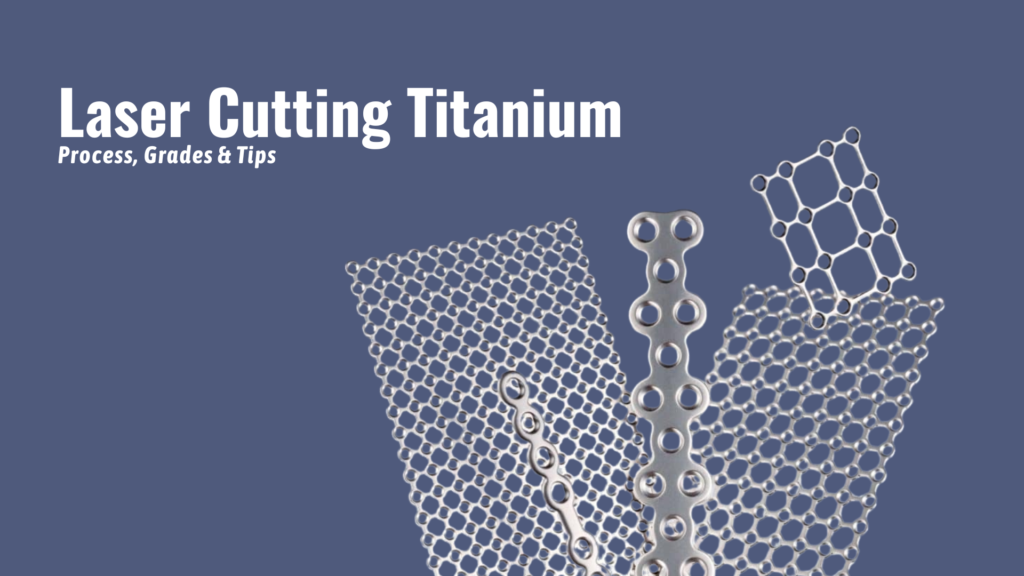
Titanium is a strong, light, and highly chemically resistant metal. These characteristics make it hard to cut with traditional tools. It’s widely used in aerospace, medical devices, and high-performance automotive parts. Regular cutting methods can be slow, costly, and risk damaging the material.
Cutting titanium using a laser creates a clean break at the exact location programmed into the machine’s software. A laser melts or vaporizes the metal cleanly. It can quickly cut thin sheet stock, small parts, and other complex shapes. Moreover, it provides quick processing times and helps to reduce waste generated from the cutting operation.
This article covers the process of laser cutting titanium, its benefits, and the compatibility of titanium alloys, and offers some tips for achieving high-quality cuts.
Can Titanium Alloys Be Cut With a Laser?
Yes, titanium alloys can be cut effectively with a laser. However, the process requires close monitoring of the laser cutting process. Even when choosing the optimum parameters, titanium can absorb heat and produce a uniform flow of molten metal.
Titanium has a relatively high melting temperature (approximately 1660°C) and is an excellent conductor of heat. This results in low distortion and high cutting accuracy when the parameters for the laser cutting process are in order. The kerf width and heat-affected zone (HAZ) in the cutting of titanium can be minimized or eliminated by varying the laser power, the rate at which the laser is moved, and the use of assist gases.
However, due to the highly reflective nature of titanium, a powered laser is usually required. Additionally, when titanium is heated, the material’s surface undergoes an oxidation reaction. This oxidation reaction can negatively impact the cut quality produced by the laser and also negatively affect the finished edge appearance.
Using inert gases like nitrogen or Argon during the laser cutting process prevents oxidation reactions from occurring, minimizes discoloration, and produces a uniform finished edge.
How to Cut Titanium Using a Laser Cutter
To successfully laser cut titanium, you need to have the right equipment and set it up correctly. A high-powered fibre laser is necessary for laser cutting metal parts, along with inert assist gases such as nitrogen or argon, to prevent oxidation. Then adjust laser power, cutting speed, and optical focus according to the specific type of titanium alloy and sheet thickness to produce accurate and clean cuts.
Cutting Complex Shapes
Titanium can be laser cut to accommodate curved and patterned designs. Parts with custom designs can be cut directly from CAD files, eliminating the need to create separate tooling. This is beneficial for specialty parts.
Small-Batch Production
Laser cutting is easy to set up, cuts material fast, and allows you to adjust settings quickly. Therefore, it’s a good choice for small production batches.
Thin Sheet Cutting
Generally, titanium sheets up to approximately 10 mm can be cut efficiently using a laser. When cutting thinner sheets, they melt and vaporize easily, resulting in a smooth edge and minimal distortion.
How to Choose the Right Cutting Method for Titanium Sheets
The correct cutting method selection for titanium sheets depends on the sheet thickness, precision requirements, desired edge quality, and post-processing requirements. Both laser cutting and water jet cutting have benefits and limitations based on the end-use application.
When to Use Custom Metal Laser Cutting
- Laser cutting ideally produces clean edges and narrow kerfs with sheets less than 10 mm thick.
- Laser cutting provides high surface smoothness and tight tolerances (e.g., aerospace, medical devices, electronic components).
- The technique offers rapid cutting capabilities for medium- to small-sized titanium sheets and is particularly beneficial for large-scale production runs.
- Laser cutting creates minimal heat-affected zones. This allows the titanium to remain in a stable condition for subsequent welding or assembly operations.
When to Use Water Jet Cutting
- Water jet cutting does not limit the sheet thickness like laser cutting does.
- For heat-sensitive materials, water jet cutting eliminates oxidation and prevents any structural changes that occur when heat is applied.
- Water jet cutting preserves the original titanium properties, which is why it is commonly used in the manufacture of defence, chemical, and other specialized products.
Challenges of Fibre Laser Cutting Titanium
Fibre laser cutting of titanium is highly effective; however, there are some practical considerations to be followed.
High Reflectivity
Because titanium reflects a large portion of the laser energy, particularly when cutting thin sheets, low-power lasers may result in slow cutting and poor penetration. Most machine shops utilize high-power fibre lasers (1–3 kW or higher) to obtain consistent results.
Surface Oxidation
During the heating phase, titanium rapidly forms an oxide layer. This can result in rough edges or additional post-processing requirements. Utilizing inert assist gases, such as nitrogen or argon, during cutting can help eliminate oxidation and improve the cut edge quality.
Heat Control
Titanium is a poor conductor of heat. So, if the cutting speed is too slow, heat buildup can occur. This can result in an enlarged heat-affected zone and slight warpage of thin sheets. By adjusting the cutting speed, focus, and power according to the sheet thickness, this issue can be minimized.
Equipment Stress
Cutting titanium causes excessive wear on optics and lenses due to reflection and high temperatures. To minimize downtime and repair costs associated, regular cleaning and proper equipment setup are essential.
Best Titanium Grades for Laser Cutting
Not all titanium alloys are created equally. Each grade of titanium has varying strength, corrosion resistance, and heat tolerance. The selection of a suitable titanium grade for your application will depend on how the part will be used and the environment in which it will be used.
Pure Titanium (Grades 1–4)
Pure titanium is lightweight and strong, with increased strength from grades 1 to 4. They also offer excellent corrosion resistance. Applications include medical instruments, aerospace parts, marine equipment, and chemical machinery.
Grade 5 (Ti 6Al-4V)
Grade 5 is one of the most common grades of titanium. It is strong, heat-resistant, and offers excellent corrosion resistance. Aerospace parts, medical implants, and industrial components are typical applications for this grade. It also works well for precise cuts and can be cut into complex shapes.
Grade 9
Grade 9 of titanium contains aluminum and vanadium. It is stronger and more corrosion-resistant, and also easier to weld than Grade 5. Marine parts, aerospace systems, and sporting goods are examples of applications for Grade 9. Grade 9 offers designers more flexibility in designing parts while maintaining durability.
How to Choose the Right Grade
Consider:
- Required weight and strength
- Level of heat or chemical exposure
- Corrosion resistance required
- Type of post-cut processes to be performed (i.e., welding)
- Industry and application
Consult with a professional before determining the best grade of titanium for your project.
Assist Gases for Titanium Cutting
The type of assist gas used affects the cut quality, the rate of cut, and the surface finish when laser cutting titanium. Utilizing the proper assist gas minimizes oxidation, burn marks, and irregularities on the edge of the cut.
Nitrogen (N₂)
Nitrogen is frequently used for laser cutting of titanium. Nitrogen forms a protective barrier on the surface of the titanium during cutting. Therefore, it prevents burn marks and ensures a clean edge to the cut. It is a suitable choice for applications that require precise cuts, where surface finish is a concern.
Argon (Ar)
Argon does not react with titanium, making it a good choice for cutting delicate surfaces. It provides a consistent and smooth cut surface, even at slower cutting speeds. This is beneficial when surface finish is a priority.
Oxygen (O₂)
Oxygen increases cutting efficiency by promoting faster melting of the titanium. It’s a good choice for thicker sheets, but it can cause discoloration or rough edges if utilized excessively. Oxygen should be used cautiously when the speed of cutting is more important than a superior finish.
Conclusion
Titanium laser Cutting is a high-precision technique that achieves clean edges with minimal heat impact. It can cut various thickness levels (small parts or large production batches), making it ideal for many different applications.
Laser-cut titanium parts are used in Aerospace, Automotive, Medical, and other industries, which have very stringent requirements for reliability and accuracy. When using correct settings, along with assisting gases, laser-cut titanium produces consistent results for a variety of demanding projects.