The instinct is understandable: a large lawn means a lot of mowing, and the idea of a small autonomous robot handling an acre or more sounds like wishful thinking. The reality is that large lawns are where robot mowers make the most compelling financial and practical case, not the least.
Here’s why a robot mower for 1 acre or larger pays off more clearly than it does for a small suburban lot.
The Manual Mowing Math on Large Properties
A 1-acre lawn takes roughly 3 to 4 hours to mow with a typical ride-on mower, or 6 to 8 hours with a push mower. At weekly intervals from April through October, that’s 21 to 28 ride-on sessions or 42 to 56 push sessions per year. In total time: 63 to 112 hours per year of active mowing, not counting setup, refueling, and cleanup.
A professional lawn service for an acre-plus property runs between $80 and $150 per visit in most US markets. At weekly visits over a 7-month season, that’s $2,240 to $4,200 per year in recurring costs. A premium robot mower for large properties is typically a one-time investment that pays back within 1 to 2 seasons compared to professional service costs.
Why Large Lawns Suit Robot Mowers Particularly Well
Robot mowers thrive on repetition. A daily or near-daily mowing schedule keeps grass consistently short, which means each session is a light trim rather than a heavy cut. On large properties, this translates directly to battery efficiency: the robot removes a small amount of growth per pass, requires lower blade force, and covers more ground per charge cycle than it would cutting overgrown grass.
The mulching benefit compounds on large lawns. Fine clippings returned to a large lawn surface add up to a significant volume of organic matter over a season, reducing or eliminating the need for nitrogen fertilizer applications. For properties that currently spend $200 to $500 per year on lawn fertilizer, the mulching benefit alone meaningfully improves the robot mower’s return on investment.
Coverage capacity is the first spec to check when evaluating robot mowers for large lawns. The rated coverage area should comfortably exceed your actual mowable area, not just meet it, to account for slopes, obstacles, and battery variation in cold weather.
What Large-Lawn Robot Mowers Do Differently
Models designed for acre-plus coverage differ from suburban models in three meaningful ways: cutting width, battery capacity, and navigation efficiency.
Cutting width directly determines how many passes the robot needs to cover a given area. A 9-inch cutting deck requires roughly twice as many passes as an 18-inch deck to cover the same area, which doubles session time and battery consumption. Large-lawn models use wider cutting systems to complete coverage in fewer passes.
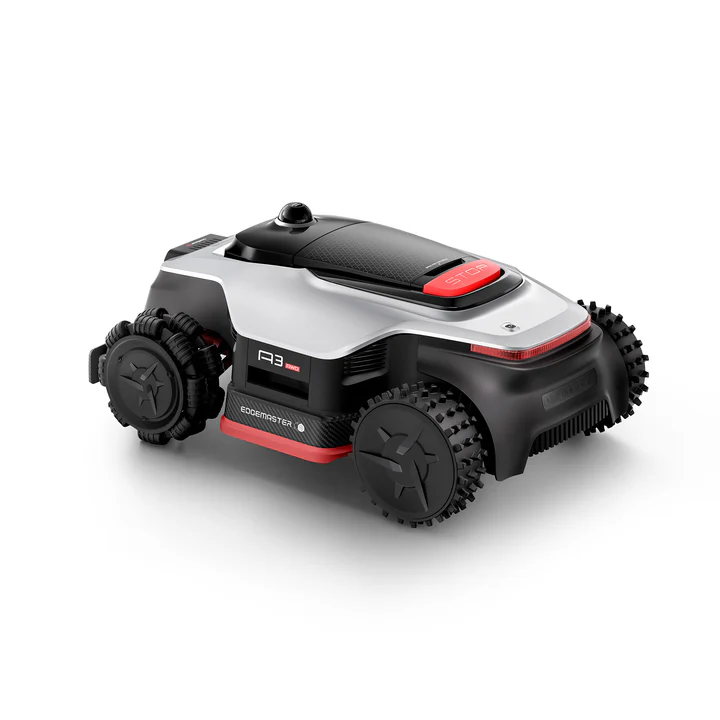
Battery capacity determines how much area the robot covers on a single charge before needing to return to base. Large-lawn models carry larger battery packs or use more efficient brushless motors to extend range. Some, including Dreame’s A3 AWD Pro series, handle up to 1.25 acres per charge cycle, which covers a full acre in a single session on most daily maintenance schedules.
Navigation efficiency matters on large properties because inefficient routing wastes both time and battery. A robot that makes redundant passes or can’t navigate complex layouts without extensive backtracking performs significantly below its rated coverage area in real-world conditions. OmniSense 3.0’s LiDAR-based mapping generates optimized coverage paths that minimize redundant passes across the full operating area.
Slopes: The Real Challenge on Large Properties
Large residential and rural properties more commonly include slope sections that smaller suburban lots don’t. A robot mower rated for 35% (19°) slope handles gentle gradients but fails on steeper sections that many acre-plus properties include near drainage ditches, natural grade changes, or raised lawn sections.
The Dreame A3 AWD Pro series reaches 80% slope capability (38.7°), which covers steep residential gradients that previously required manual mowing or professional service. All-wheel drive distributes torque across all four wheels, maintaining traction on wet or uneven slopes where two-wheel-drive models lose grip and stall. For properties with any significant gradient, slope rating is a non-negotiable spec, not an optional upgrade.
The Maintenance Comparison
A ride-on mower for a 1-acre property requires annual maintenance: oil changes, blade sharpening or replacement, air filter replacement, fuel stabilizer for storage, spark plug changes, and belt inspections. Total annual maintenance cost typically runs $150 to $400, plus the cost of a professional service if the owner is not mechanically comfortable.
A robot mower’s maintenance is blade replacement (a consumable similar to printer ink), seasonal cleaning, and occasional software updates via the app. No oil, no fuel, no belt, no seasonal winterization beyond storage in a dry location. For owners who dislike small-engine maintenance, this difference is significant.
The Bottom Line for Large Lawn Owners
A robot mower on a large property delivers a return on investment that is straightforwardly quantifiable: in reclaimed time, in eliminated professional service costs, or in both. The objections that applied to earlier robot mowers — insufficient coverage, poor slope handling, complex installation — have been addressed in the current generation. For acre-plus properties, the question in 2026 is less “is this worth it?” and more “which model matches my specific property?”